A clear desk usually isn’t clear. It’s a desk that was swept into a drawer ten minutes before a video call, and by Thursday everything is back: the mug, the cable, the pile of paper nobody has decided about yet.
That’s why I think most minimalist desk ideas start in the wrong place. Owning fewer things helps, but what actually keeps a desk clear is that every item on it has somewhere obvious to go when you’re done. Minimalism here is a storage problem wearing a design costume.
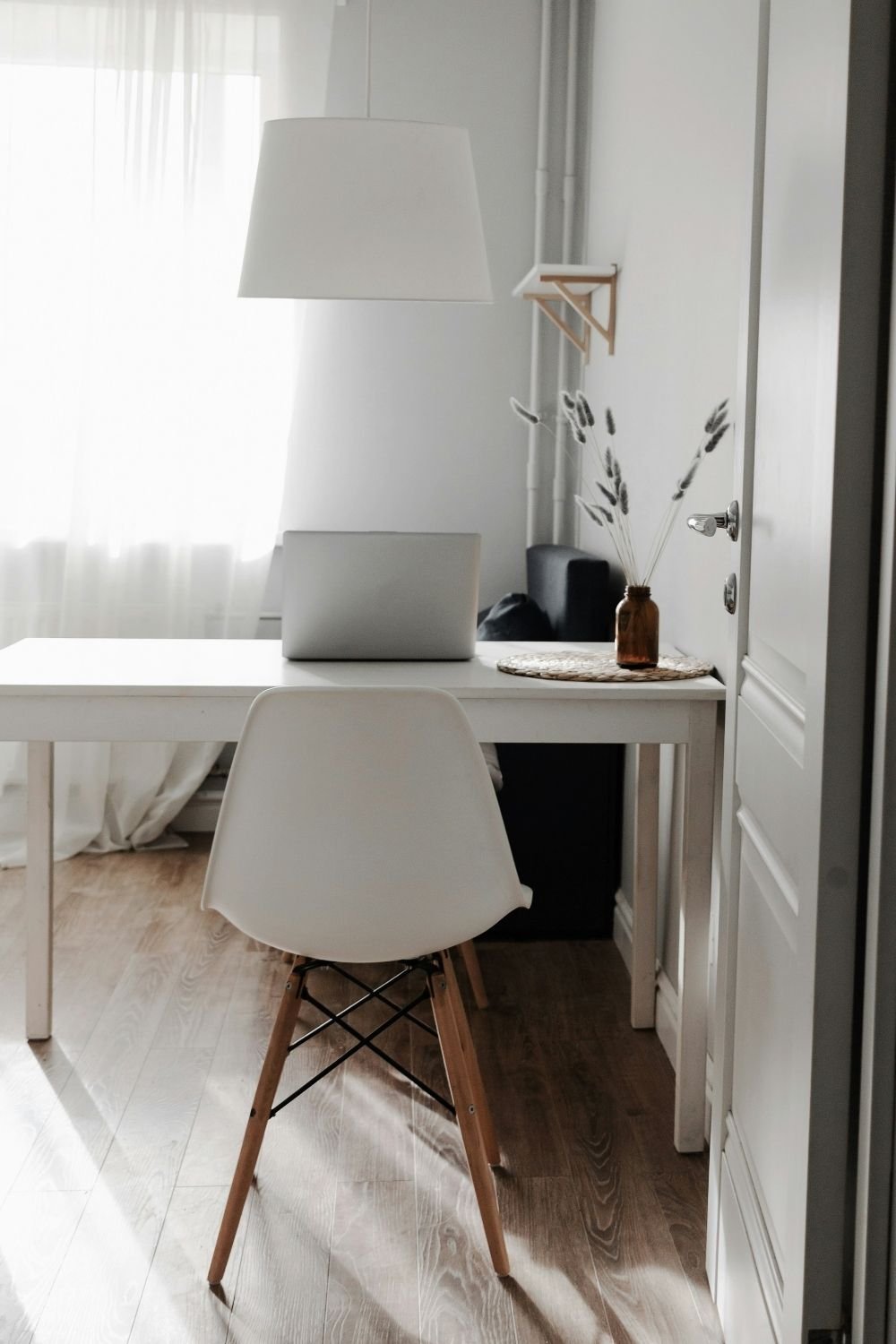
Photo by Elina Sitnikova on Unsplash
The desk above is about as pared back as it gets: a plain white table, a molded chair on wood legs, a laptop, and a small amber bottle of dried grasses on a woven mat. Daylight through a sheer curtain does the rest. Nothing is hiding, because there’s nothing to hide.
The desk matters more than the study desk decor
If you’re choosing one, go smaller than you think and shallower than you expect. Somewhere around 110 to 120 cm wide and 55 to 60 cm deep is enough for a laptop or a single monitor, a notebook and a lamp, and the tighter footprint does half the decluttering for you. A thin top and open legs keep the corner visually light, which matters most when the desk lives in a bedroom rather than an office.
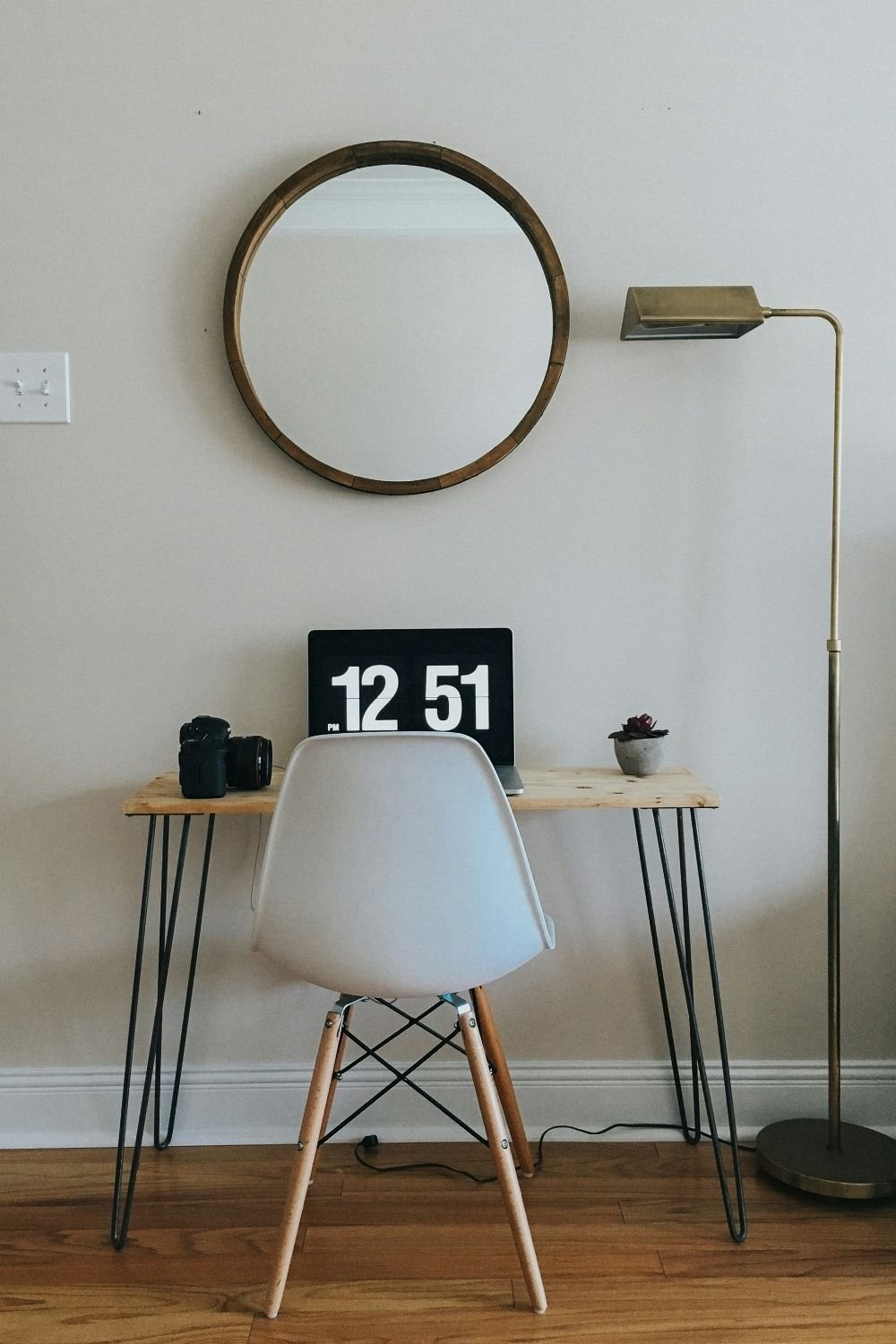
Photo by Hannah Busing on Unsplash
This one is barely a desk: a pine top on hairpin legs, with a laptop showing a flip clock, a camera at one end and a small succulent at the other. A round wood mirror and a brass floor lamp finish the wall. It works because the desk reads as a console table, so the whole corner looks like part of the room instead of an office that wandered in.
What actually stays on the surface
My rule is three things: the machine you work on, one light, and one object that isn’t useful at all. A plant, a small photo, a nice pot of pencils. The third item is what stops a minimal study table from feeling like an airport desk, and it’s the one people skip.
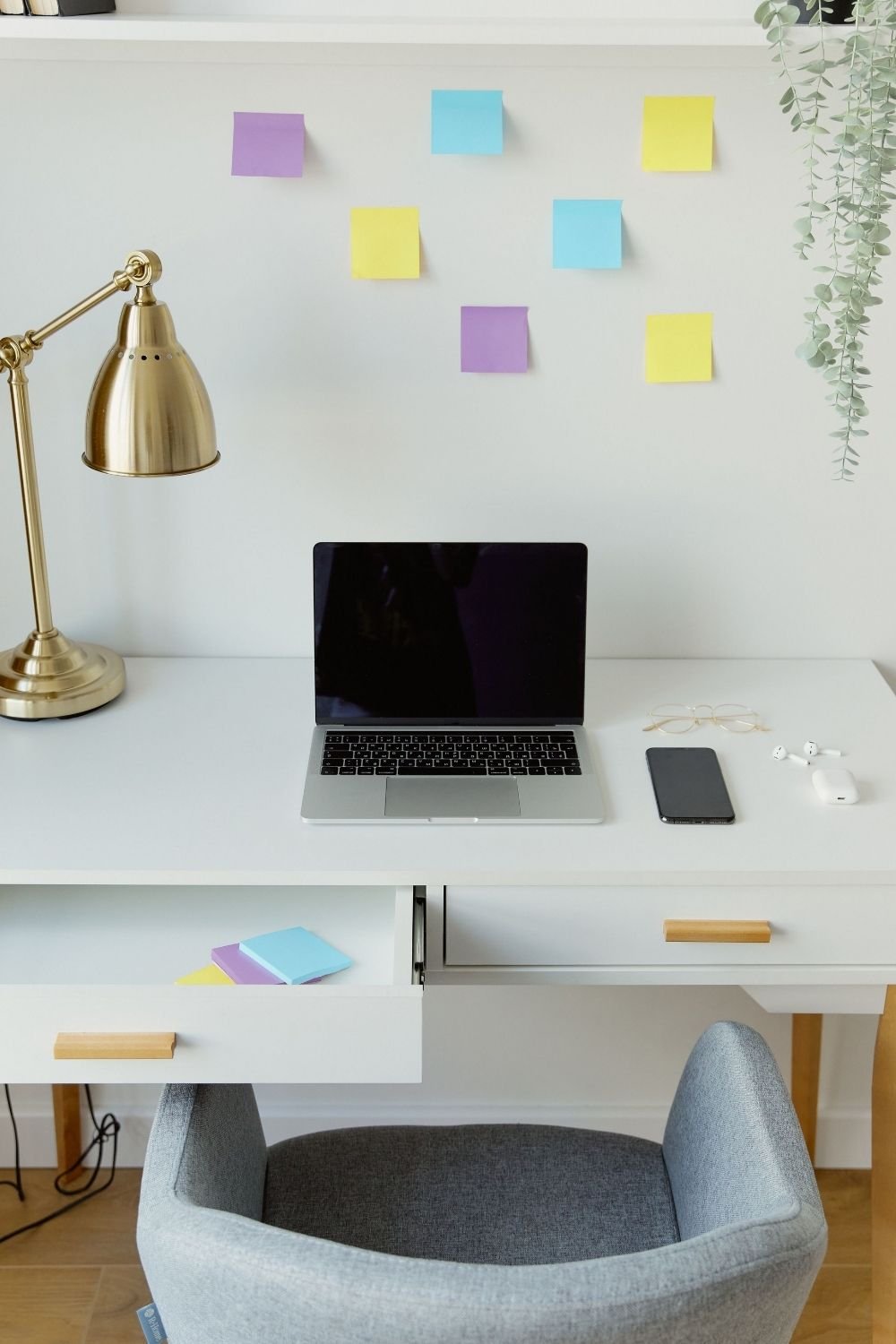
Photo by Darina Belonogova on Pexels
Here a white desk holds a laptop, glasses, a phone, earbuds and a brass lamp, with sticky notes on the wall above and more in the open drawer. That wall of notes is worth thinking about. When it’s a live list you’re working through today, it earns its place. When the same six notes have been there since spring, they’ve turned into wallpaper, and you stop reading them entirely. I’d keep one small board or one row of notes, and clear it weekly.
The everyday things that need to be within reach, like a charger, a notebook or headphones, are better off in the top drawer than on the top surface. You can still grab them in a second, and the desk stays photogenic by accident.
The chair is the exception to all this restraint. A minimal desk with a beautiful but punishing chair gets abandoned by eleven in the morning, and then it becomes a shelf. If the chair has to look quiet, a low-backed office chair in a pale fabric or a wood-legged shell chair with a seat pad does the job without the gaming-chair silhouette. What matters is that your elbows land at roughly desk height and your feet reach the floor.
Everything else needs a drawer
This is the part that makes or breaks it. A desk with no storage nearby will collect piles no matter how disciplined you are, because there’s nowhere for the half-finished things to live.
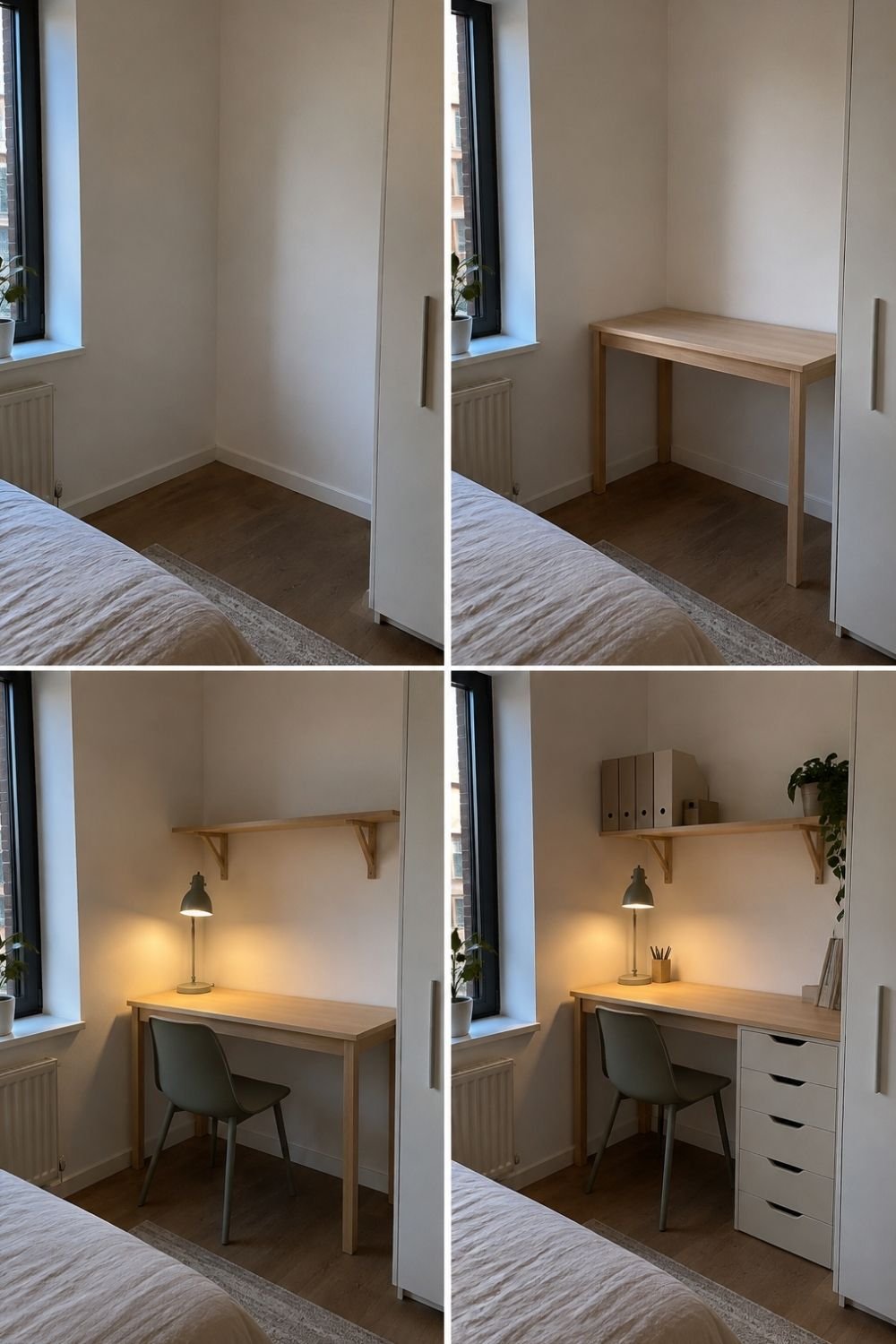
Photo by OurHoneyHome
The four frames above build a workspace into a bedroom alcove, and the order is the useful bit. First the empty corner between a window and a wardrobe, then a simple pale wood desk, then a shelf and a warm lamp, and finally a white drawer unit tucked under one side with magazine files and a plant on the shelf above. Storage came last, but it’s what keeps the first three steps looking like they did on day one.
For paper specifically, I’d give yourself exactly two homes: a tray for things that need action this week, and a box file for everything worth keeping. Anything that fits in neither is usually rubbish pretending to be admin.
Closed storage beats open storage at a desk, which is the opposite of what I’d say in a kitchen. Open shelves make you tidy things attractively; a drawer lets you tidy things quickly, and speed is what gets it done at the end of a working day. If most of the storage is closed, one open shelf for books and a plant is plenty.
Cables are half the battle
Nothing ruins a clean desk faster than the view underneath it, especially when the desk sits in a bedroom and you see it from the bed.
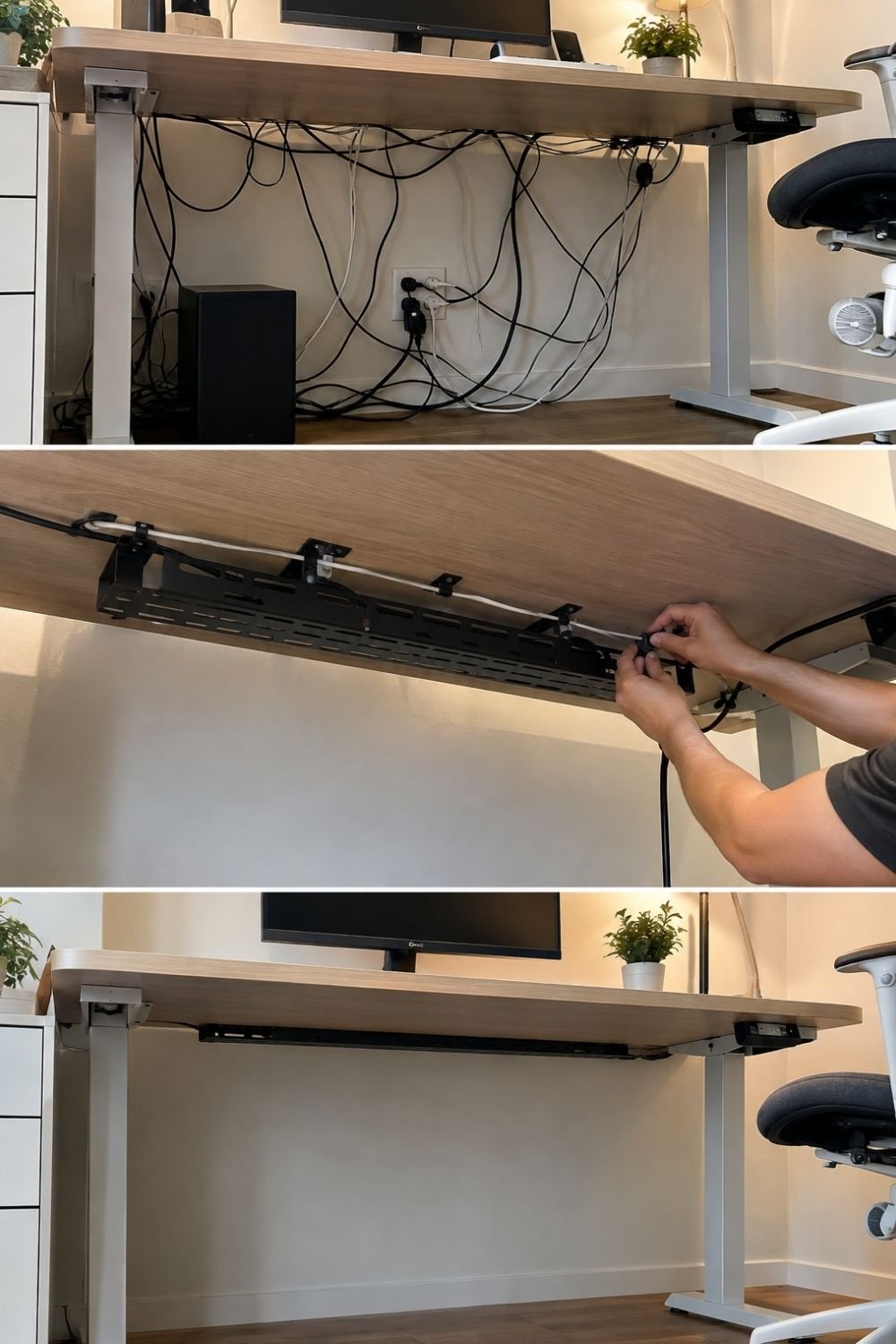
Photo by OurHoneyHome
The three frames here show a standing desk going from a tangle of black cables and a floor-level power strip to a metal cable tray screwed under the top, with every lead clipped into it and the floor completely clear. It’s an hour of work, and it’s the single biggest visual upgrade on this list. Mount the power strip under the desk so everything plugs upward, bundle by destination rather than by color, and run one sleeved cable down a leg to the wall socket.
Light it so you don’t need the ceiling fixture
Lighting is where minimalist study room plans usually stop too early. Position first: sitting side-on to a window gives you daylight without glare on the screen, which is better than facing the window or putting your back to it.
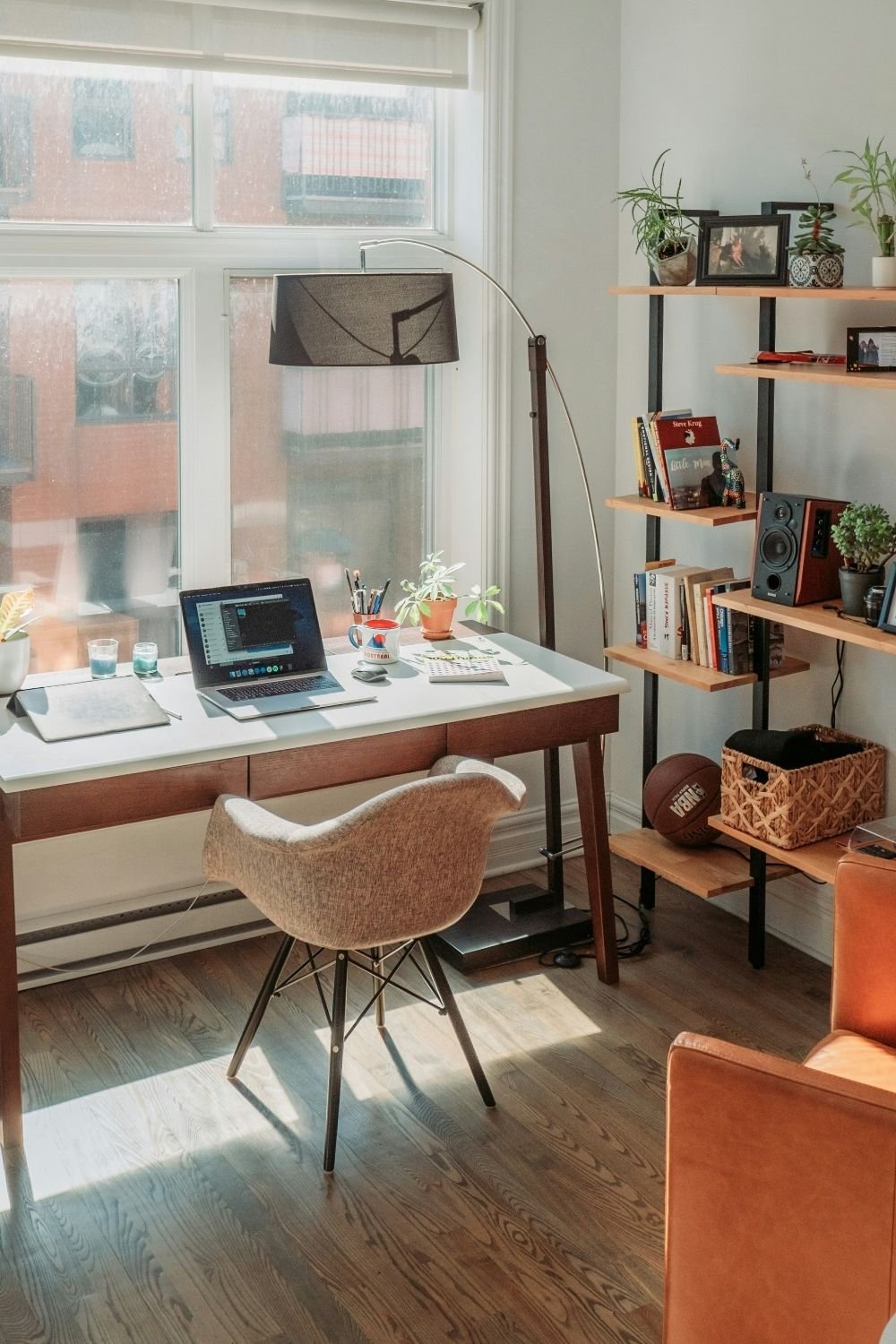
Photo by Michael Descharles on Unsplash
The desk above sits right under a tall window, with an arc floor lamp leaning over it and an open shelving unit alongside holding books, plants and framed photos. The lamp is the part to copy: one directed light aimed at the desktop, not at the wall, in a warm bulb so the corner still feels like a room after dark.
If the desk is also where you read or take calls in the evening, add a second small light somewhere behind the screen, such as a lamp on a shelf or a strip behind the monitor. It softens the contrast between a bright screen and a dark room, and it means the ceiling light can stay off, which is most of what makes a workspace feel calm at night.
The wall above the desk
A shelf and a couple of pictures do more than a full gallery wall, because the wall you stare at all day is also the wall your attention leaks into.
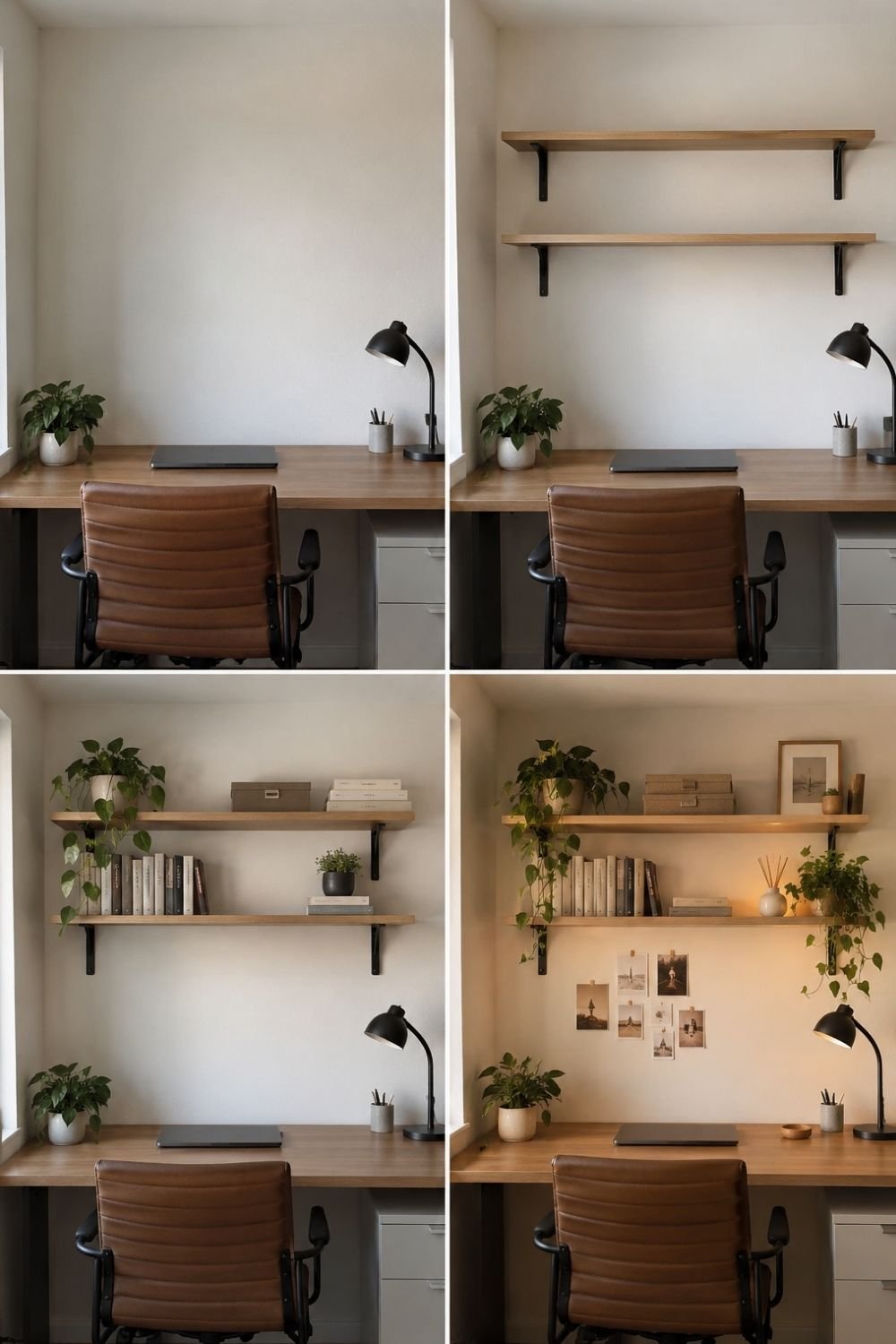
Photo by OurHoneyHome
The four frames above add two wood shelves on black brackets above a built-in desk, then fill them slowly: books with the spines lined up, two storage boxes, a trailing plant, a small framed print, and finally a handful of photos clipped to the wall under warm lamplight. The shelves hold things that get used, and only the last layer is decorative. That’s the balance I’d aim for on any minimalist study wall.
Warm minimalism, not a waiting room
The difference between calm and clinical is usually material rather than quantity. Wood instead of white laminate, a linen cushion on the chair, one plant, a warm bulb.
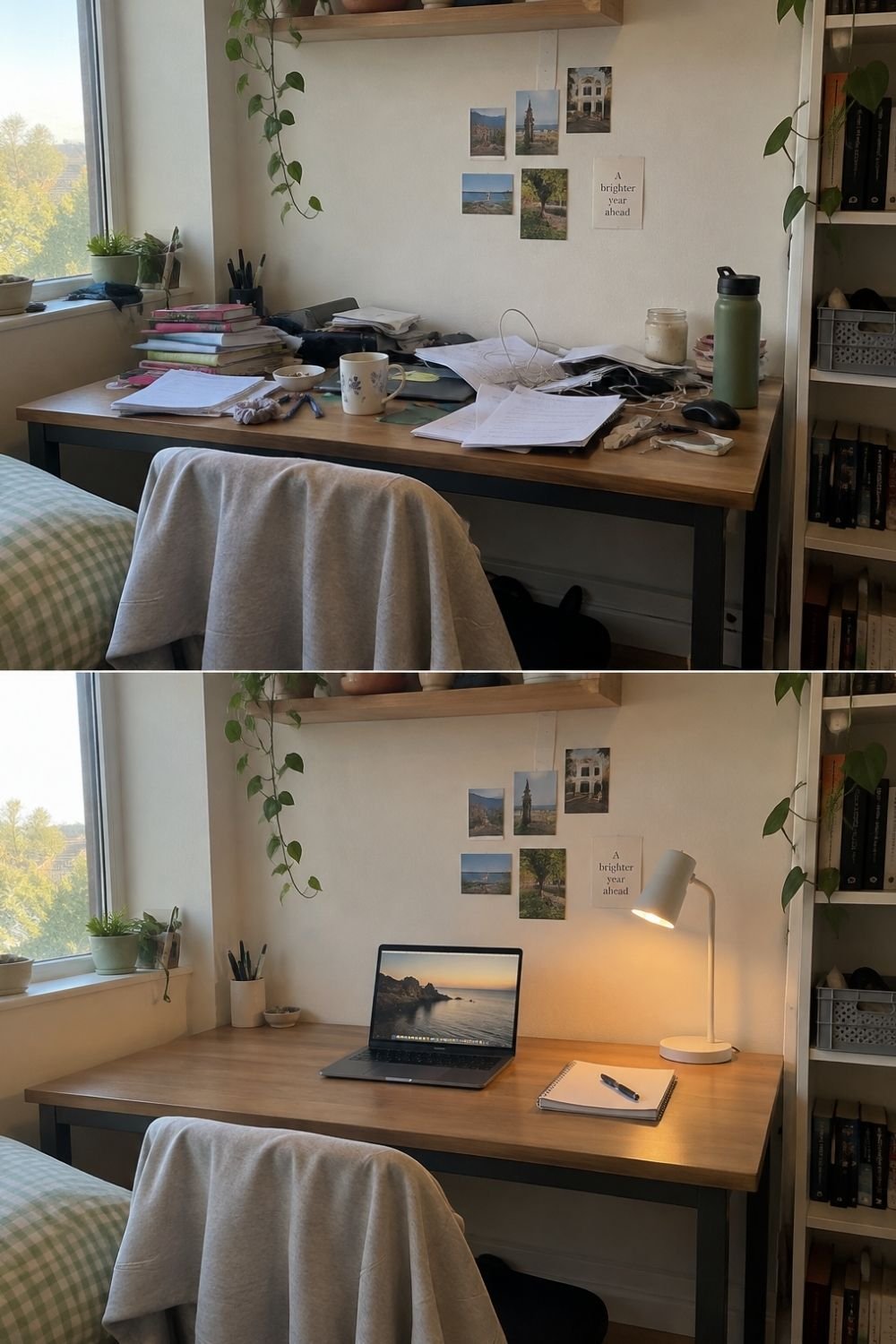
Photo by OurHoneyHome
The before-and-after above is a student desk. In the first frame it’s buried under notebooks, loose paper, a mug, a water bottle, headphones and a jumper on the chair. In the second, the same desk holds a laptop, a notepad, a pen, a pot of pencils and a white lamp, with the postcards still on the wall and the plants still on the sill. Nothing about the room changed, and it went from stressful to somewhere you’d sit down voluntarily. A study corner in a shared room has the same needs on a tighter budget, which the uni room post goes into.
If your desk also has to handle evenings and games, the small bedroom gaming setup post covers the same corner with more gear in it.
Renting changes almost none of this. Shelves are the only part that needs drilling, and a slim freestanding unit beside the desk or a stack of two storage boxes on the floor covers the same ground. Everything else, the lamp, the drawer unit, the cable tray under the top, the tray for paper, comes with you when you move.
The test isn’t the photo
Any desk can look minimal for the twenty seconds it takes to photograph it. The test is Friday afternoon, after a week of ordinary use: is the surface still clear, or is it holding four days of half-decisions?
If it’s the second one, the fix usually isn’t more restraint. It’s one more drawer, one tray for paper, and somewhere to put the headphones. Give the clutter an address, and the clean desk takes care of itself.
