There’s a specific afternoon in early December when three boxes come down from the loft, get opened in the middle of the living room, and half an hour later the floor is covered in tangled lights, single baubles and a wreath that has lost its ribbon. At that point most people start hanging things wherever there’s a gap, and the result is a house that’s decorated everywhere and finished nowhere.
The fix is boring but it works: decide on a palette before you open the boxes, and then do the rooms in order rather than all at once. My own shortcut is to think in three layers. Something green in every room, something that glows, and something soft. Once those three are in place, everything else is optional, and the whole home already looks cozy rather than half-dressed.
So this is the order I’d follow, with the living room first because that’s where the tree lives and where the palette gets set.
The living room, and how much tree is enough
Start with the lights, always. Warm white, wound around the branches from the inside out rather than draped over the surface, and switched on before a single ornament goes up, because that’s the only way to see where the dark patches are. After that, one metal (gold or silver, not both), one color, and as much natural material as you like.
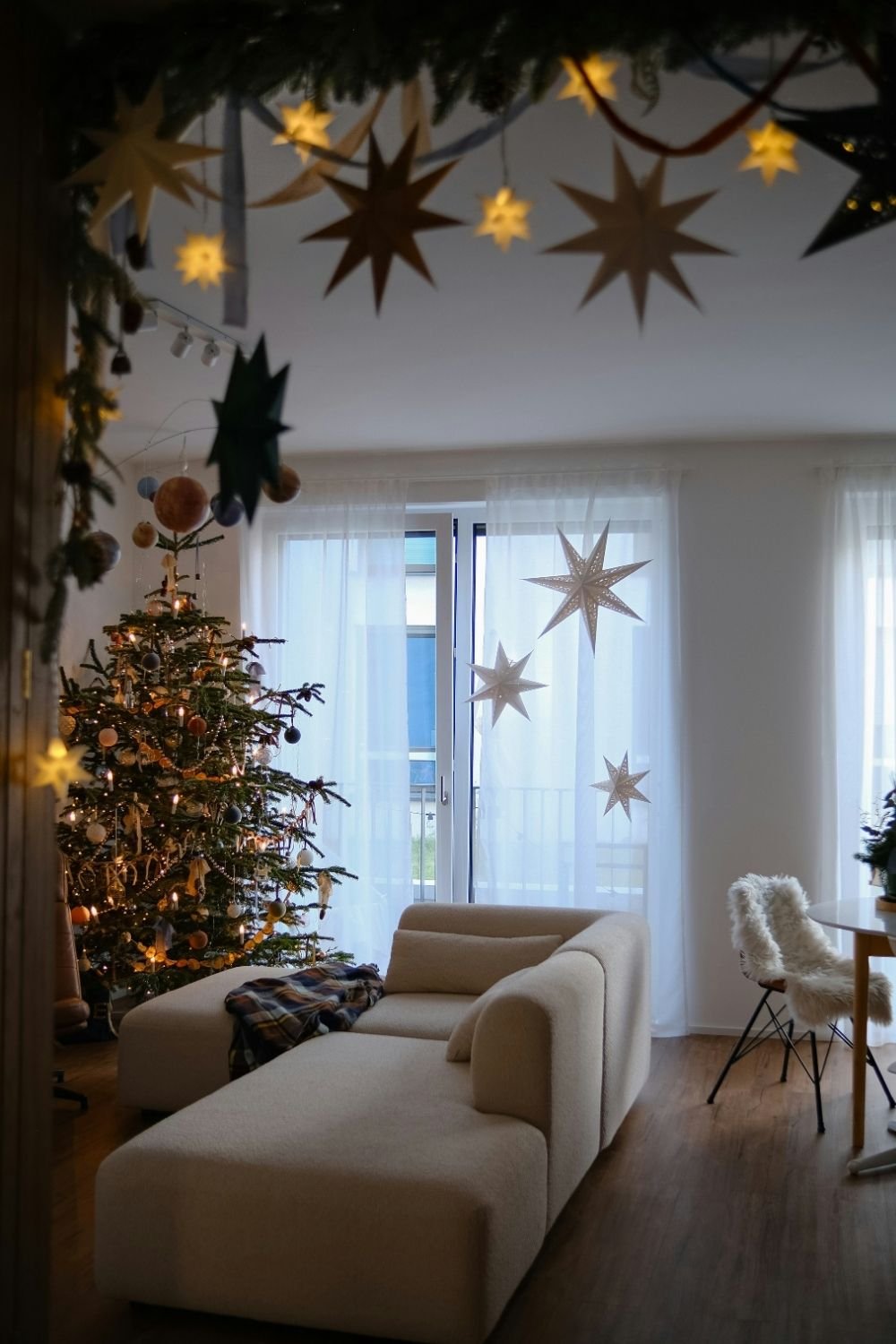
Photo by Julia Blumberg on Unsplash
This apartment does something I’d copy immediately. The tree stands in the corner by the balcony door, lit and hung with muted glass baubles and a planet mobile, but the smartest move is overhead: paper stars in cream, brown and black hang from a fir garland along the ceiling edge, with small lit stars tucked between them, and three white paper stars hang in the window. The sofa stays plain cream with one plaid throw. The decoration is at ceiling height and window height, which leaves the living space completely usable, and it makes a fairly small flat look layered rather than crowded.
That’s the principle I’d hold onto for Christmas living room decor in general. Decorate the edges of the room, the ceiling line, the window, the mantel, the top of a bookshelf, and leave the middle alone. Rooms get tiring when the coffee table and every side table are full, because those are the surfaces you actually need.
A quick word on trees: a live tree wants water every day and a spot away from the radiator, or it drops needles by the second week. A faux tree looks better if you spend ten minutes bending the branches out in three directions before decorating. And if the room is small, a narrow tree in front of the window beats a wide one in the corner, because the window does the backlighting for you.
Greenery is the cheapest decoration there is
Nothing else gives you as much for as little, which is why greenery sits at the center of most of my Christmas decorating ideas. A bundle of fir or spruce offcuts costs almost nothing at a market stall in December, and most tree sellers will hand you the trimmed lower branches for free if you ask.

Photo by OurHoneyHome
The four frames above show a garland coming together on a kitchen table: a pile of fir, cedar and eucalyptus with scissors and twine, then the stems being bound into small bundles, then dried orange slices and pinecones being worked in, and finally the finished length lying across the table. It takes about half an hour, costs the price of a ball of string, and it smells like the whole point of the season.
Where I’d put it, in order of impact: along a mantel, over a doorway, down the middle of the dining table, up a stair rail, and around a mirror. Fresh greenery lasts roughly two weeks indoors, longer in a cold hallway, and a quick spray of water every few days buys you a few more days. If the garland has to go up in the first week of December and stay until January, faux with a few fresh stems pushed in is a fair compromise.
The entryway sets the tone
The front door is the only part of your decorating that other people see from the street, and it’s the first thing guests meet. It also happens to be the easiest room to style, because there’s rarely much furniture in the way.
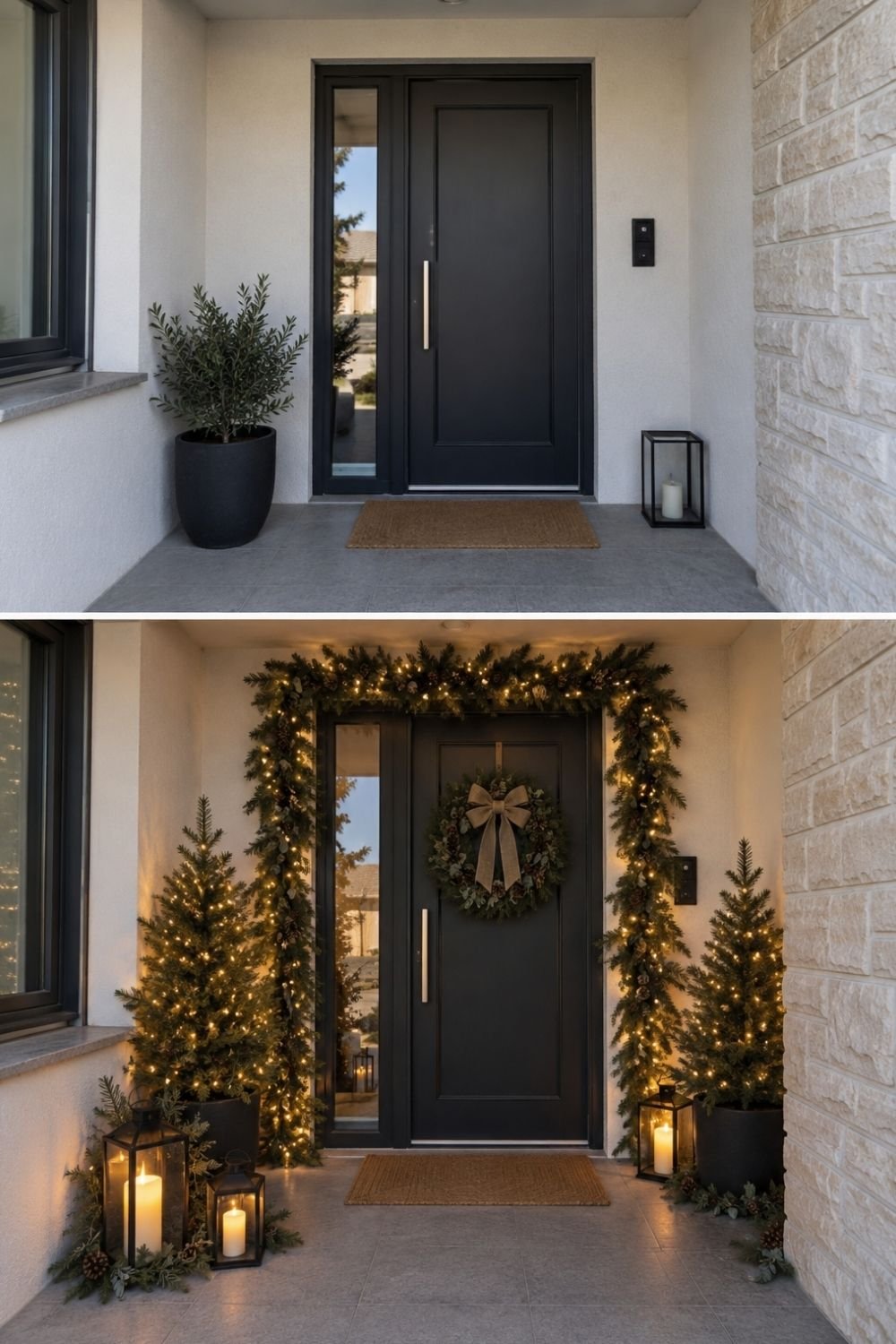
Photo by OurHoneyHome
The before-and-after above is a plain black front door with a potted olive tree on one side and a single lantern on the other. In the second frame, a lit garland frames the whole doorway, a wreath with a burlap bow hangs on the door, two small lit fir trees stand in black pots on either side, and three lanterns with candles sit at ground level among loose greenery and pinecones. The door itself hasn’t changed at all.
The pattern here is worth remembering for Christmas entryway decor: frame the opening, hang one thing on the door, and put light at floor level. Inside the hall, the same idea works on a console, with a small garland, a lamp and a bowl for keys, and it’s worth keeping the floor clear because December means wet coats and boots.
The bedroom, kept quiet
I’d decorate a bedroom less than any other room. It’s the one place where you want the season to feel calm rather than festive, and anything that jingles, glitters or blinks is going to be irritating at half past eleven at night.
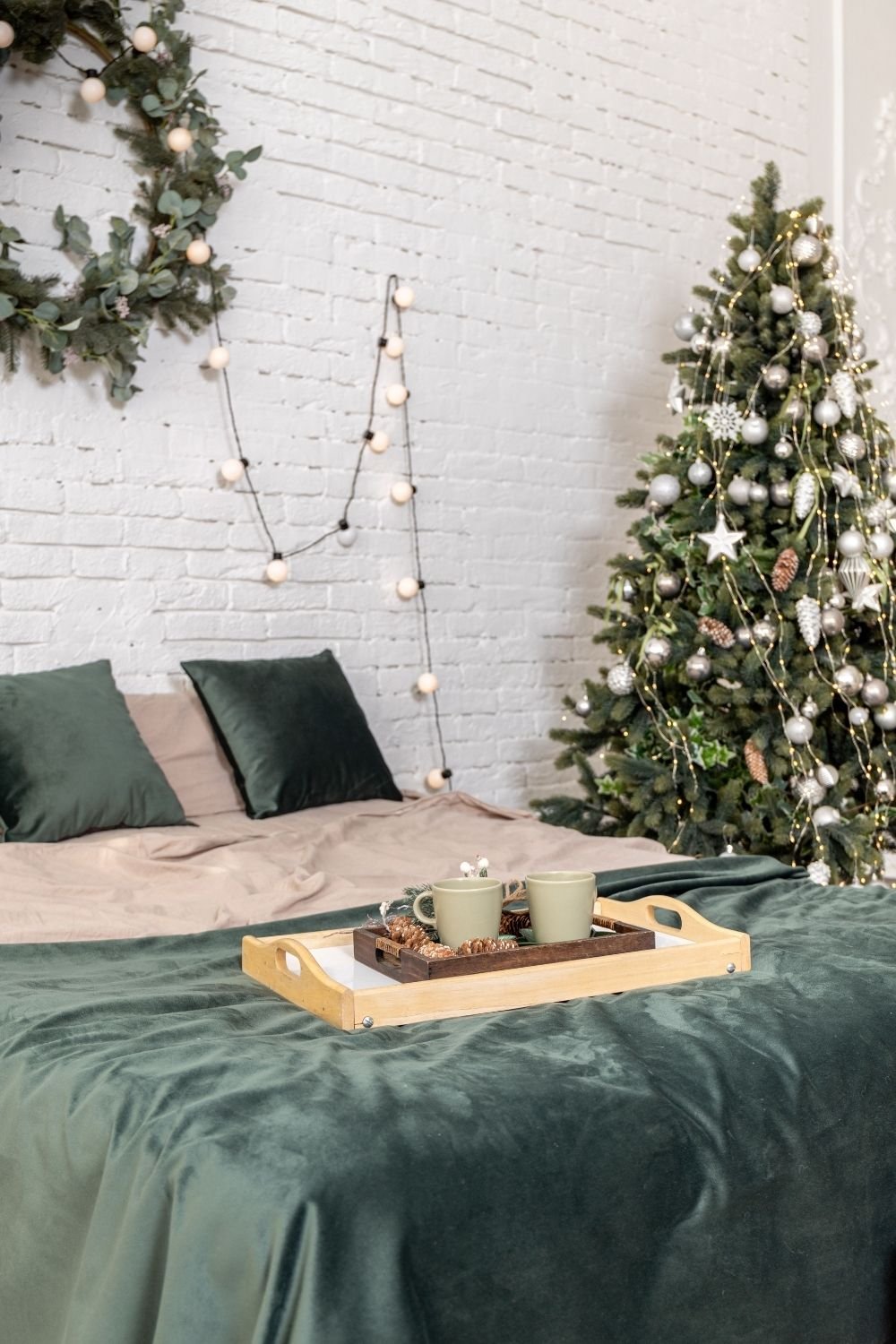
Photo by Dima Valkov on Pexels
The bedroom above gets it right with four things. A deep green velvet throw over the bed, dark green cushions against warm beige linen, a eucalyptus and fir wreath on a white brick wall, and a string of bulb lights draped beside it. A small tree stands in the corner in silver and white, and there’s a wooden tray with two green mugs and a few pinecones on the bed. That’s the whole scheme, and it would take twenty minutes to put together.
For Christmas bedroom decor, textiles do most of the work: a throw and two cushion covers in the season’s colors change the room more than any ornament. Add one light source, either a small string of warm lights along the headboard or a lamp with a lower-watt bulb, and one green thing. A wreath above the bed, a small tree in the corner or a jug of branches on the dresser all qualify.
The table and the dining room
The dining table is where the actual event happens, so it earns more effort than the rest of the house put together, and it’s also the place where a tight palette pays off most.
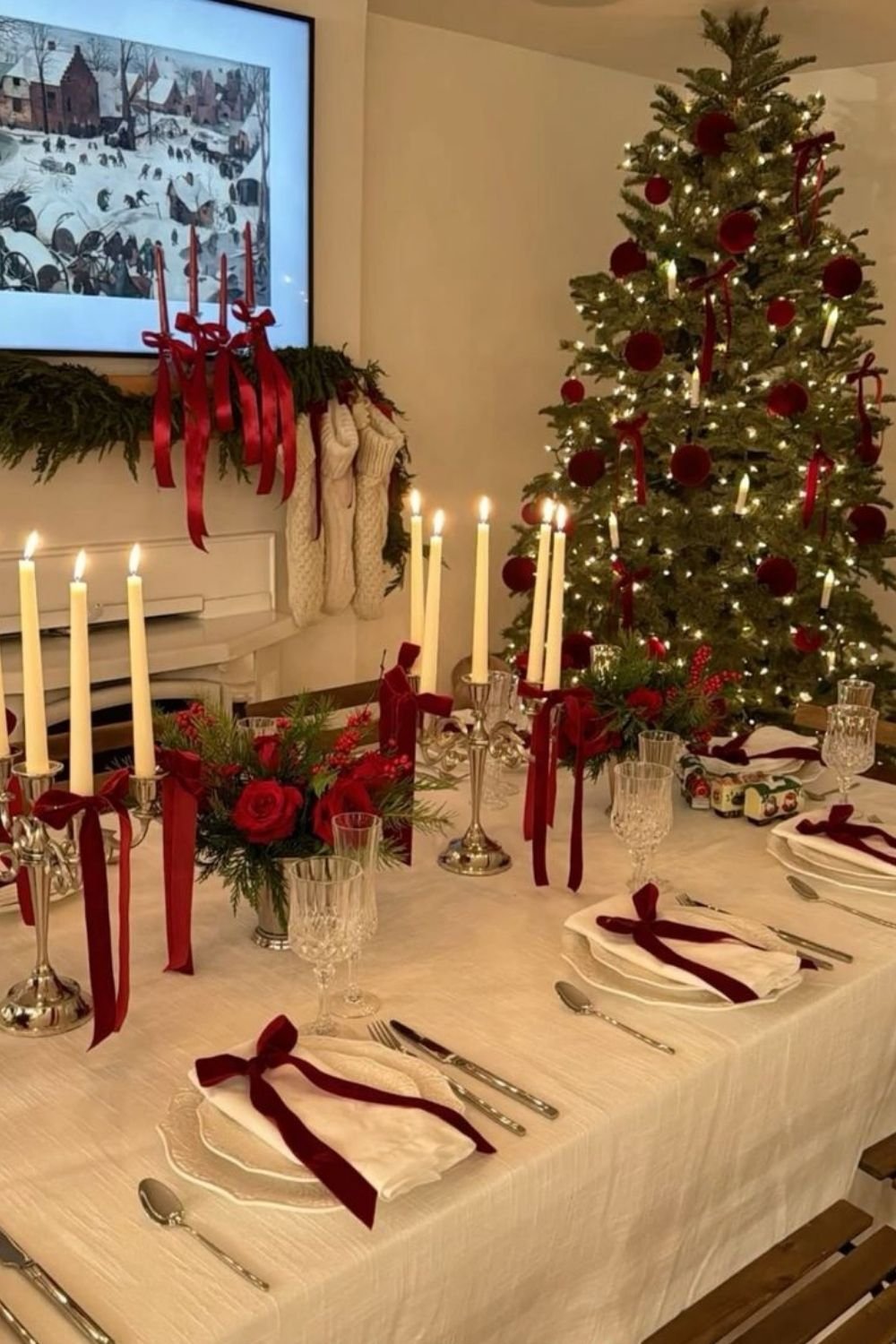
Photo by OurHoneyHome
This table runs on two colors and one material. A cream linen cloth, white plates, cut glassware and a deep red velvet ribbon tied on every napkin, with matching ribbons on the silver candlesticks and the taper candles burning down the middle. A small arrangement of red roses, berries and fir sits low between them, and behind it the tree carries the same red velvet baubles and ribbons, with the mantel garland trailing more of the same. Everything rhymes, and none of it needed a shopping list longer than three items.
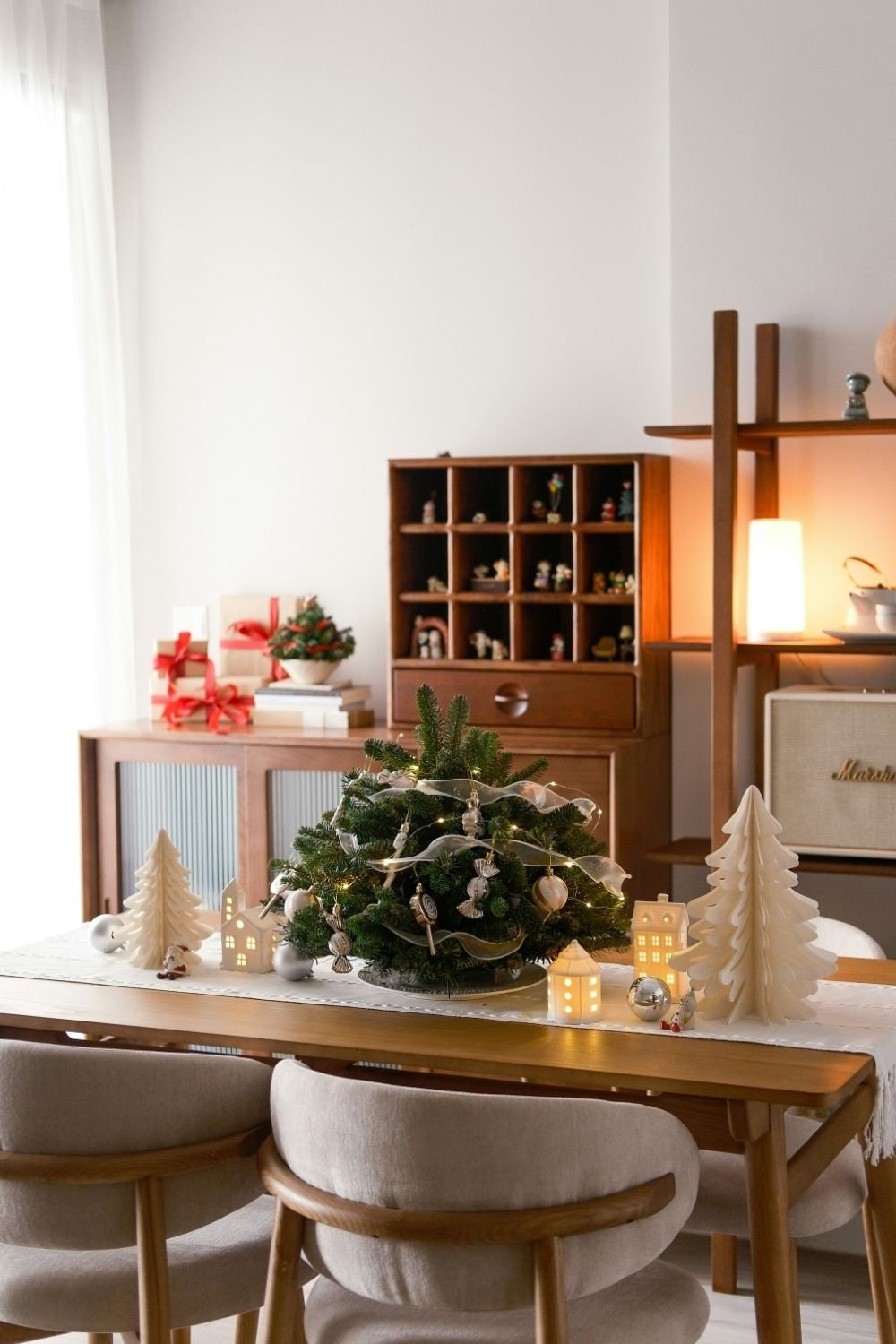
Photo by Duong Ngan on Unsplash
The gentler version is above: a wood table with a cream runner, a low arrangement of fir with fairy lights, ribbon and a few glass ornaments as the centerpiece, two paper trees, small lit ceramic houses and a couple of silver baubles scattered along the runner. Behind it, a wooden cabinet full of tiny figures and a stack of wrapped presents does the rest. Keeping the centerpiece low is the rule I’d never break, since the point of the table is that people can see each other across it.
The rooms everyone forgets
Guests visit the bathroom, and the kitchen is where everyone stands. Both take about ten minutes, and both are where a bit of Christmas kitchen decor or a single bathroom garland goes further than you’d expect.
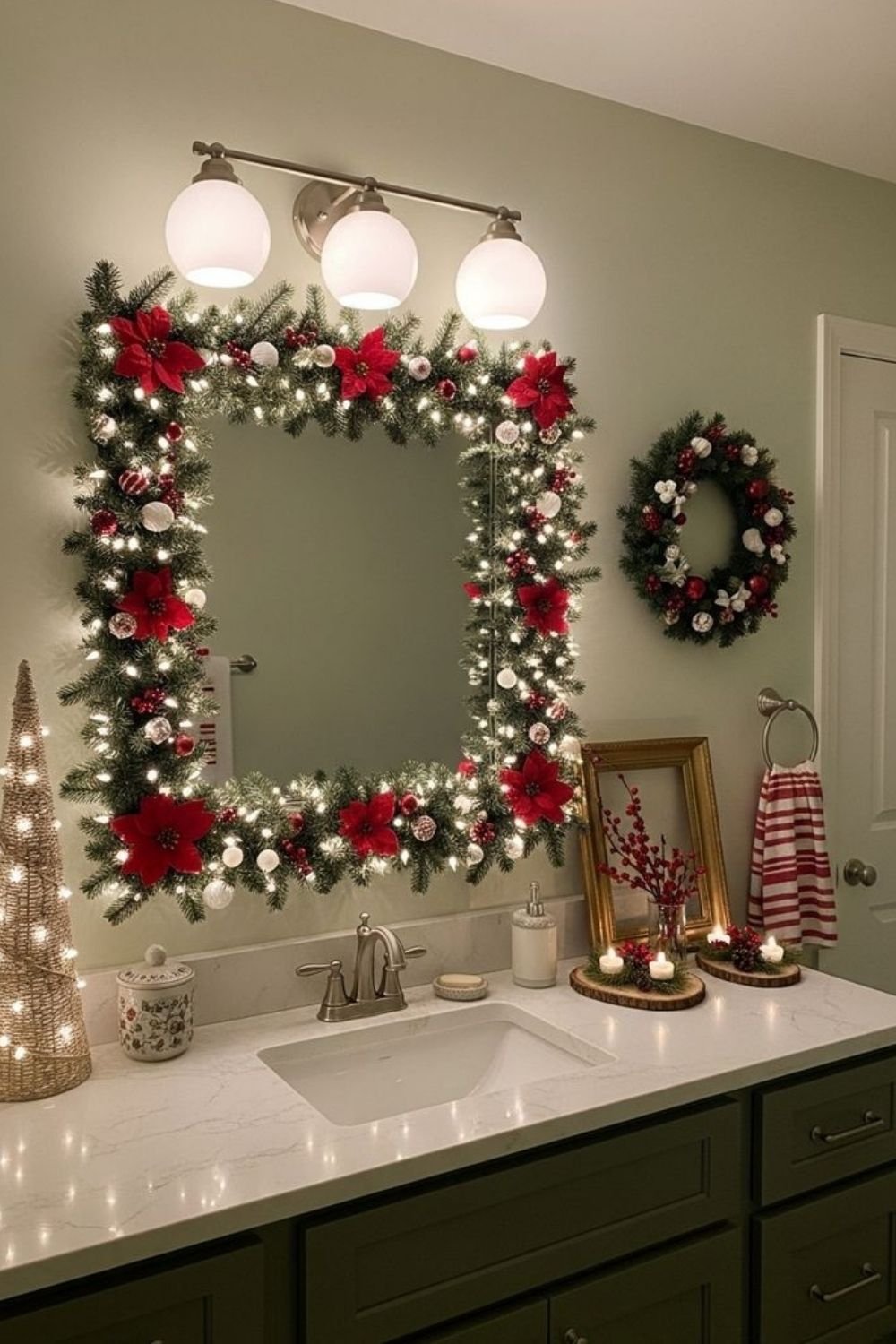
Photo by OurHoneyHome
Here a lit garland with poinsettias, red and white baubles and berries frames the whole bathroom mirror, a small matching wreath hangs on the wall, and the vanity holds a lit rattan cone tree, candles on wood slices, a gold frame with red berries and a striped hand towel on the ring. It’s a lot for a bathroom, and I’d personally pull it back to the garland and the towel, but it shows how much a mirror frame can carry. In the kitchen, a swapped tea towel, a bowl of clementines and a few lights along an open shelf do the same job.
DIY, because handmade ages better
Bought ornaments look the same in year five. Handmade ones get better, partly because they collect memories and partly because slightly wonky is charming.

Photo by OurHoneyHome
The four frames above cover an afternoon of DIY Christmas decorations: paper snowflakes being cut and unfolded, dried orange slices tied with cinnamon sticks and twine, a star made from glued lolly sticks, and small fabric trees in green, red plaid and ticking stripe being stuffed and stitched. Dried oranges take a couple of hours in the oven at a low temperature, and the fabric trees are a good use of scraps if anyone in the house sews.
The ones with staying power are the ones that suit your palette. If your tree is cream, brass and green, a bright plastic ornament will always look like a guest, whereas a cinnamon-and-orange slice will look like it belongs.
Small apartments and rentals
Apartment Christmas decor works best with a single point of focus. In a small flat, I’d pick one zone and commit to it rather than spreading a thin layer everywhere. Usually that’s the living room corner with the tree, plus the front door and one shelf.
Everything can go up without a drill. Removable hooks hold wreaths and garlands on doors and windows, a garland can be tied to a curtain rod or a stair rail, and fairy lights run happily along a bookshelf edge with clear clips. A tabletop tree on a sideboard leaves the floor free, and if there’s genuinely no space, a branch in a heavy jug hung with a few ornaments does the job. The same logic that makes a Hanukkah display work on one shelf applies here too.
If you only have an hour
Put up the lights first, because they do the most and they’re the thing you’ll look at every evening. Then the greenery, on the mantel or over the door. Then the textiles, since a throw and two cushion covers change a whole room in two minutes. Ornaments come last, and the small stuff scattered across side tables never has to happen at all.
Come January, the same order works in reverse. Ornaments and anything obviously Christmassy go back in the box first, but the candles, greenery and warm lights can stay through the dark part of winter, which makes the house feel less abruptly empty. If you’re hosting again a week later, the New Year’s Eve post picks up exactly where this one leaves off, and the Thanksgiving post covers the month before it with the same room-by-room approach.
