Most homes have one window that nobody really uses. It gets good light, it has a view of something, and yet the space in front of it holds a stack of mail, a plant, or nothing at all. That window is usually the best place in the house for a cozy reading nook, and a reading nook bench is the simplest way to claim it.
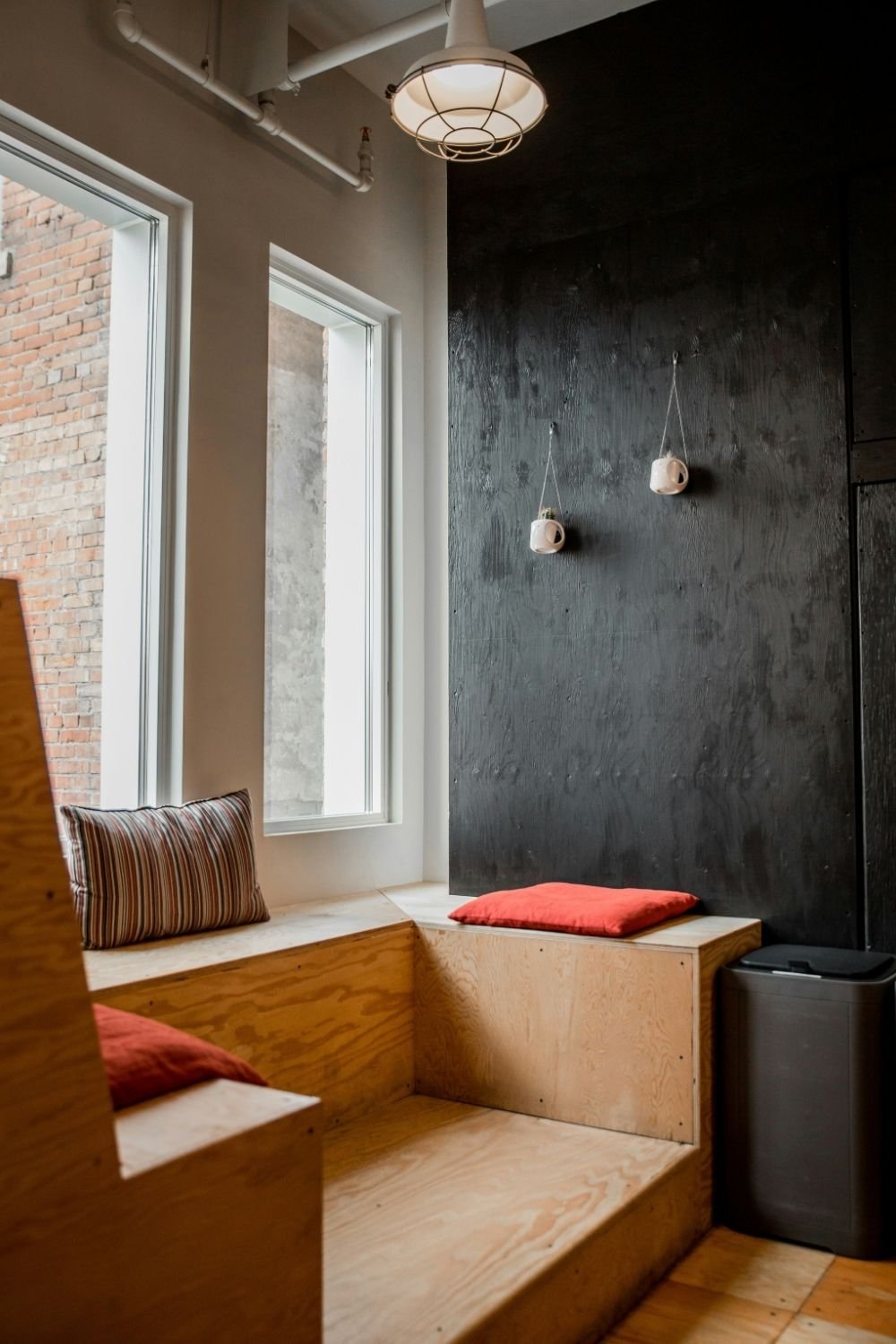
Photo by Redd Francisco on Unsplash
The bench above is nothing fancy: plain plywood boxes built along two walls, a couple of cushions, one pendant light. It works because it follows the window instead of fighting it. The seat sits just below the sill, the light comes from the side, and there’s a solid dark wall to lean against.
Getting a spot like this right comes down to a handful of questions. Is the window worth building around? Bench, chair, or seat with storage? What happens after dark? The sections below go through them in the order you’d face them.
Is your window actually a good spot for reading?
Before buying or building anything, spend ten minutes in front of the window at the time of day you’d most likely read. A few things decide whether the spot will get used or ignored:
- Direction of light. North-facing windows give soft, even light all day. South and west windows are brighter but can be harsh in the afternoon, so plan for a sheer curtain or blind.
- Glare. Light coming from directly behind a page is comfortable. Light bouncing off a phone or a glossy magazine is not. Sitting side-on to the window usually solves it.
- Drafts and heat. Older windows leak cold air in winter. A radiator under the sill is a different problem: you can’t block it with a solid bench front, so it needs a vented panel or an open base.
- Privacy. A street-facing window at eye level means passersby can see in. Café curtains or a frosted film on the lower half keep the light and lose the audience.
- Depth. A deep sill or a bay alcove gives you a ready-made frame. A flat wall with a window in it can still work; the furniture just has to build the frame instead.
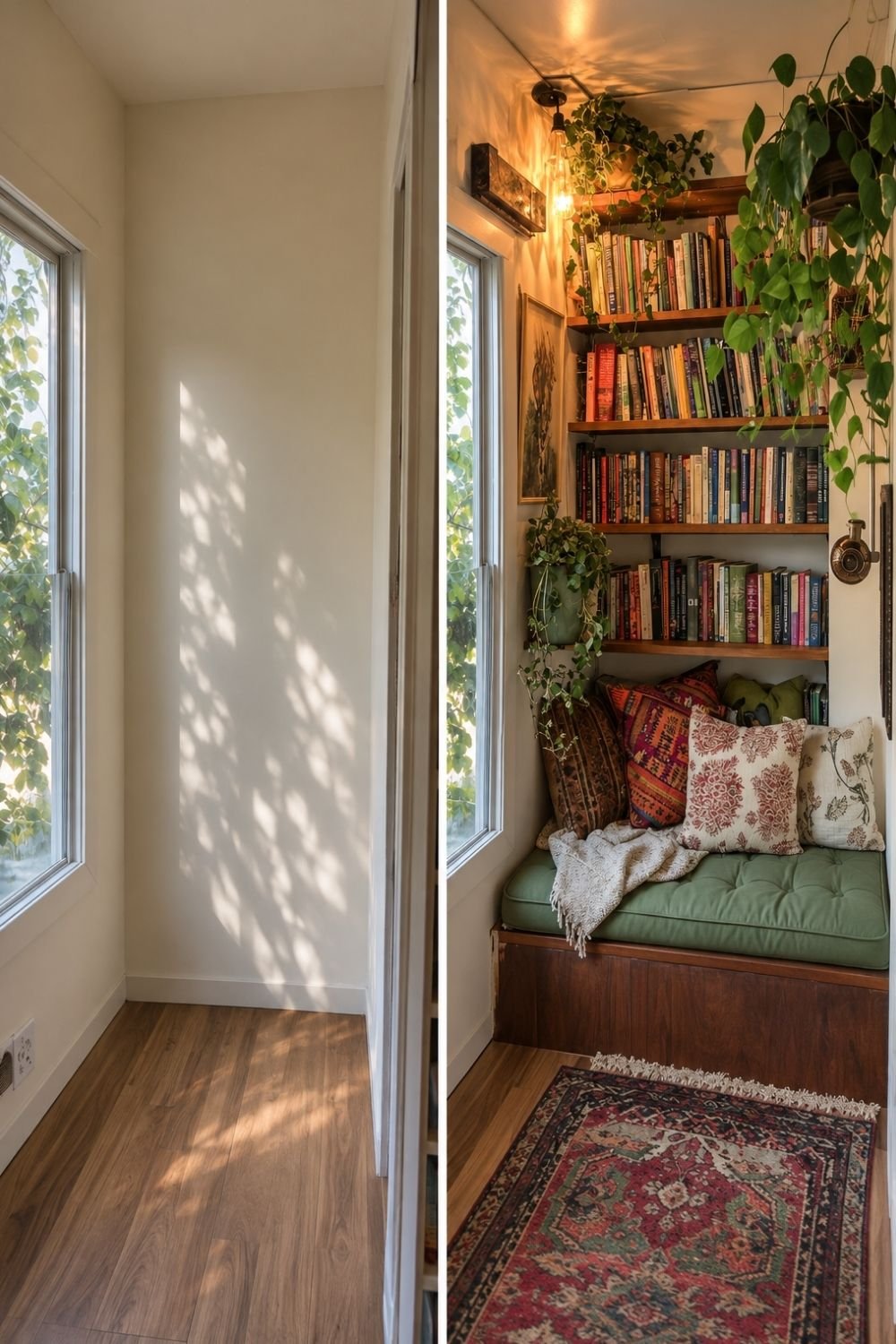
Photo by OurHoneyHome
The before-and-after above shows how much an alcove gives you for free. On the left, it’s an empty recess with a window and bare walls. On the right, a built-in wood bench fills it wall to wall, with a thick green tufted cushion, patterned pillows and a knit throw. Shelves on either side hold books, a trailing pothos hangs down one side, a wall sconce handles the evenings, and a vintage runner rug leads the eye into the nook. Nothing in the room is expensive; the alcove does most of the work.
Built-in bench, freestanding chair or seat with storage?
This is the main decision, and it depends on how much space you have, whether you own or rent, and how much stuff needs a home.
| Option | Best for | Space needed | Renter-friendly? | Storage |
|---|---|---|---|---|
| Built-in window bench | Alcoves, bay windows, owners | Full width of the window, 40–50 cm deep | No | Drawers or lift-up lids possible |
| Freestanding reading bench | Flat walls, renters, trying it out first | 100–150 cm wide | Yes | Sometimes (baskets underneath) |
| Armchair and ottoman | Corners, bedrooms, small rooms | About 90 × 150 cm with the ottoman | Yes | None, unless the ottoman opens |
| Bench seat with storage | Kids’ rooms, entryways, small homes | Same as a bench | Yes, if freestanding | Lots |
A few measurements make any window bench seat more comfortable:
- Seat height: around 45–50 cm including the cushion, roughly the height of a dining chair. Higher than that and your feet dangle.
- Seat depth: 40–50 cm if you’ll sit upright with your back against the wall. If you want to sit sideways with your legs stretched out, go deeper, 55–65 cm.
- Length: at least 120 cm for stretching out. Shorter benches work fine for sitting upright.
- Back support: a bench nook needs something to lean on, either a wall, the window frame, or a stack of firm pillows.
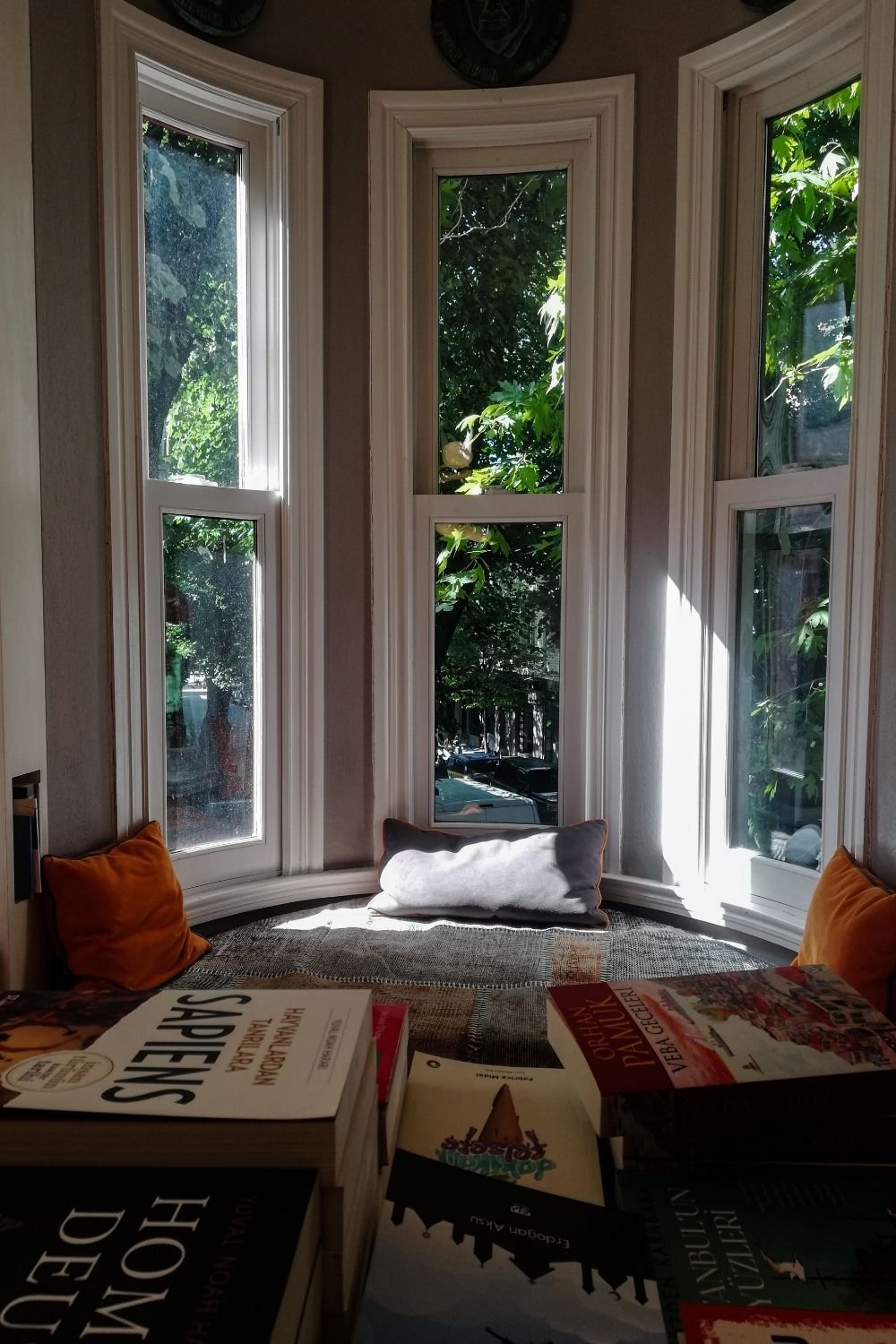
Photo by Reyhan Alioğlu on Pexels
A bay window is the classic setting for a built-in bench reading nook. The seat follows the angles of the bay, so you get light from three sides and a natural backrest at each end. In the photo, orange and gray pillows and a patchwork cushion make it look lived-in, and the books piled up in front show what the space is for.
If your home is short on closets, a seat with storage is the most practical version. Lift-up lids are cheaper to build, but the cushion comes off every time you open them. Drawers or open cubbies with baskets are easier to use day to day.
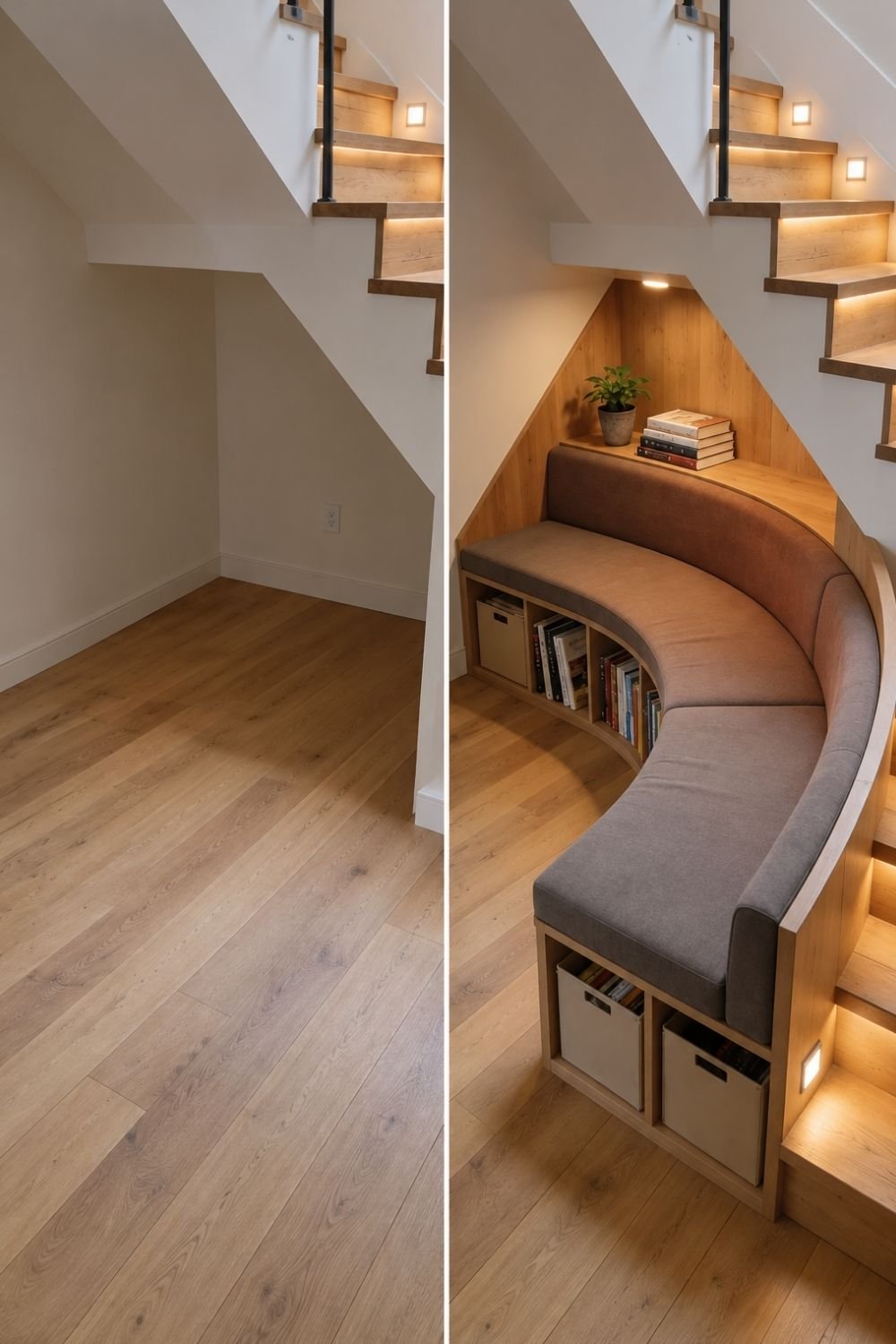
Photo by OurHoneyHome
This one started as an empty space under a staircase. The finished version is a curved, upholstered reading bench with open cubbies below for fabric bins and books, a small shelf above for a plant and a few more books, and LED strip lights on the stairs. The curve makes it look softer than a straight box, and the cubbies mean it earns its space even when nobody is reading.
No window alcove? What about a corner or the space under the stairs?
A window isn’t the only place a reading spot can go. Any underused corner works as long as it has decent light nearby, room for one comfortable seat, and a way to look separate from the rest of the room.
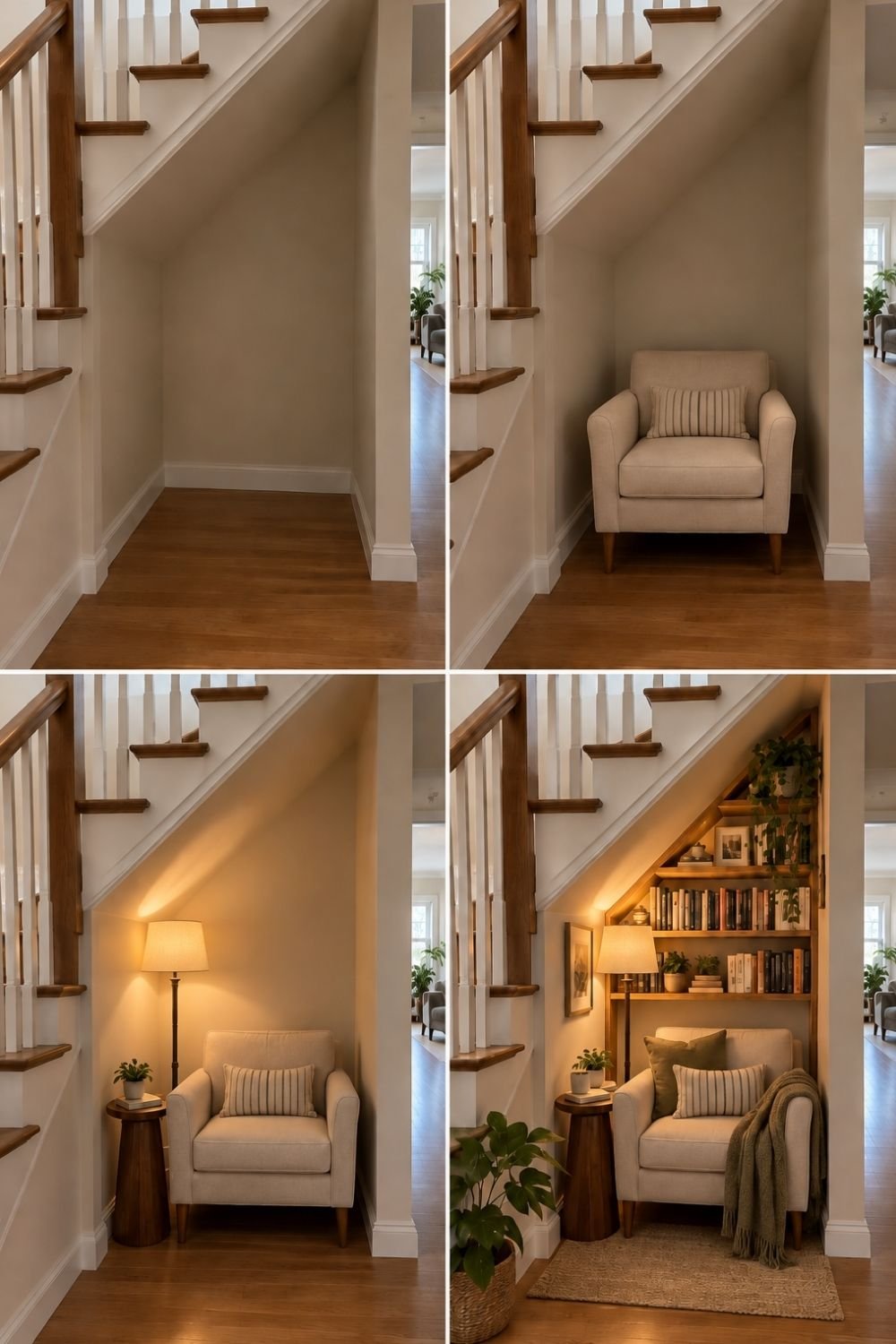
Photo by OurHoneyHome
The four frames above build a nook under a staircase step by step. The first shows an empty slot of wall. The second adds an armchair. The third adds a floor lamp and a small wood side table, which is the point where it starts to look like a place to sit. The last frame adds a bookshelf built into the slope of the stairs, pillows, an olive throw, a rug and a plant.
That order is a good general rule for any corner: seat first, then light, then a surface for a cup, then everything soft.
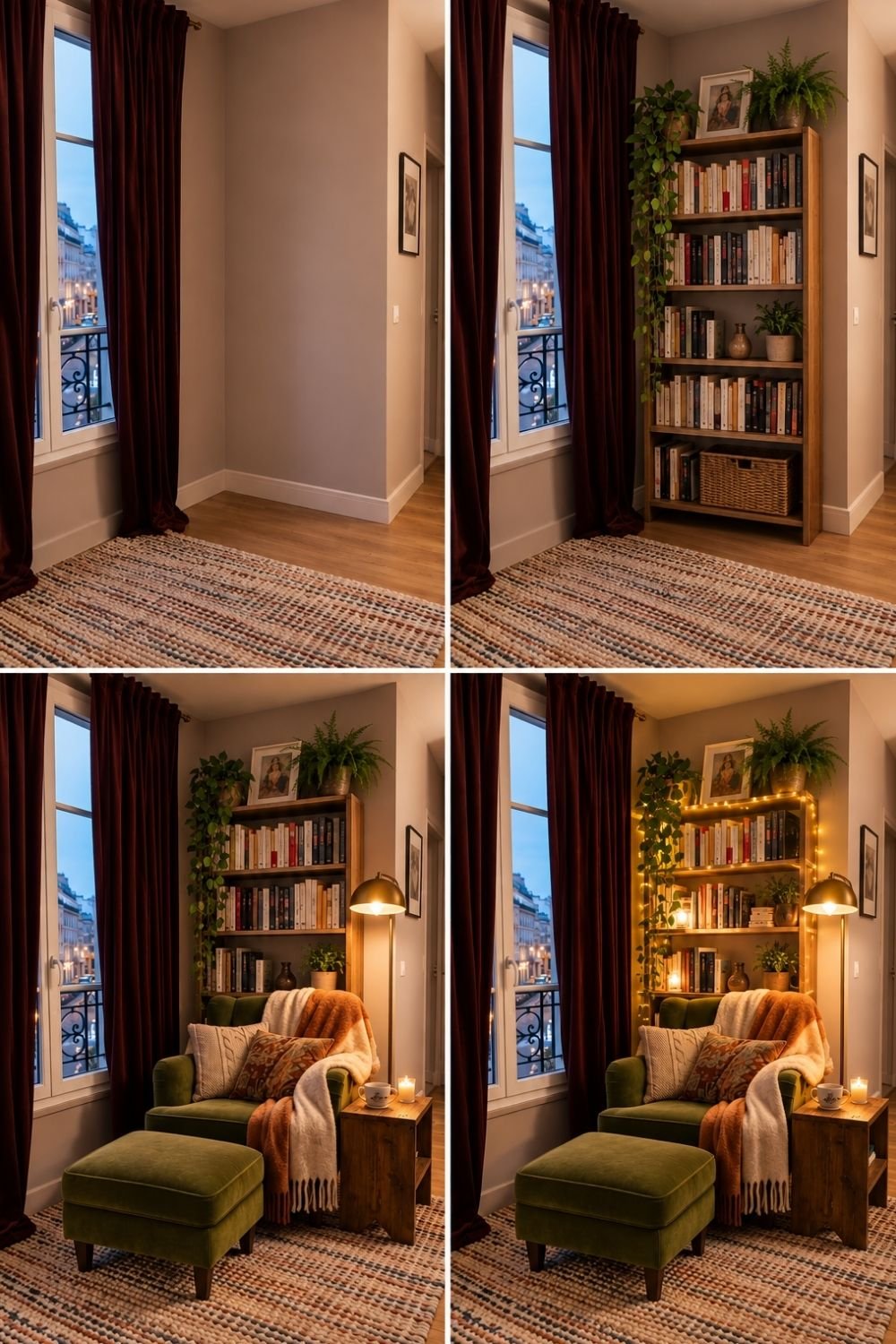
Photo by OurHoneyHome
Here a plain corner next to a window with burgundy velvet curtains gets the same treatment. A wood bookshelf goes in first, with plants on the top shelves. Then a green velvet armchair with an ottoman, a brass floor lamp, a wood side table and a couple of throws. String lights along the shelf come last. The rich colors (burgundy, green, brass) lean toward a dark academia look without needing dark walls.
What helps a corner read as a separate zone:
- A rug that only covers the reading spot, not the whole room.
- A floor lamp that belongs to the chair, not to the room.
- A shelf or plant on one side to act as a soft wall.
- Angling the chair slightly toward the window or away from the TV.
If the corner is in a living room, the rest of the seating layout matters too; the sofa layout guide covers how to leave a corner free without the room looking lopsided.
Can you build a reading bench on a budget?
Yes, and it’s one of the easier furniture projects to DIY, because a bench is basically a sturdy box with a cushion on top.
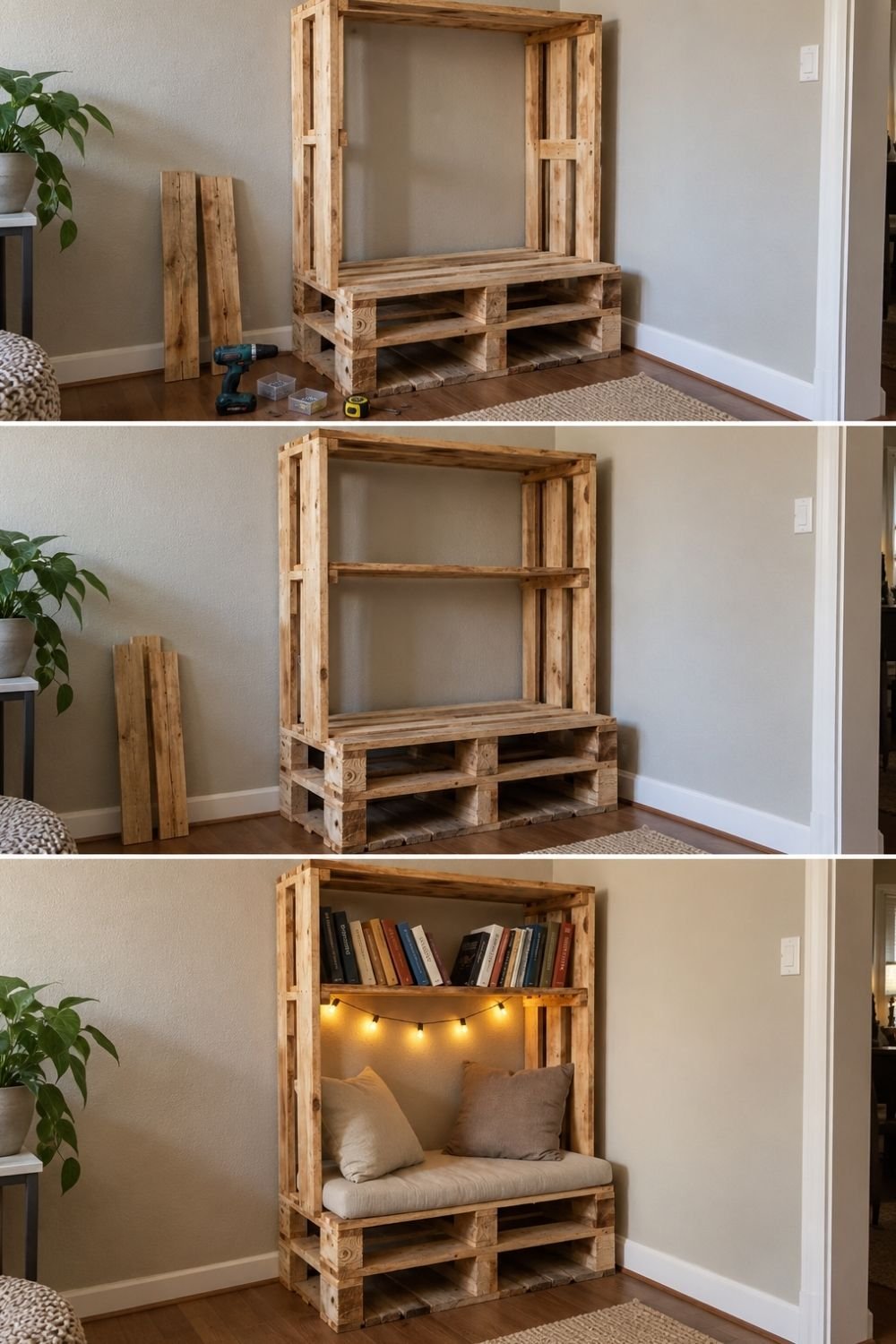
Photo by OurHoneyHome
The project above uses pallets. The first frame shows the pallet base and a frame being put together with basic tools. The second adds a shelf. The third finishes it with a cushion, pillows, books and string lights. If you use pallets, pick ones stamped “HT” (heat-treated) rather than chemically treated, sand them well, and seal the wood so it doesn’t snag clothes.
Other budget routes:
- Kitchen wall cabinets on their side. Short upper cabinets laid along a wall make a solid base with storage built in. Add a plywood top and a cushion.
- Cube shelving turned horizontal. Two-by-four cube units are about the right height for a bench and hold baskets underneath. Screw them together and to the wall.
- A storage ottoman or blanket chest under the window, with a long seat cushion on top.
- Foam and fabric. Custom cushions are often the most expensive part. Buying a sheet of firm foam and a zippered cover (or sewing one) costs a fraction of the price.
For renters, freestanding is the way to go. A bench that isn’t fixed to the wall, a floor lamp instead of a hardwired sconce, tension-rod curtains, and command-strip hooks for string lights all leave the walls untouched when you move out.
What kind of lighting works after dark?
Daylight is the reason to sit by a window, but most reading happens in the evening. A nook with no lamp becomes a place you walk past after sunset.
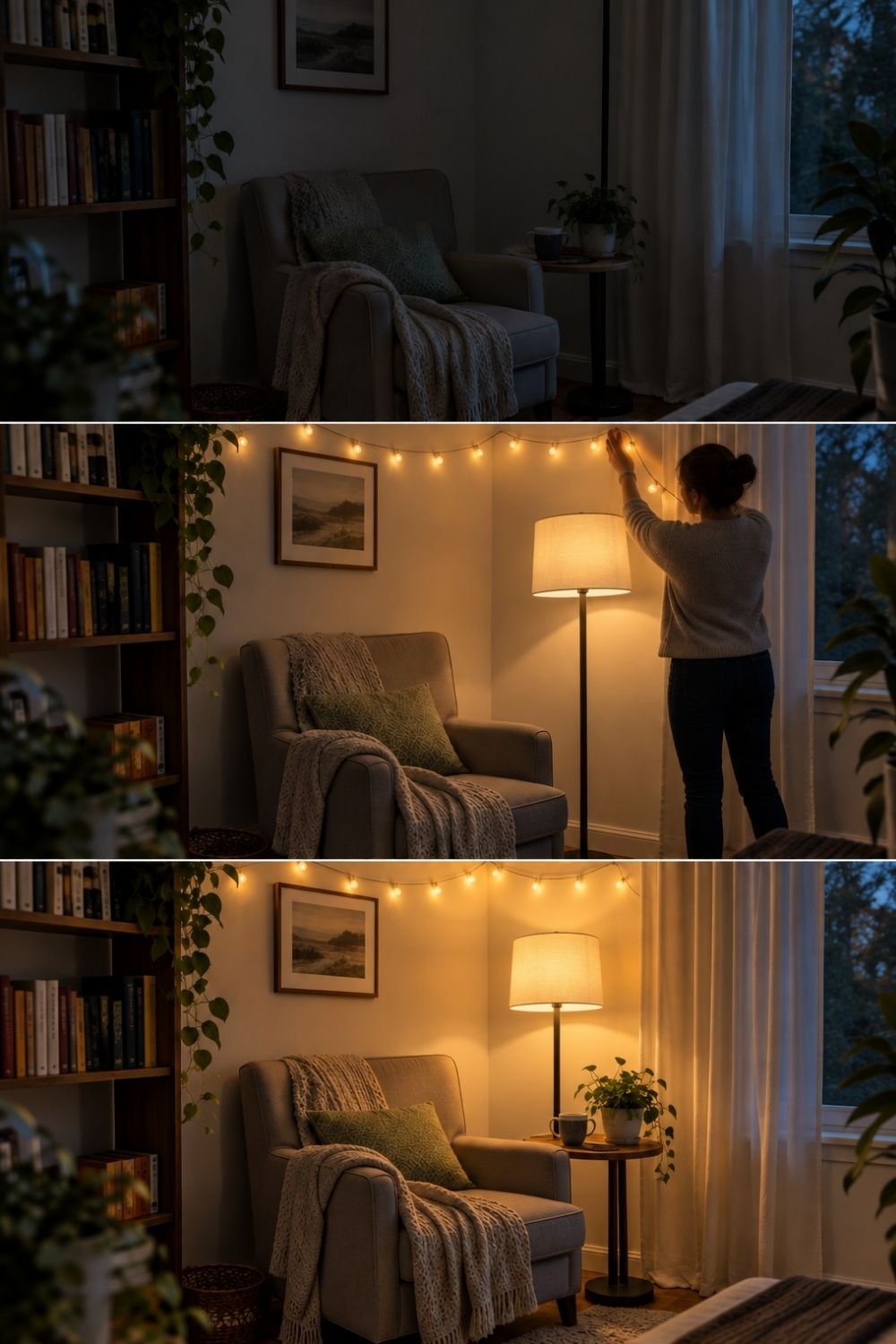
Photo by OurHoneyHome
The three frames above show the same corner at night. In the first, it’s dim and flat, with just an armchair in shadow. In the second, string lights go up and a floor lamp is switched on. In the third, the corner glows, with a plant, a mug and a framed print picking up the light.
Think of it in layers:
- Task light: the lamp you actually read by. Place it slightly behind and to the side of your shoulder, so it lights the page without shining in your eyes. A floor lamp with an adjustable arm, a plug-in wall sconce or a clamp lamp on a shelf all work.
- Ambient light: something softer so the nook isn’t a bright spot in a dark room. String lights, a small table lamp, or LED strips under a shelf.
- Bulb color: warm white (2700–3000K) for a relaxed feel. Very warm or dim bulbs look nice but make small print harder to read, so keep the task lamp a little brighter.
Candles look lovely in photos, but a nook full of cushions, throws and paper isn’t the place to leave them burning. Battery candles give the same glow.
Cushions, throws and a place to put your tea
This is where the spot goes from “a bench by a window” to somewhere you want to stay for an hour. A few details make the difference:
- Seat cushion thickness: at least 7–10 cm of firm foam. Thin cushions flatten within weeks, and then you’re sitting on plywood.
- Removable covers. A window seat gets sun, crumbs and the occasional spilled drink. Zippered covers can go in the wash; sun-resistant or outdoor fabric fades less.
- Back pillows. Two or three large, firm ones for support, then a couple of smaller ones for color. Too many small pillows just end up on the floor.
- One throw, folded at the end or draped over the arm. Wool or chunky knit for winter, linen or cotton for summer.
- A surface within reach. A narrow side table, a tray that sits on the sill, a wall-mounted ledge, or a flat top on the end of the bench. Anywhere a cup and a phone can go without balancing on the cushion.
- Books close by. Shelves beside or above the bench, a basket on the floor, or cubbies underneath. If the books live in another room, the nook turns into a place to scroll instead of read.
Which style fits your room?
A reading nook doesn’t have to match a single style, but it helps if it agrees with the room around it.
Minimalist. A simple wood or white bench, one solid-colored cushion, one throw, a slim lamp. Leave the sill empty or put a single plant on it. Hidden storage keeps it calm.
Cottage. Floral or gingham cushions, a painted bench, a vintage quilt, lace or linen café curtains, and books in a mix of old and new covers. Trailing plants on the sill fit right in.
Dark academia or “poet” corner. Deep green, burgundy, brown and brass. A velvet armchair or leather cushion, a stack of old hardbacks, a brass lamp, a framed print or two, maybe a small bust or candle holder. The burgundy-curtain corner above is a good starting point.
Boho. Rattan, jute, patterned pillows in warm colors, and a lot of plants. The same layering approach from the boho living room post works on a smaller scale here.
Bedroom nook. A window seat or a small chair by the bedroom window gives you somewhere to read that isn’t the bed. Soft colors and a sheer curtain keep it restful; the dreamy bedroom styles post has ideas for matching it to the rest of the room.
Mistakes that make a window seat go unused
A lot of reading nooks look great in photos and never get sat in. Usually it’s one of these:
- The cushion is too thin or too hard. If it’s not comfortable for thirty minutes, it won’t get used.
- There’s nothing to lean on. A bench in the middle of a window with no wall or firm pillow behind you gets tiring fast.
- No light after dark. Covered above, but it’s the most common one.
- The window is drafty. Heavy curtains, a draft stopper or new seals help more than extra blankets.
- The sill becomes storage. Once it’s piled with plants, mail and chargers, the nook stops looking like a place to sit.
- Nowhere to put a cup. People leave a seat when they have to get up to set something down.
- It’s too small to stretch out when that’s how you like to read. Measure your own legs before building.
If you only do one thing
Put one comfortable seat and one good lamp in front of that window, and move a small stack of books next to it. That’s the whole reading nook in its simplest form. A built-in window bench, storage underneath, custom cushions and string lights can come later, once you know you’ll use the spot. Most of the time, it’s not the budget that decides whether a reading corner works. It’s whether sitting there is easier and more pleasant than sitting anywhere else.
