The balcony is usually the last part of a rental anyone touches, and I understand why. You can’t drill, you can’t paint, you can’t replace the floor, and the whole thing belongs to somebody else. So it stays a concrete ledge with a drying rack on it for three years.
That’s a waste of the only outdoor space in the flat. Every problem a rental balcony has can be solved with something that comes back off again when you leave, usually for less than the price of one piece of furniture.
So this post is organized by problem rather than by theme. Each section is one specific thing that makes a rental balcony unpleasant, and what I’d do about it. The rule underneath all of these balcony makeover ideas: if it can’t come down in an afternoon, it doesn’t go up.
The concrete floor is the whole problem
Start here. Not with plants, not with cushions. The floor is the largest surface, it’s always the ugliest thing out there, and it’s the reason the space reads as a building site rather than a room.
Click-together deck tiles are the fix, and they’re the best money in this entire post.
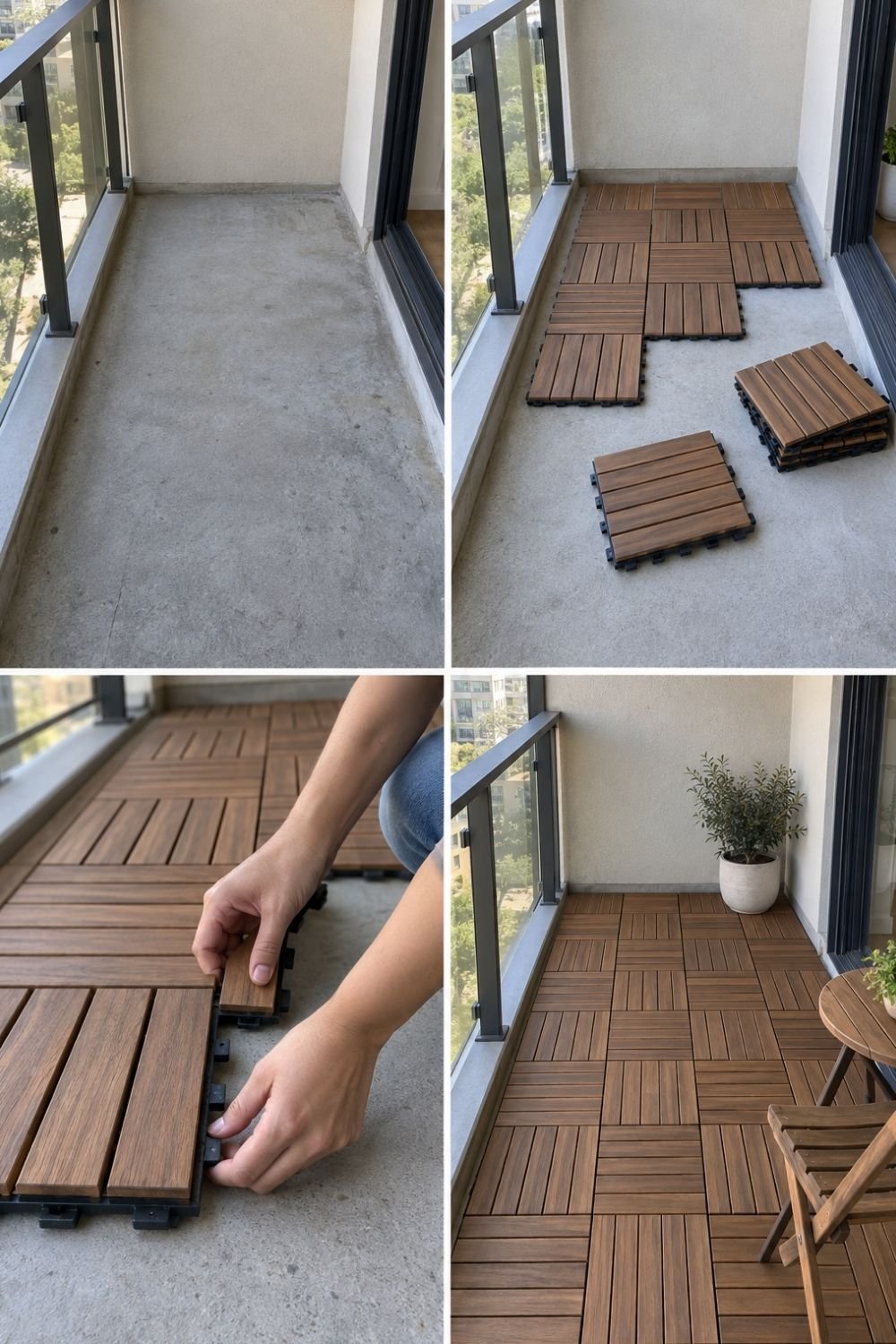
Photo by OurHoneyHome
The four frames above are one narrow balcony going from bare gray concrete to a finished wood floor. The tiles come in stacks, get laid out loose first to work out the pattern, then snap into each other by hand along the plastic grid on the back. No adhesive, no cutting, nothing fixed to the building.
Measure and divide by the tile size before you order, because most are 30 by 30 cm and you’ll want a few spare. Lay them from the door outward, so the neat edge is where you look and the awkward strip ends up against the far wall where the planter goes.
They lift out in ten minutes on moving day and go in a bag. That’s the whole appeal.
Everyone can see in, and you’re not allowed to drill
The second thing that stops people using a balcony isn’t the floor. It’s the feeling of sitting in a display case, especially on a low floor or when the building opposite is close.
Landlords say no to screws, which rules out almost every privacy screen sold for this. Zip ties don’t need permission.
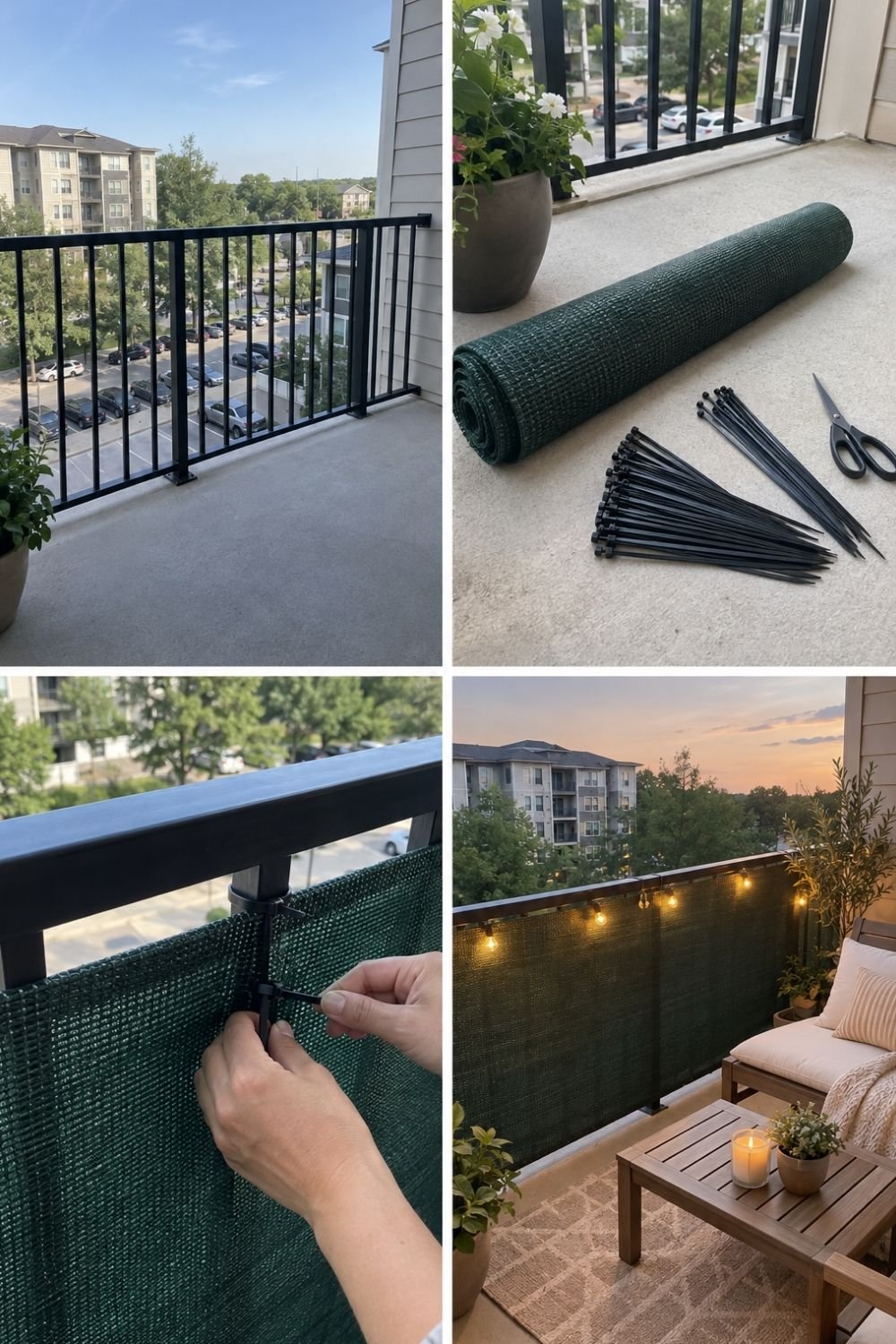
Photo by OurHoneyHome
Above, a balcony that looked straight into a car park gets a roll of dark green shade mesh, a bag of black zip ties and a pair of scissors. The mesh goes on the inside of the railing, the ties go through the weave every 20 cm or so, and the tails get snipped flush. The last frame is the same balcony at dusk, screened, with string lights up and a lounge chair that now makes sense to sit in.
Buy the mesh slightly taller than the railing and let it sit a few centimeters above the top rail, because a screen that stops short of the handrail always looks like a fence repair. Black or dark green disappears; beige shows every mark.
One caution worth knowing: solid panels catch wind like a sail. Mesh with an open weave lets air through, which is why it survives a storm when a bamboo roll doesn’t.
Furniture that folds beats furniture that fits
Most small balcony decor advice tells you to buy smaller furniture. I’d rather buy furniture that disappears.
A balcony has two completely different jobs. On a Tuesday evening it’s one chair and a coffee. On a Saturday it’s four people. Fixed furniture can only do one of those, and a narrow balcony with a permanent bistro set on it means squeezing past the chairs every time you water a plant.
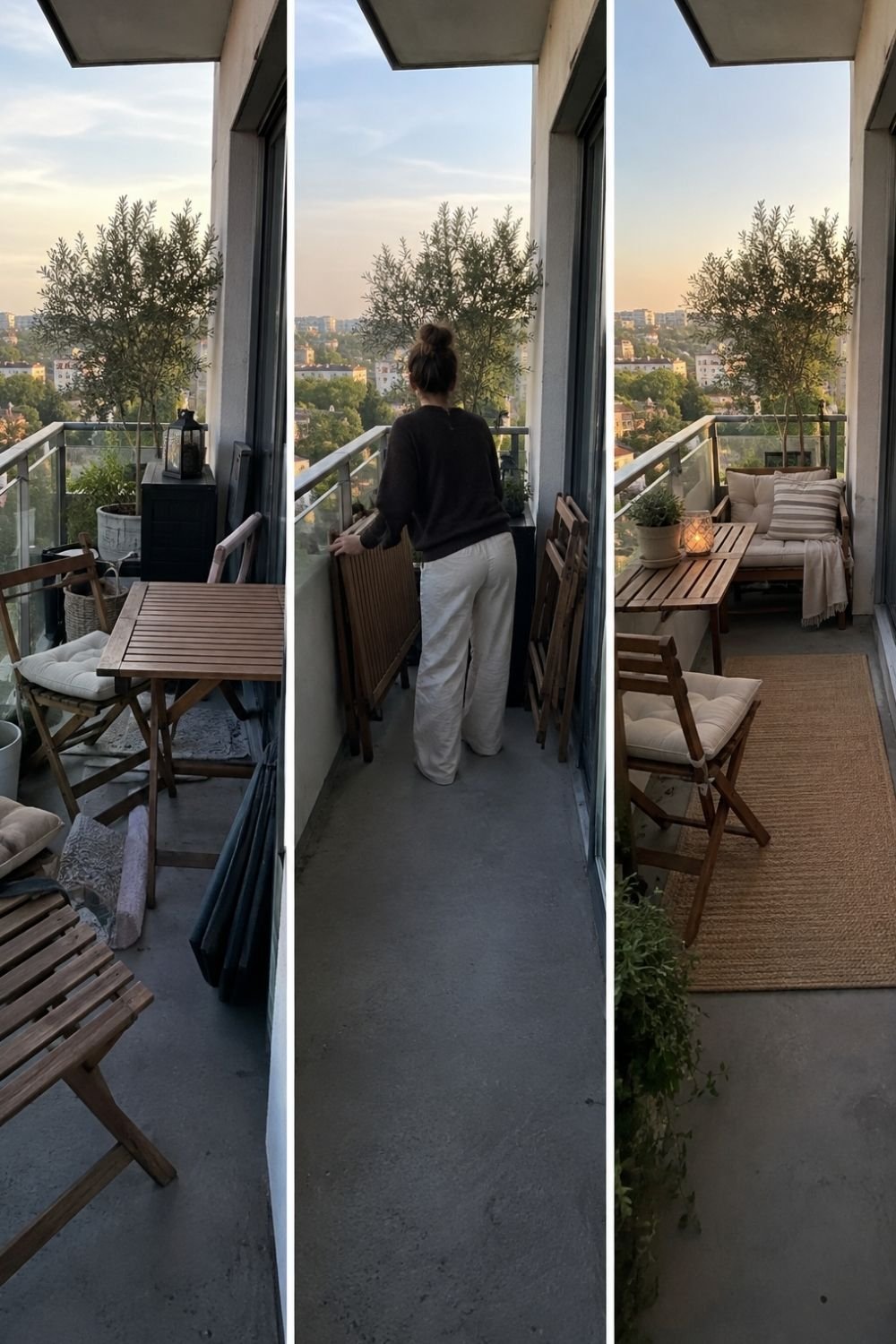
Photo by OurHoneyHome
These three frames show the difference on a long, narrow balcony. First it’s cluttered: table out, chairs at angles, cushions on the floor, nowhere to walk. Then the chairs get folded flat and leaned against the end wall. In the last frame the balcony is calm, with a jute runner down the middle, a bench with a throw at the far end, an olive tree in the corner and a lantern on the side table.
Same objects. Different evening.
Folding chairs with slatted seats and a tied-on cushion are the version I’d buy, because they dry fast and stack four deep in about 15 cm of depth.
A concrete box needs softening, not more furniture
Once the floor is covered and the railing is screened, the temptation is to buy more things. What the space actually needs at this point is texture, and mostly at eye level and above.
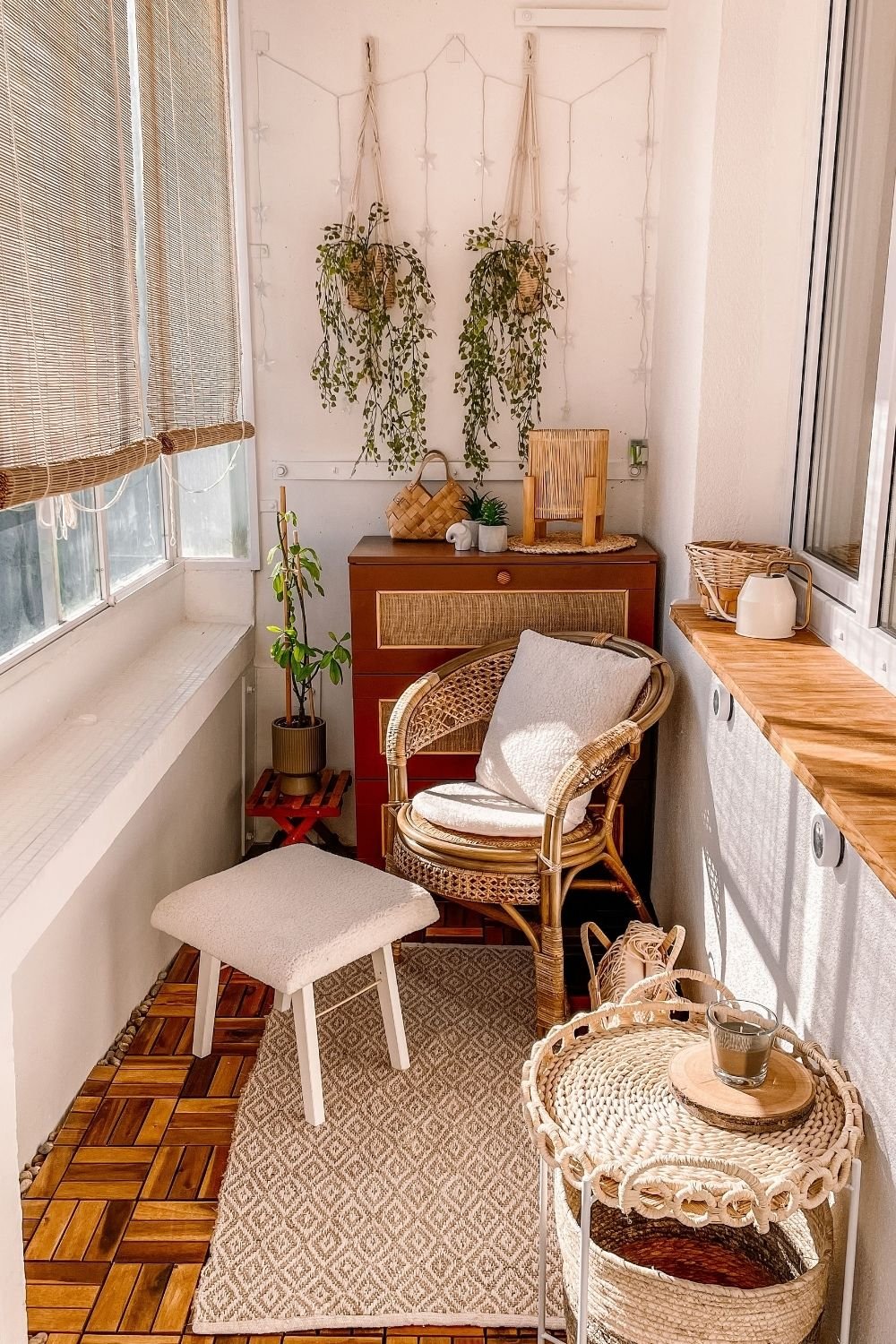
Photo by Kejmy Tatranská on Pexels
This enclosed balcony is a good lesson in layering. Wood tiles on the floor, a diamond-weave jute rug over them, a rattan armchair with a bouclé cushion, a small stool, a basket side table with a tray on top, two trailing plants hanging from macramé at the top of the wall, a star light string across it, and bamboo blinds at the window. The dresser is an old indoor piece that ended up out here.
Notice how much of that is hung rather than stood. Trailing plants at head height do more for a narrow space than the same plants on the floor, because they fill the volume nobody was using and draw your eye up instead of along.
For hanging things with no drilling, tension rods between two side walls and adhesive hooks rated for outdoor use both work. I’d test any adhesive hook with something worthless before I trusted a plant to it.
The seating I’d build if I wanted more than two chairs
If the balcony is wide enough for a proper sofa, buying one is expensive and moving one is worse. Pallets are the budget answer, and they’re a genuinely good one.
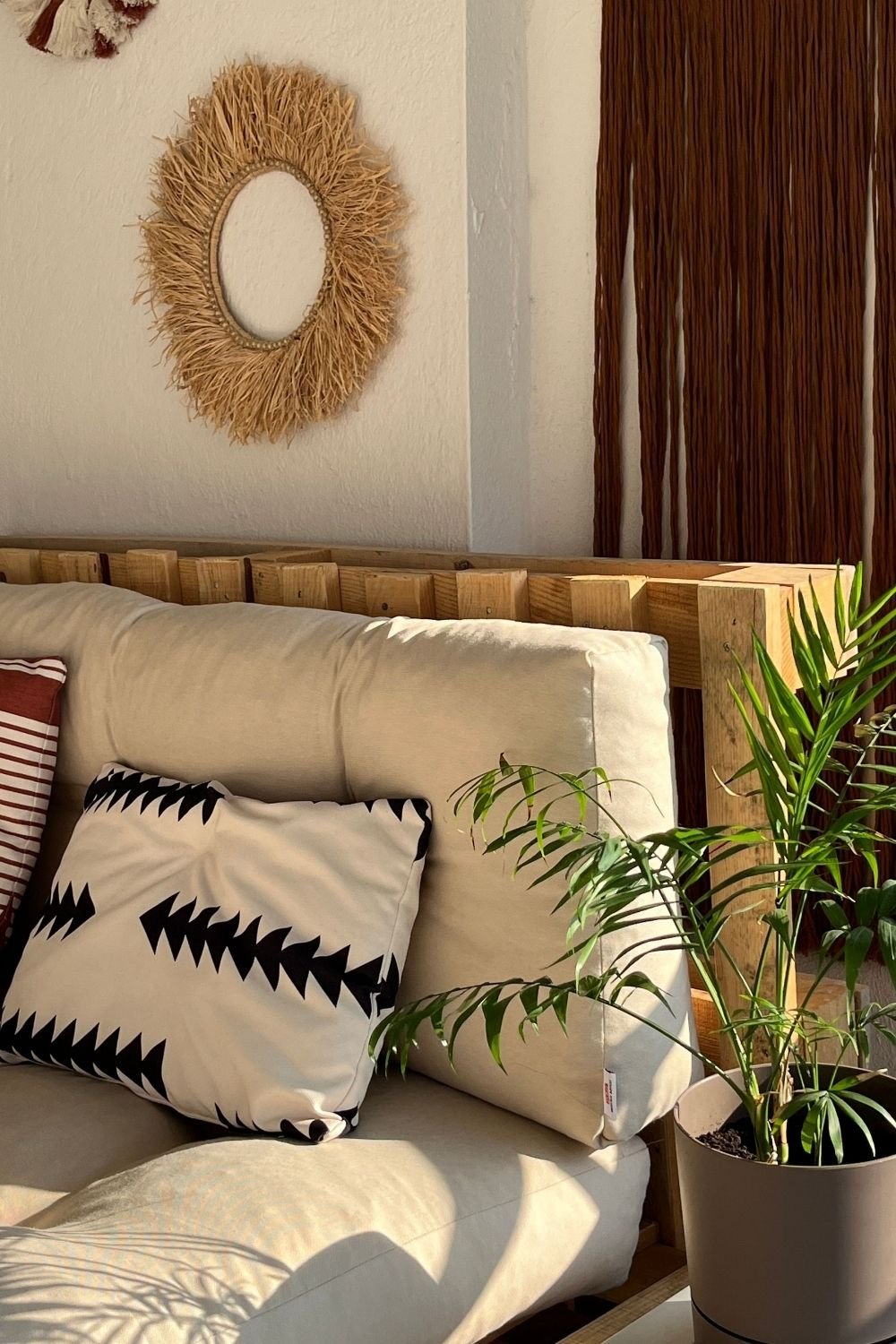
Photo by Mine Canan Göldaf on Pexels
Here two stacked pallets carry a deep seat cushion and a tall back cushion, with a striped rust pillow and a black-and-cream patterned one on top. Above it, a raffia-fringed round mirror and a long rust textile hang on the plaster, and a palm sits in a matte planter beside it.
Three things make this work rather than look like a student project. The cushions are proper outdoor foam rather than folded blankets, the pallets are sanded and left bare instead of painted, and the wall behind gets something on it so the seat isn’t floating against blank plaster.
A mirror outdoors is a trick I’d use on any dark balcony. It doubles whatever light reaches the space and makes a 1.2 meter depth read as more.
Lighting decides whether you use it after work
This is the part that gets skipped, and it’s why so many finished balconies only get used at weekends. Most of the year, the only free time anyone has is after dark.
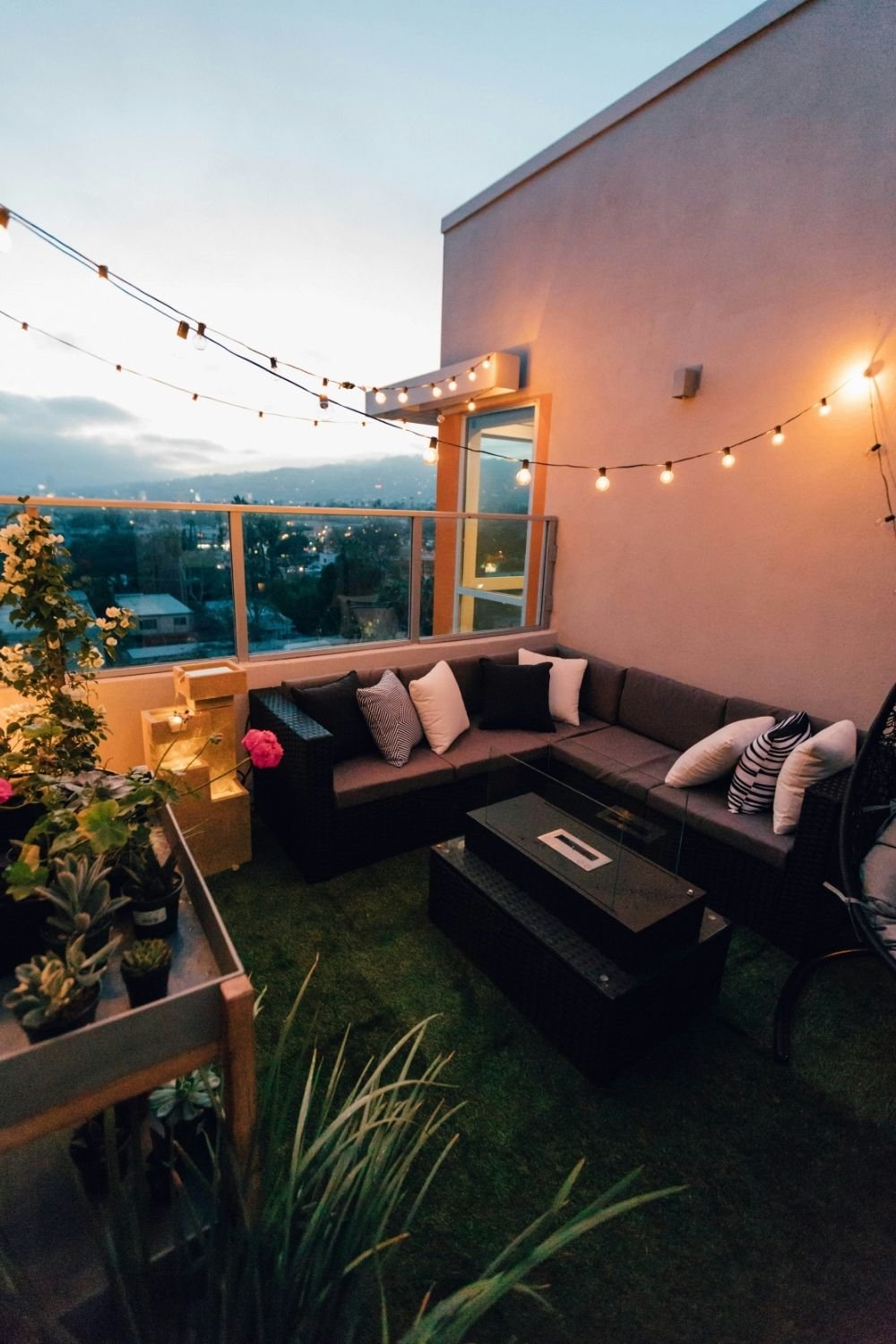
Photo by Roberto Nickson on Unsplash
This one is doing exactly what I’d copy. Two runs of warm festoon bulbs cross the space at different heights, one along the wall and one out over the seating, with a dark rattan sectional underneath, artificial turf on the floor, a low fire table, a lantern on a crate and planters of succulents along the edge. The city is going dark behind it and the balcony is the brightest thing in the frame.
Warm bulbs only, and at least two runs at different heights. A single string along one wall lights a wall; two crossing runs light the space between them, which is where people sit.
Solar versions have got much better, and they save an extension lead trailing through the door. I’d still choose a plug-in set if a socket is reachable, because solar gives up in February exactly when you’d want the light most.
Room for a table for two, even on the narrow ones
Almost every apartment balcony can seat two people at a table. The mistake is buying a table sized for a garden.
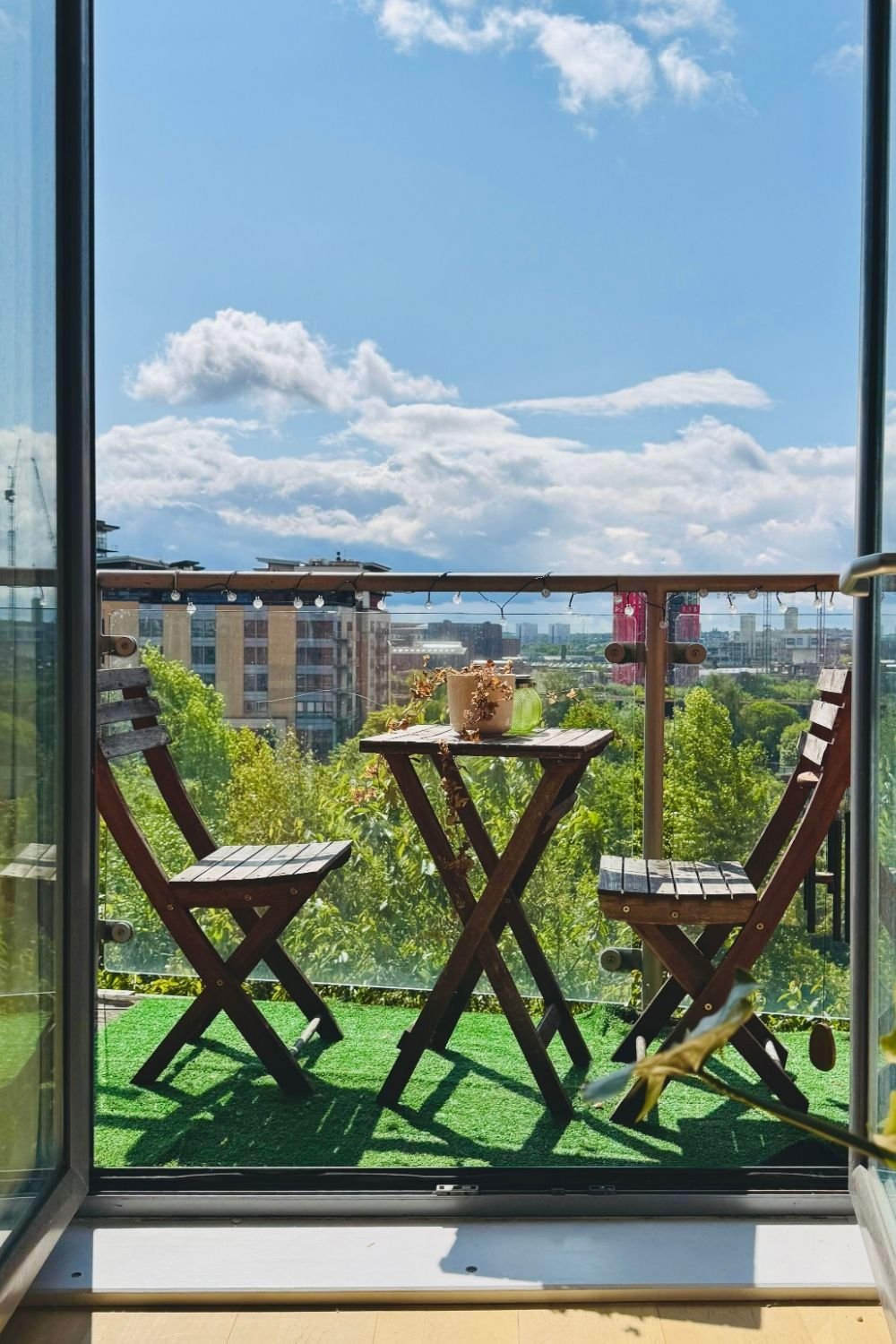
Photo by Obsolete Lense on Pexels
Seen through the open doors here: a small folding wooden bistro table with two matching chairs, a potted plant on the top, festoon lights along the railing, artificial grass on the floor and a glass balustrade that keeps the view of the treetops and the city. The whole arrangement takes maybe a meter and a half.
A square table of 50 to 60 cm seats two comfortably and folds against a wall. Anything bigger is an obstacle for the 360 days a year you aren’t having breakfast out there.
The glass railing is a reminder that not every balcony needs screening. If what’s behind you is trees and sky, leave it open and put the privacy budget into lighting.
What it looks like when all of it is done
None of the above is dramatic on its own. Together they add up to a space that stops being a ledge.
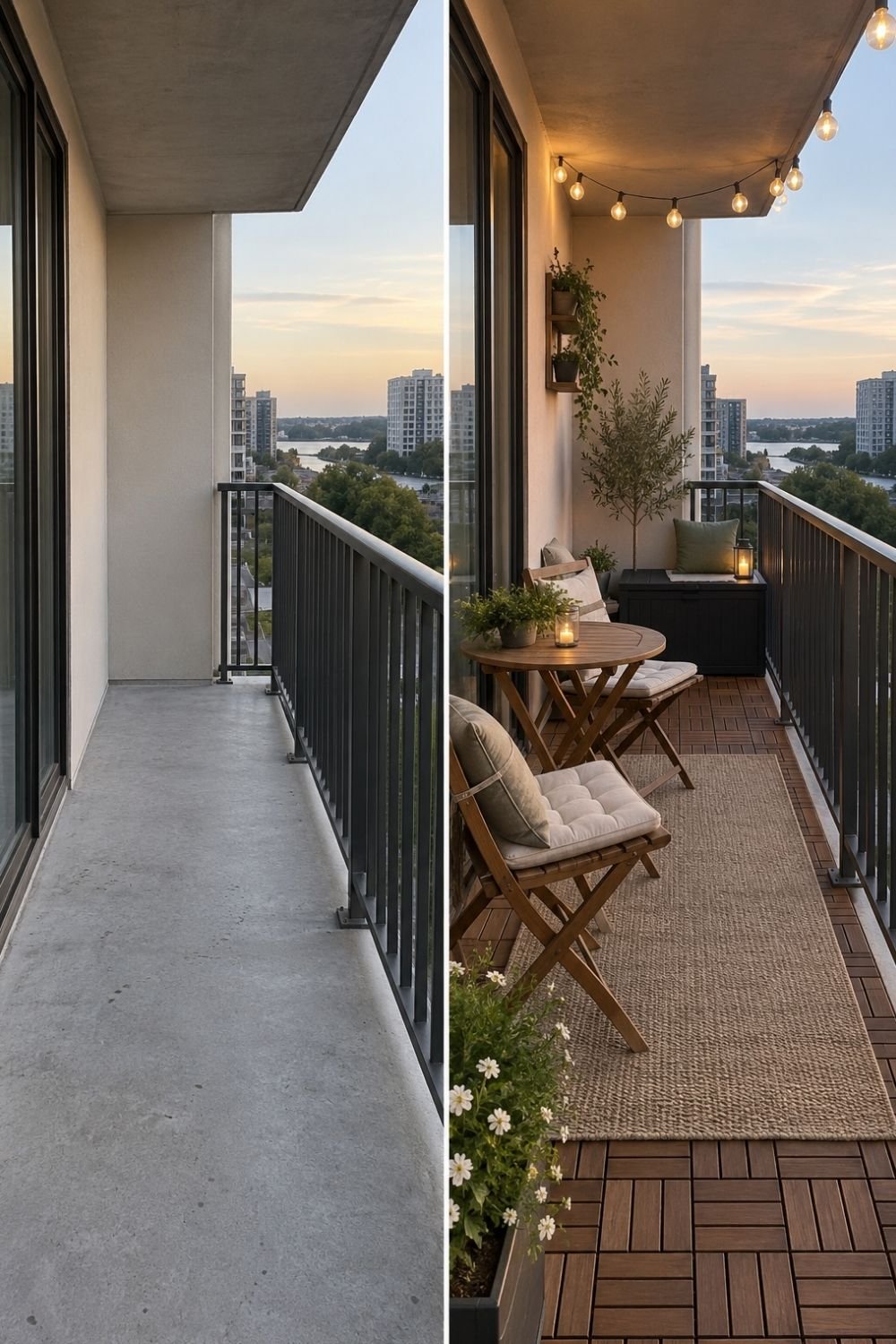
Photo by OurHoneyHome
The two halves above are the same narrow apartment balcony. On the left: bare concrete, a plain dark railing, nothing else. On the right: wood deck tiles across the floor, a flat jute rug over them, a folding table and two chairs with tied-on cushions, a black storage bench along the railing, a small olive tree, a wall-mounted planter with trailing greenery, a lantern and festoon lights along the underside of the ceiling.
Everything on that right-hand side is renter friendly. The tiles lift, the rug rolls, the chairs fold, the planter hangs on a hook, the lights come down with the hooks, and the storage bench is where the cushions live when it rains.
What I’d skip, and what comes with me
Two things I wouldn’t buy for a rental balcony. Anything that needs fixing into the wall or the floor, obviously. And anything sized to this specific balcony, because the next one will be a different shape.
That’s the quiet argument for all of this. Tiles, a rug, folding chairs, a storage bench, planters and lights work on a 1.2 meter ledge and on a 4 meter terrace, and they fit in the same van as the sofa. I’d spend the money there rather than on a built-in bench I’d be leaving behind, the same way I’d approach a rented kitchen or a room in halls.
Start with the floor, screen the railing, get one light string up, and put a plant somewhere above eye level. That’s a weekend, and it’s most of the difference.
