Short answer: yes, and not really because of the wood itself. What warms up a bedroom is having one large, continuous surface behind the bed instead of a flat painted wall. A bed pushed against bare plaster always looks like it’s floating in the room, waiting to be moved. Put something solid behind it and the whole arrangement settles.
Wood happens to be the best material for that job. It brings grain and shadow at a scale you can see from the doorway, it takes the chill out of a white room without adding a single color, and it quietly absorbs a bit of sound, which matters more in a bedroom with hard floors than anyone expects.
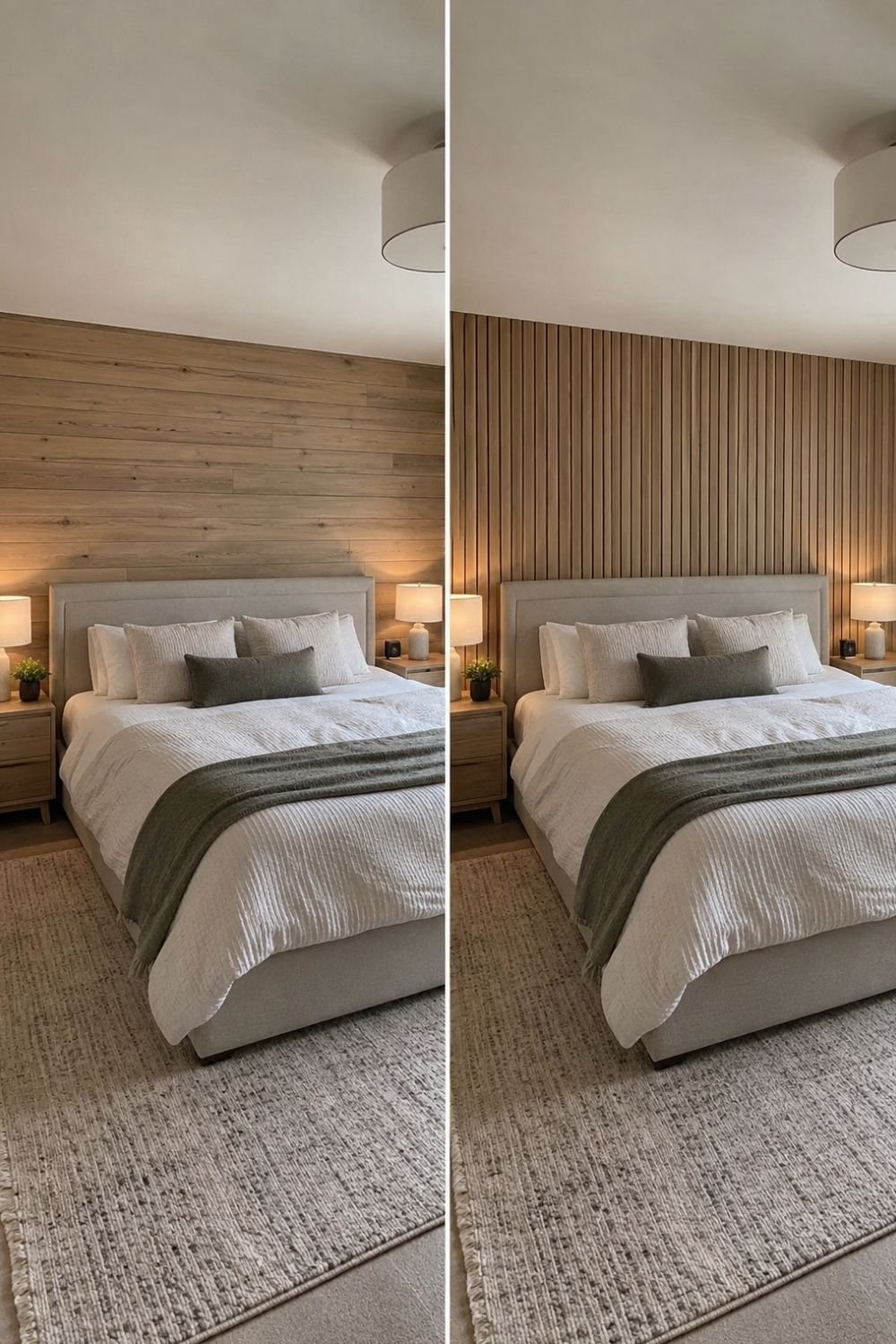
Photo by OurHoneyHome
The two frames above show the same bedroom with two different wooden headboard designs. On the left, horizontal reclaimed planks in a warm mid-brown run across the wall; on the right, narrow vertical slats cover the same area. Identical bed, identical bedding, identical lamps. The planks feel rustic and wide, the slats feel taller and calmer, and both are more interesting than the beige wall would have been.
The simplest version is one solid panel
Of all the wooden headboard designs here, this is the one that needs no building. If you only want one piece of furniture rather than a building project, a single wood panel behind the bed does most of the work. It can be fixed to the wall just above the mattress, or bolted to the bed frame in the usual way.
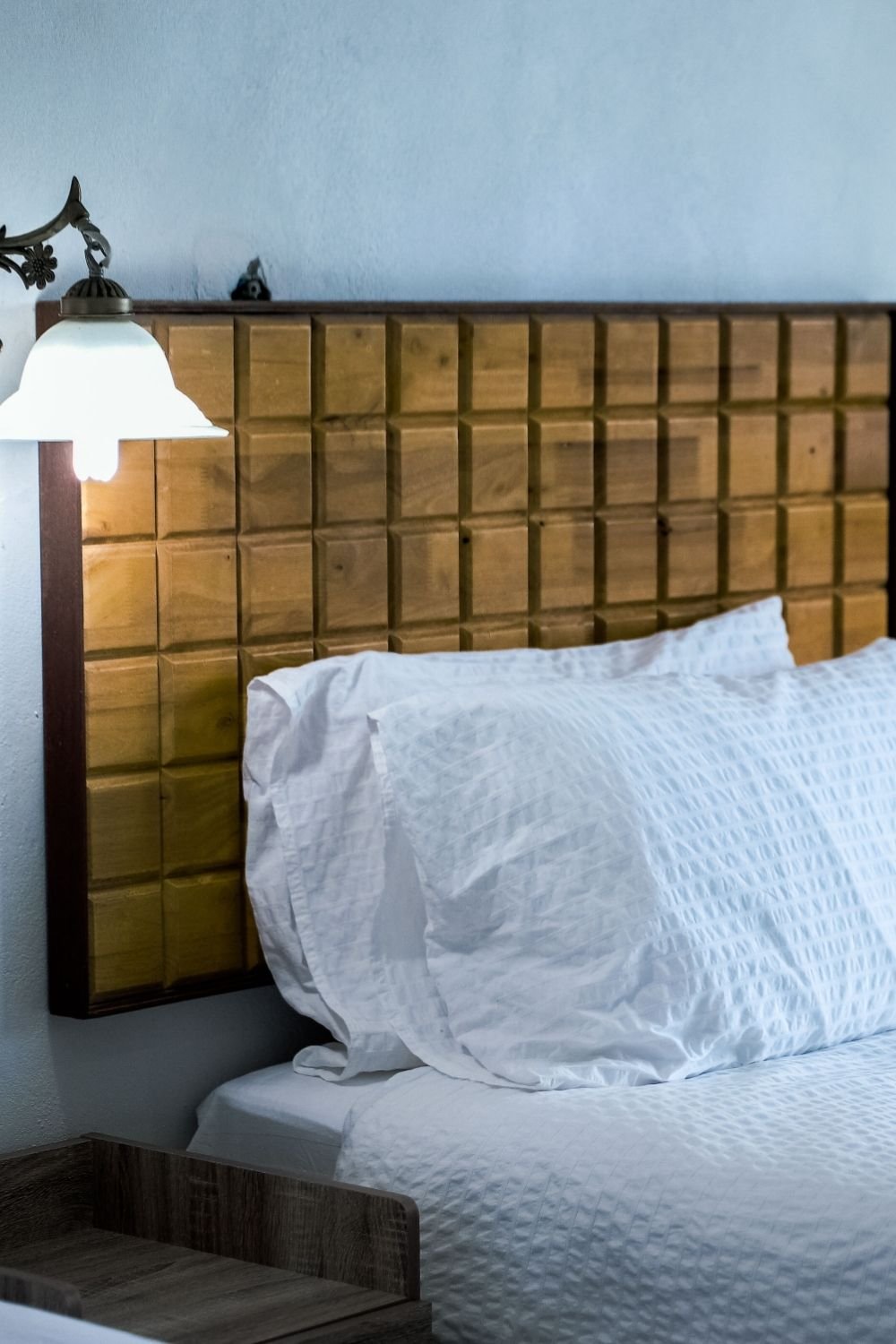
Photo by Donald Tong on Pexels
This one is a grid of shallow carved squares in honey-toned pine with a darker frame around the edge, mounted straight onto a pale blue wall with an old brass sconce hanging over one corner. It’s a good example of how much a bit of relief adds. A completely flat board would have looked like a door; the carved squares catch the light from the lamp and give the panel some depth.
Panels like this are also the easiest thing to buy secondhand. Old cupboard doors, a section of paneling from a salvage yard or a solid tabletop turned on its side all work, as long as the edges are sanded and the back is flat enough to sit against the wall.
Slatted walls, and why they read as calm
Vertical slats are the most popular bed head wall design going, and the reason is the rhythm. Dozens of identical narrow lines give the eye something regular to rest on, and the thin shadows between them change through the day.
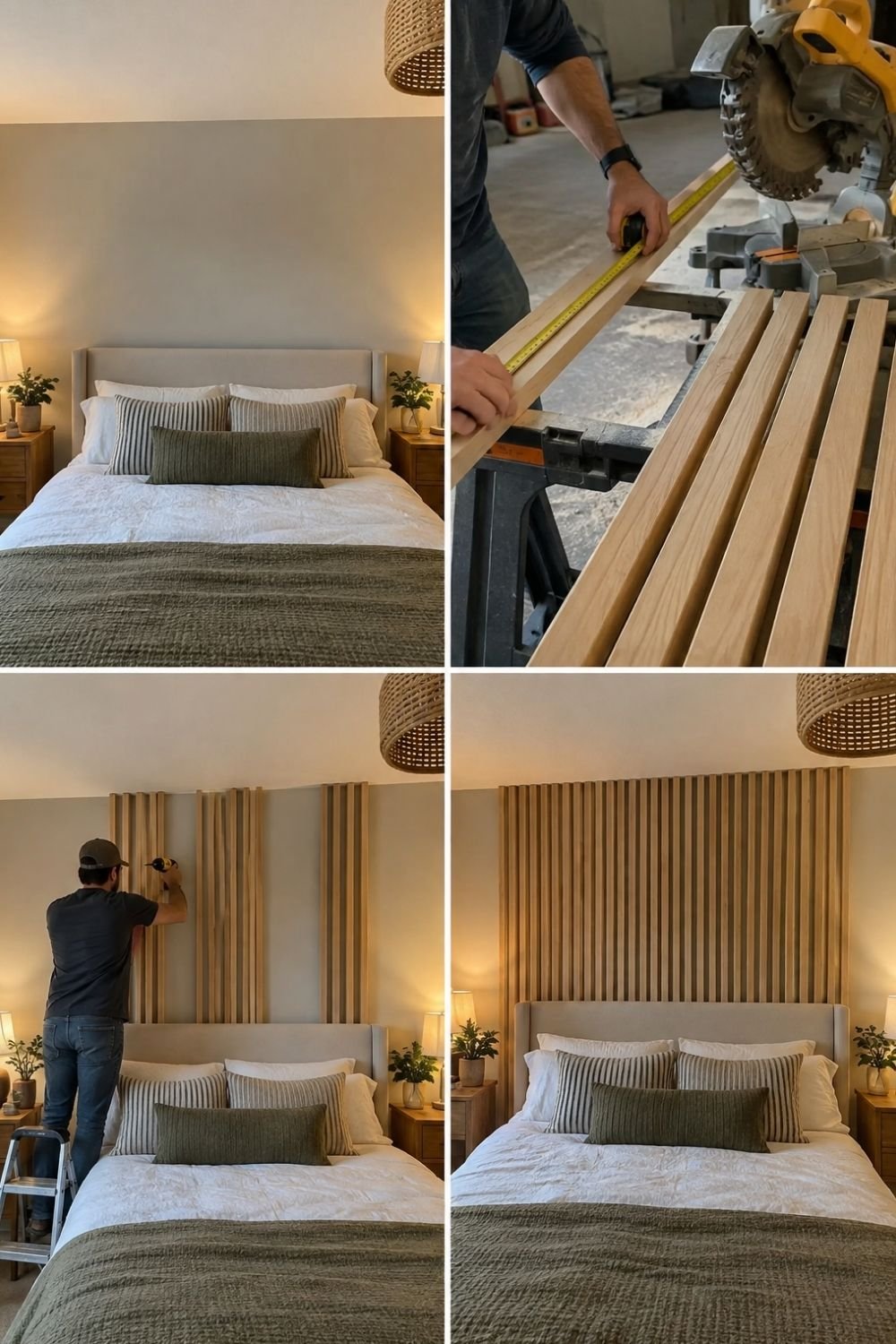
Photo by OurHoneyHome
The four frames above show one going up. The bedroom starts with a plain upholstered bed against a beige wall, then oak battens are measured and cut to length on a mitre saw, then they’re fixed to the wall one by one above the headboard, and in the last frame the finished panel runs from just above the bed to the ceiling, the full width of the bed and a little beyond.
Two things make this look right. First, the slats should be evenly spaced, with the gap either equal to or narrower than the batten itself. Second, take the panel higher than feels necessary. Stopping at picture height makes it look like a shelf backing; running it to the ceiling makes it look built in. If you’d rather not drill into the wall, the same battens can be screwed onto a plywood backing board and hung as one piece.
Reclaimed planks, for something rougher
If slats feel too tidy, planks go the other way. Mixed widths, visible knots and an uneven top edge look handmade rather than ordered from a catalog.
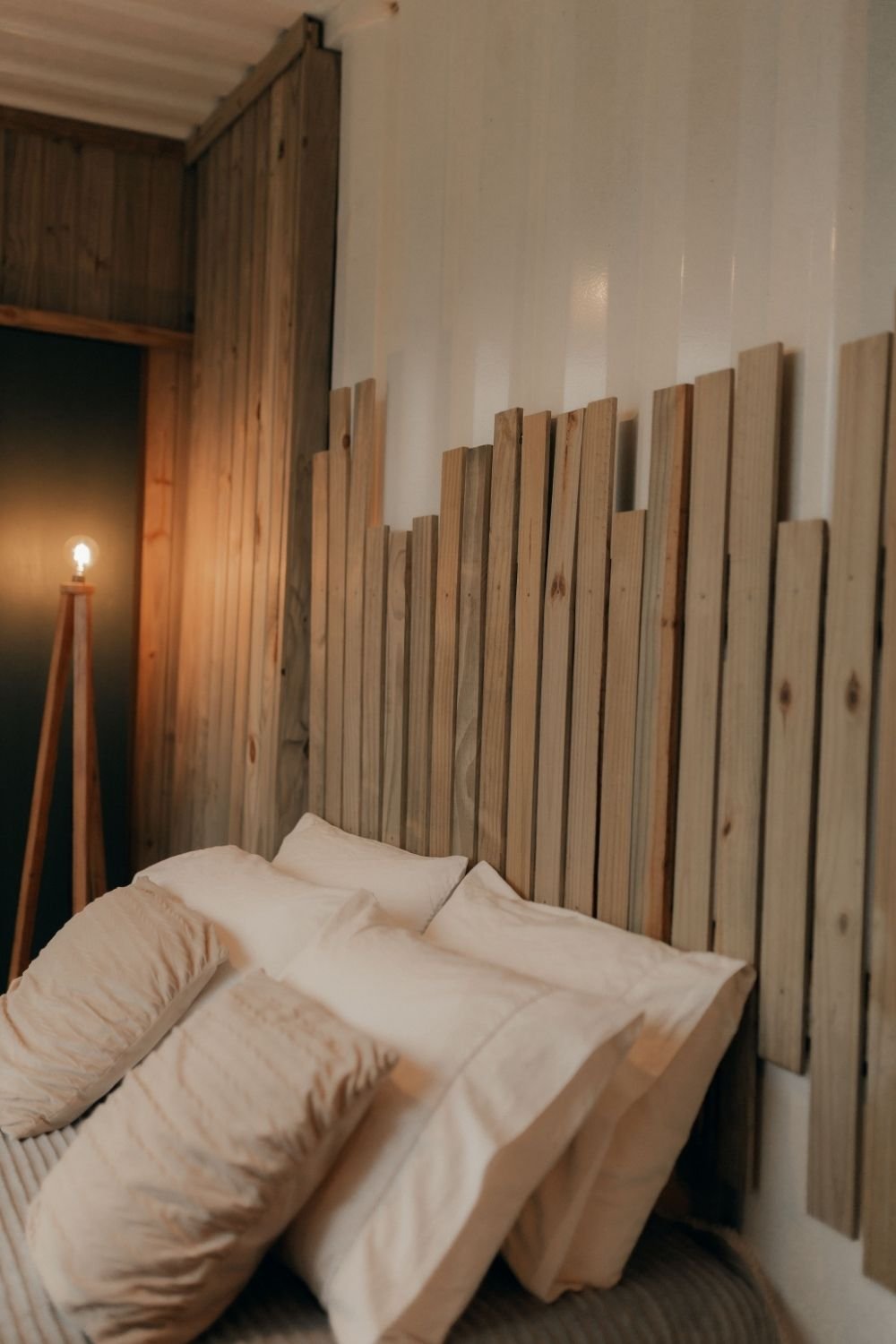
Photo by Alexander Mass on Pexels
Here rough pine boards of different lengths stand upright behind the bed, deliberately cut to a staggered top line so the headboard has a silhouette instead of a straight edge. The bedding is plain cream, the wall above is white, and there’s a wooden tripod lamp glowing in the corner. It’s the cheapest headboard in this post by some distance, and it’s the one with the most character.
If you build one, sand the edges properly and seal the wood with a clear oil or matte varnish. Reclaimed timber is lovely until it snags the bedding, and untreated pine yellows over a couple of years.
The full wall version, with light and storage
The most built-in option treats the whole wall behind the bed as one piece of joinery, which is where headboards start to earn their keep practically as well as visually.
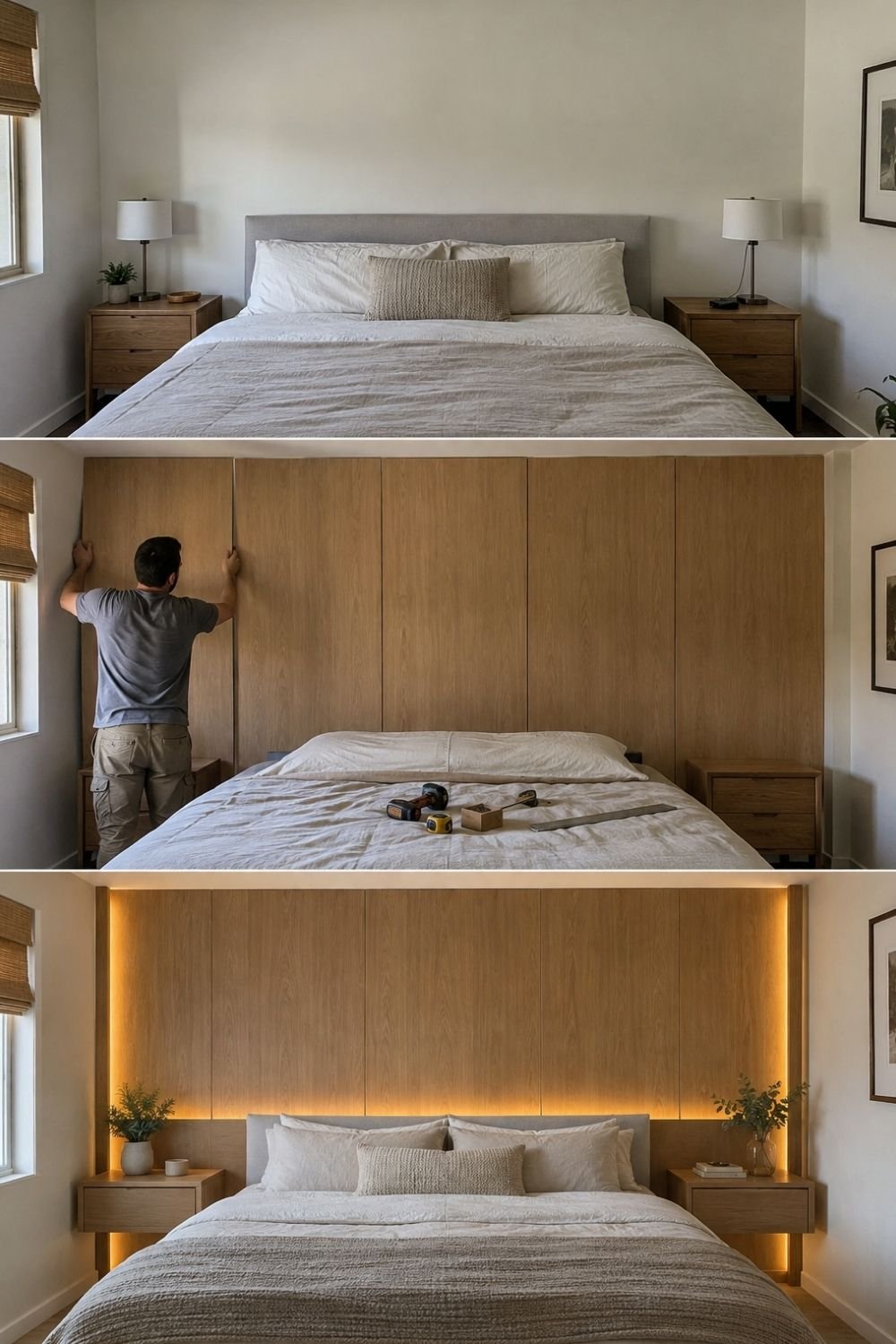
Photo by OurHoneyHome
The three frames above show a plain bedroom with a gray upholstered bed, then large oak veneer panels being fixed across the full width of the wall, and finally the finished result: the panelled wall runs almost to the ceiling with two floating oak nightstands cantilevered out of it, and a warm LED strip hidden behind the top edge and under the nightstands, washing light up the wall and down onto the floor.
That hidden strip is the detail worth stealing. Concealed lighting behind a wood panel gives a bedroom a gentle glow with no visible fixture, and on a dimmer it doubles as a night light. Floating nightstands attached to the panel also free up the floor, which makes the room easier to clean and look bigger.
How high, how wide, how thick
Most bed headboard ideas fall down on proportions rather than materials. A headboard that’s the same width as the mattress looks slightly mean. Add 10 to 20 cm on each side, or run it to the full width of the wall if you’re panelling. Height depends on what you want it to do: for sitting up in bed, the top edge wants to be 55 to 70 cm above the mattress, which lands somewhere between shoulder and head height for most people. Purely decorative panels can be lower, and full-wall designs simply go to the ceiling.
For thickness, anything from 18 mm plywood up to a 40 mm solid panel is fine; the depth matters less than how it’s fixed. French cleats are the neatest method, since the board lifts off for painting and the fixing disappears behind the panel. Whatever you use, go into studs or masonry rather than trusting plasterboard anchors with a heavy board and someone leaning back on it every night.
Wood and fabric together
The mix of the two is often more comfortable than wood alone, because you get the warmth of the panel with something soft where your back actually lands.
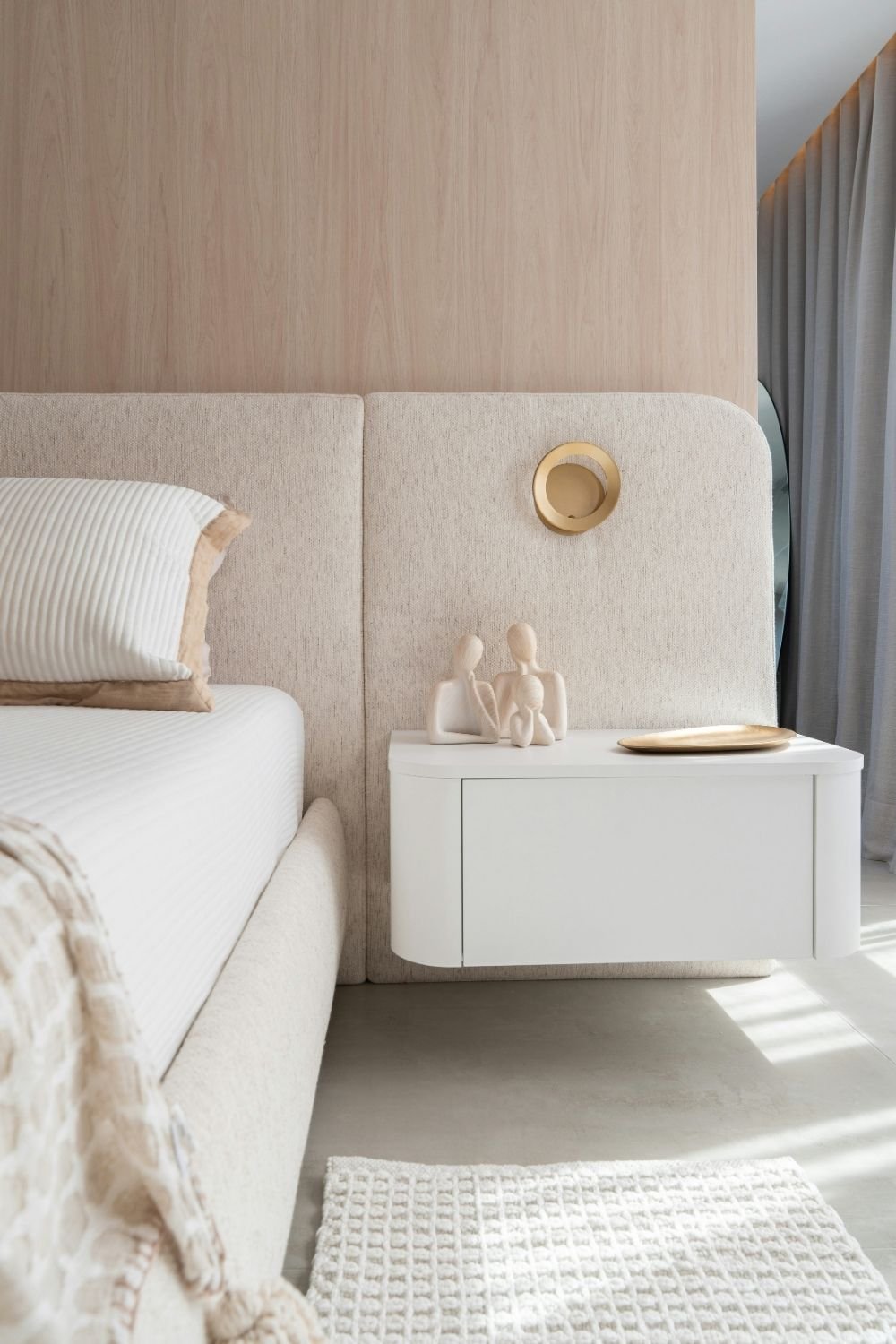
Photo by Caroline Badran on Unsplash
This bedroom layers both: a pale oak panel covers the upper wall, and a wide, rounded oatmeal upholstered headboard sits in front of it, with a small brass disc sconce mounted right on the fabric and a rounded white floating nightstand tucked alongside. The palette is three shades of beige, and it works because the textures are so different.
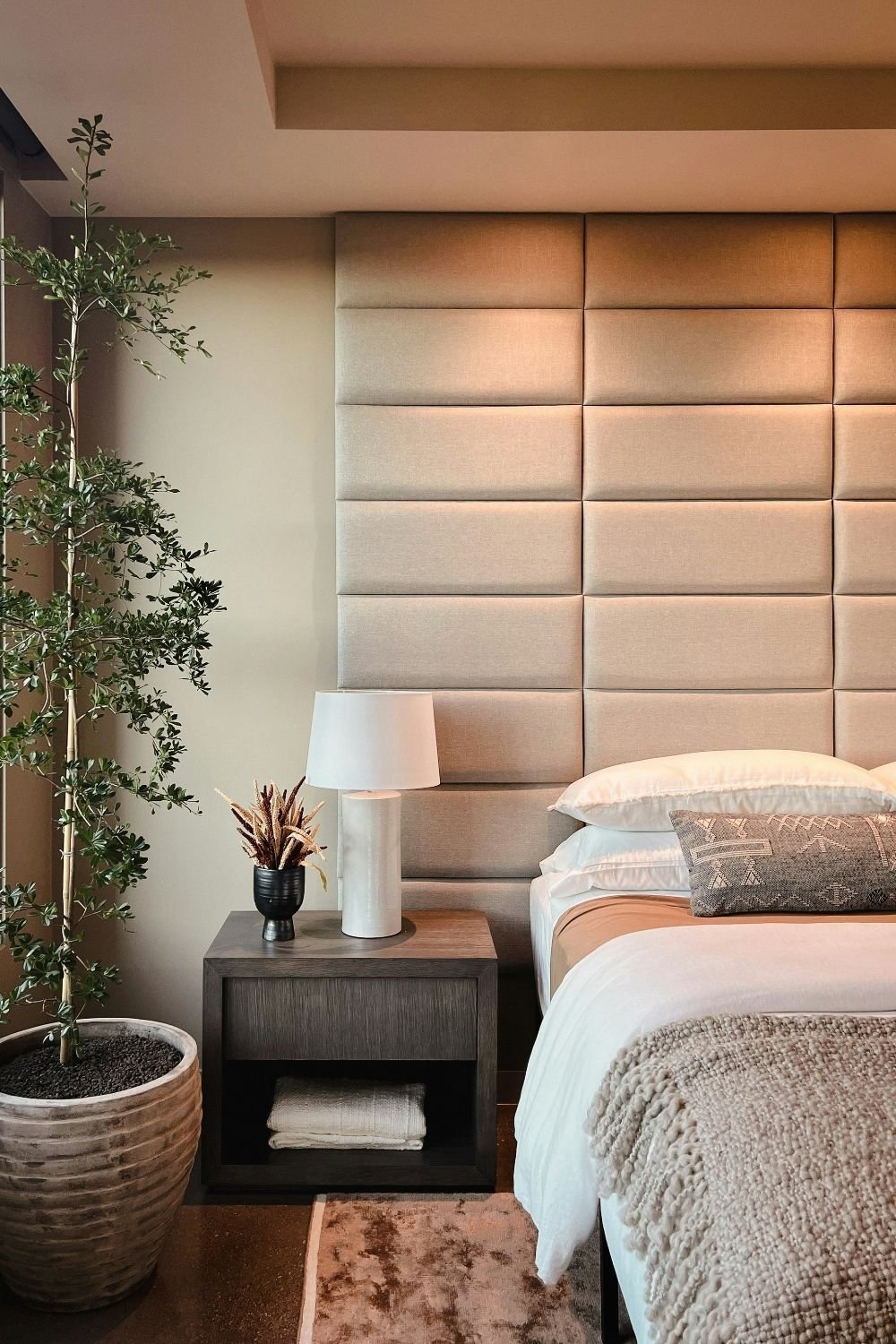
Fabric can also take over the whole wall, as it does here: tall padded panels in a warm sand linen cover the bed head wall from the floor to well above head height, with a dark wood nightstand, a marble lamp and a potted olive tree beside them. It’s the same idea as the wood panelling, just softer and better for sound, and it’s the version I’d choose in a flat with thin walls or a neighbour on the other side.
A weekend DIY: the plywood arch
If you want a project that takes a Saturday rather than a holiday, a shaped plywood board is hard to beat.
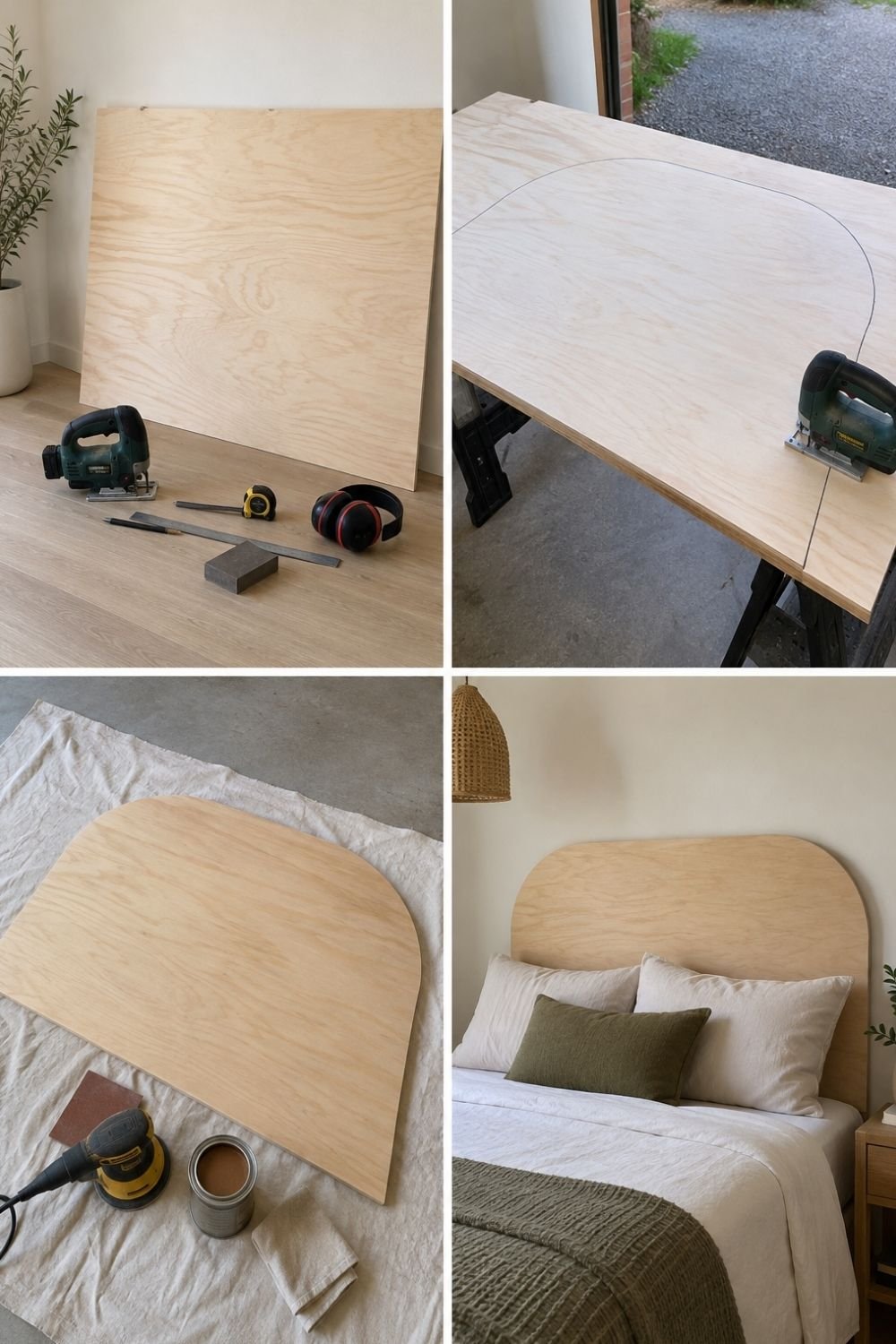
Photo by OurHoneyHome
The four frames above cover the whole build: a sheet of birch plywood leaning against a wall with a jigsaw, tape measure and ear defenders; the arch drawn on in pencil and cut with the jigsaw; the cut board being sanded, with a tin of oil ready; and the finished headboard mounted behind a bed with cream linen and an olive cushion.
Draw the curve with a length of string and a pencil, or trace round something large and round. Cut just outside the line, sand back to it, then round over the front edges with sandpaper so the plywood edge feels finished. Two coats of clear oil is enough. It costs about as much as a sheet of plywood and an afternoon.
Small rooms and rentals
In a small bedroom, thin is the priority. A 12 to 18 mm board wall-mounted behind the bed takes no floor space at all, whereas a chunky frame-mounted headboard can push the bed 10 cm further into the room, which matters when the walkway is already tight. A pale wood also keeps the wall bright, while a dark panel works better in a bigger room or when the rest of the wall is light, in the same way a black accent wall needs light around it.
Renting doesn’t rule any of this out. A plywood panel or a slatted board can be made as one freestanding piece and simply wedged between the bed and the wall, held in place by the weight of the bed. Peel-and-stick slat panels exist too, and for the softest option, a length of fabric-covered board propped behind the mattress gives the same effect with no fixings at all. For more ideas on making a bedroom feel finished without building anything, the dreamy bedroom styles post covers the textile side of it, and if you’re tempted by something graphic instead of wood, the 70s wall designs post has painted alternatives.
Which one I’d choose
Of the headboard design ideas above, this is how I’d match them to rooms. For a rental or a first attempt, the plywood arch: cheap, quick and easy to take with you. For a room that feels cold or echoey, slats or padded panels, since both soften the sound as well as the look. For a cottage or a room with beams, reclaimed planks with a staggered edge. And for a bedroom you plan to keep for years, the full wall with hidden lighting and floating nightstands, because it solves the headboard, the bedside tables and the lighting in one go.
Whichever you pick, the thing that makes a bedroom feel warmer isn’t the joinery. It’s that the bed finally looks like it belongs where it stands.
