Art Deco in its original form is a lot. Stepped mirrors, sunburst everything, chrome and black lacquer stacked until a room looks like a film set. Beautiful in a hotel lobby, exhausting at home.
Neo deco interior design keeps the parts that still work and drops the costume. The geometry stays, the materials stay, the ornament comes right down, and the palette gets updated to something you’d actually live with. What you end up with is a room that reads as considered rather than themed.
The shapes that do the work
Nearly all of it comes down to five recurring forms. Get two or three of them into a room and the style is legible without a single period antique.
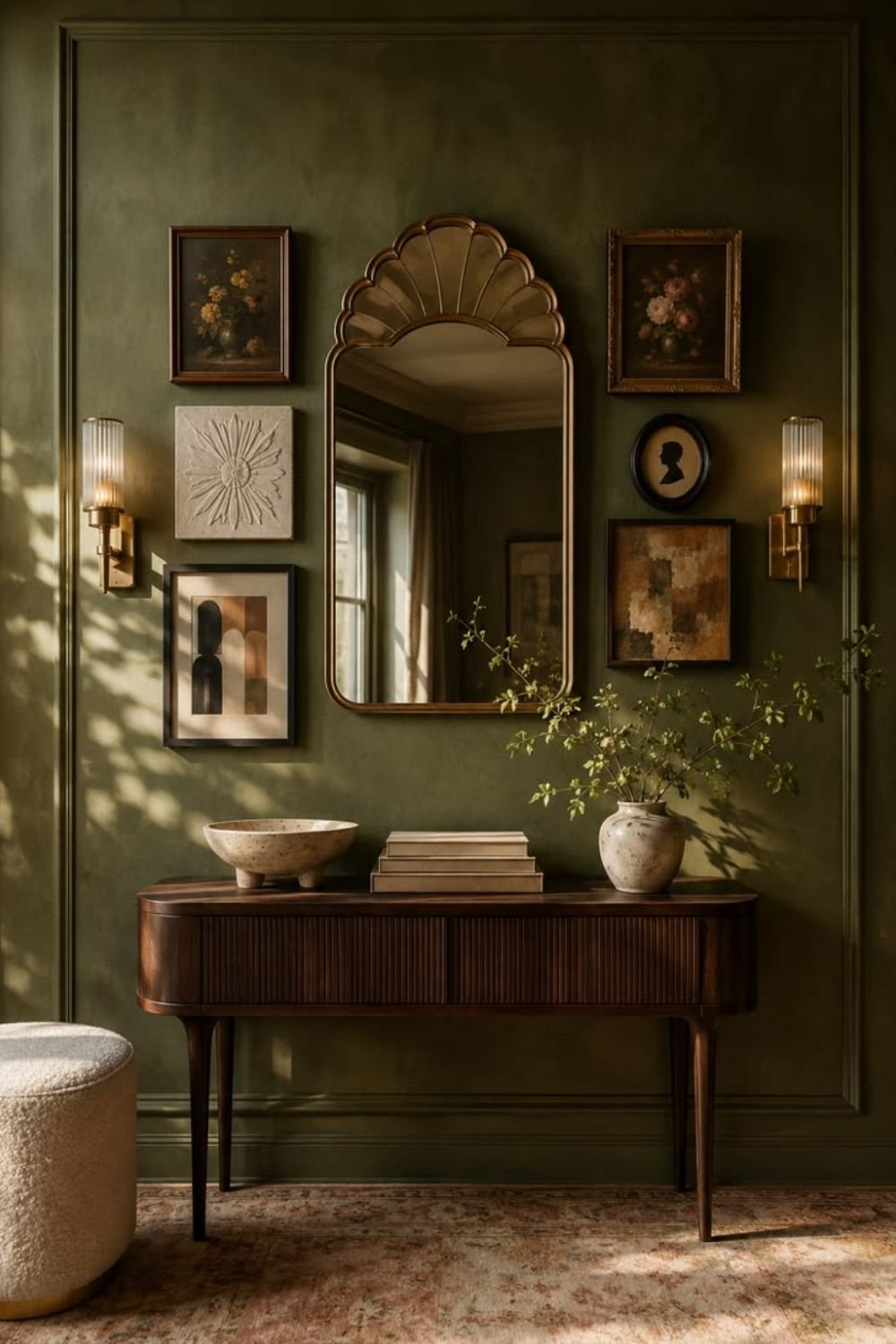
Photo by OurHoneyHome
This entryway is a compact lesson in all of them. Olive plaster walls with recessed panel moulding, a brass mirror with a scalloped shell arch at the top, fluted brass sconces either side, and a dark wood console with a reeded front and a rounded end, standing on slim tapered legs. The gallery wall mixes vintage oils, a carved plaster rosette tile and a graphic arch print.
The forms to look for:
- The arch, on mirrors, doorways, niches and the tops of headboards
- The scallop or fan, usually on one piece only, as the decorative flourish
- Fluting and reeding, vertical ribs on cabinet fronts, tubs, lamp bases and side tables
- The circle, in round tables, drum stools and globe lighting
- The stepped or tapered line, in legs, plinths and layered light fittings
The console above carries three of the five by itself, which is why one piece of furniture can set the tone for a whole hallway.
What’s missing is as telling as what’s there. No stepped mirror, no sunburst clock, no chrome. A period deco hallway would have had at least two of those, and leaving them out is most of what makes this neo deco rather than a reproduction.
Brass is the metal, but pick one finish and stay there
Deco ran on chrome and nickel as much as brass. Neo deco leans warm, and the single fastest way to lose the look is to mix three metal finishes in one room.
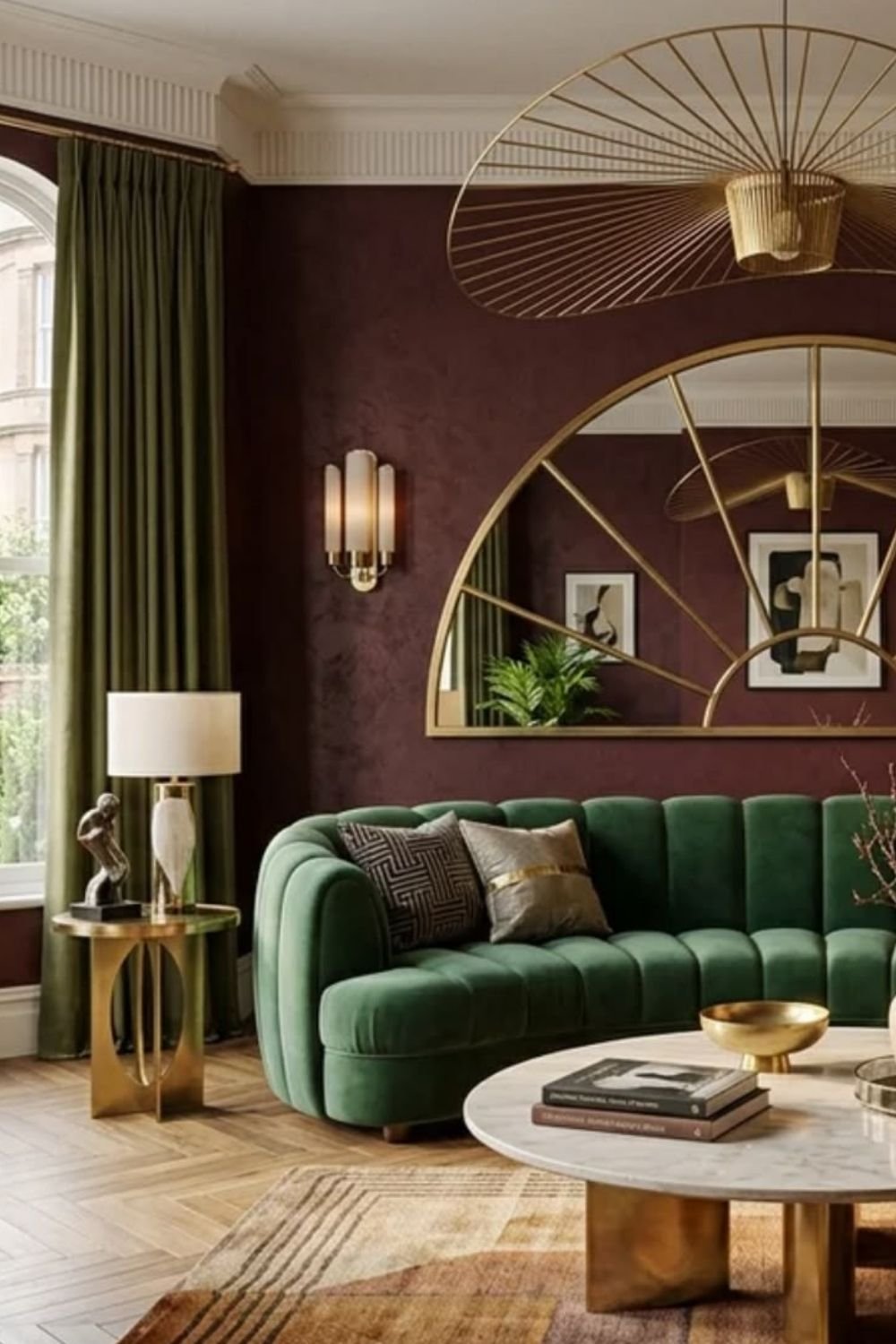
Photo by OurHoneyHome
Look at how consistent this living room is. A plum wall, olive velvet curtains, a green velvet channel-tufted curved sofa, and then brass on the fan pendant, the arched fan mirror, the tube sconce, the side table frame and the base of the round marble coffee table. Same tone throughout, on five different objects.
That repetition is what makes the brass aesthetic read as deliberate. One brass lamp in a room of black hardware looks like an accident. Five brass items in a row look like a decision, and a consistent metal is the single cheapest correction available in neo deco interiors.
The curved sofa is the other thing worth copying. A rounded back against a straight wall gives you the deco silhouette without any ornament at all.
Three palettes that actually work
Neo deco interior design survives in three color directions, and mixing them rarely goes well. Pick one and commit to it.
| Palette | Base | Accent | Metal |
|---|---|---|---|
| Neutral | Cream, sand, warm plaster | Walnut, camel leather | Brushed brass |
| Jewel-tone | Burgundy, forest, aubergine | Mustard, terracotta | Polished brass |
| High contrast | Black and cream | One saturated color | Brass or chrome |
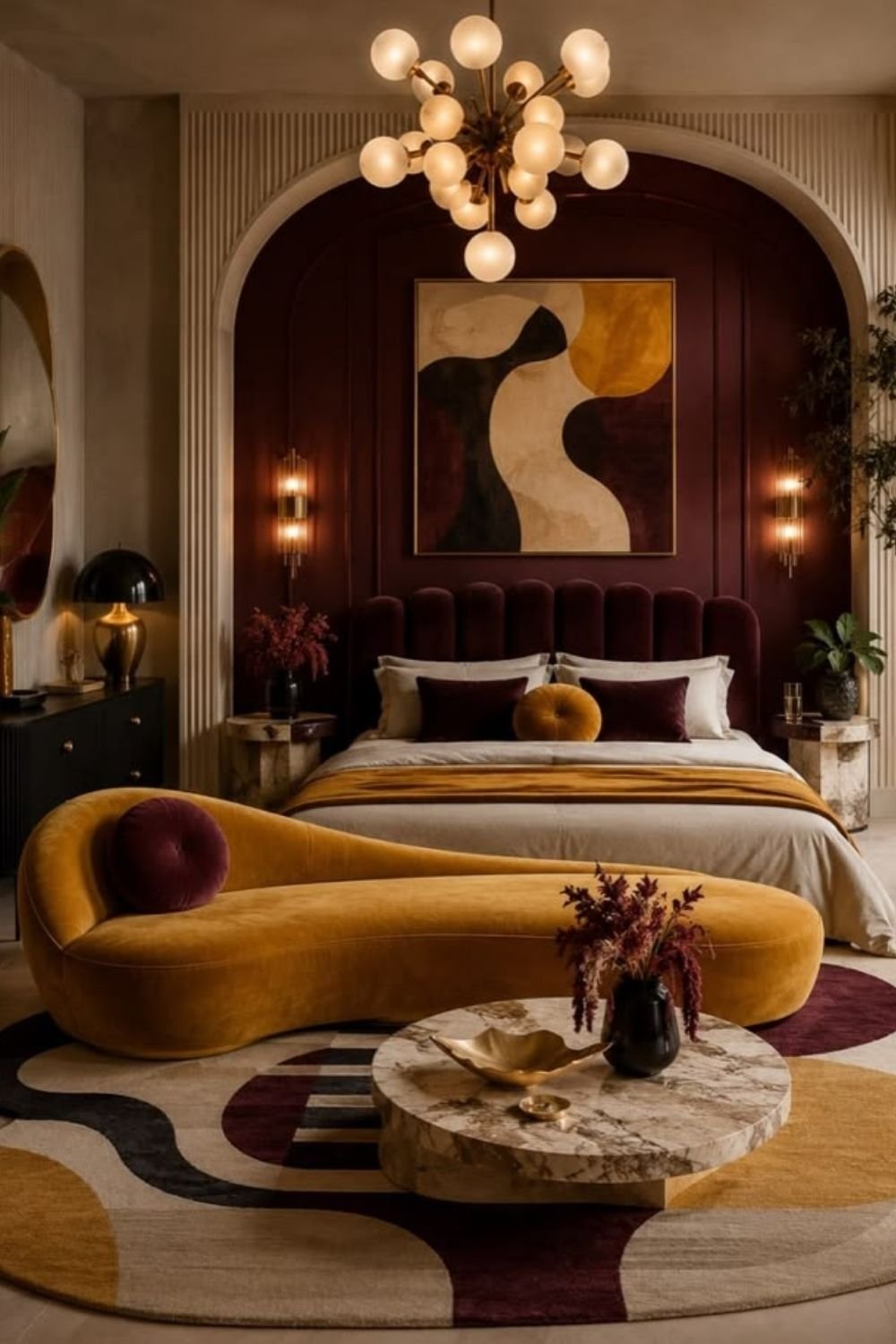
Photo by OurHoneyHome
This bedroom is the jewel-tone version done properly. A deep burgundy arched alcove framed by fluted cream plaster, a channel-tufted burgundy velvet headboard inside it, a cluster of glass globes overhead, slim tube sconces on the panelling, a mustard curved velvet sofa at the foot of the bed, a round marble coffee table and a rug of overlapping curves in the same four colors.
Two saturated colors, one stone, one metal. The restraint in the count is what stops jewel tones from tipping into pantomime, and it’s the same logic behind styling a dark accent wall rather than painting the whole room.
High contrast without the period costume
Black and cream is the most obviously deco of the three palettes and the easiest to overdo.
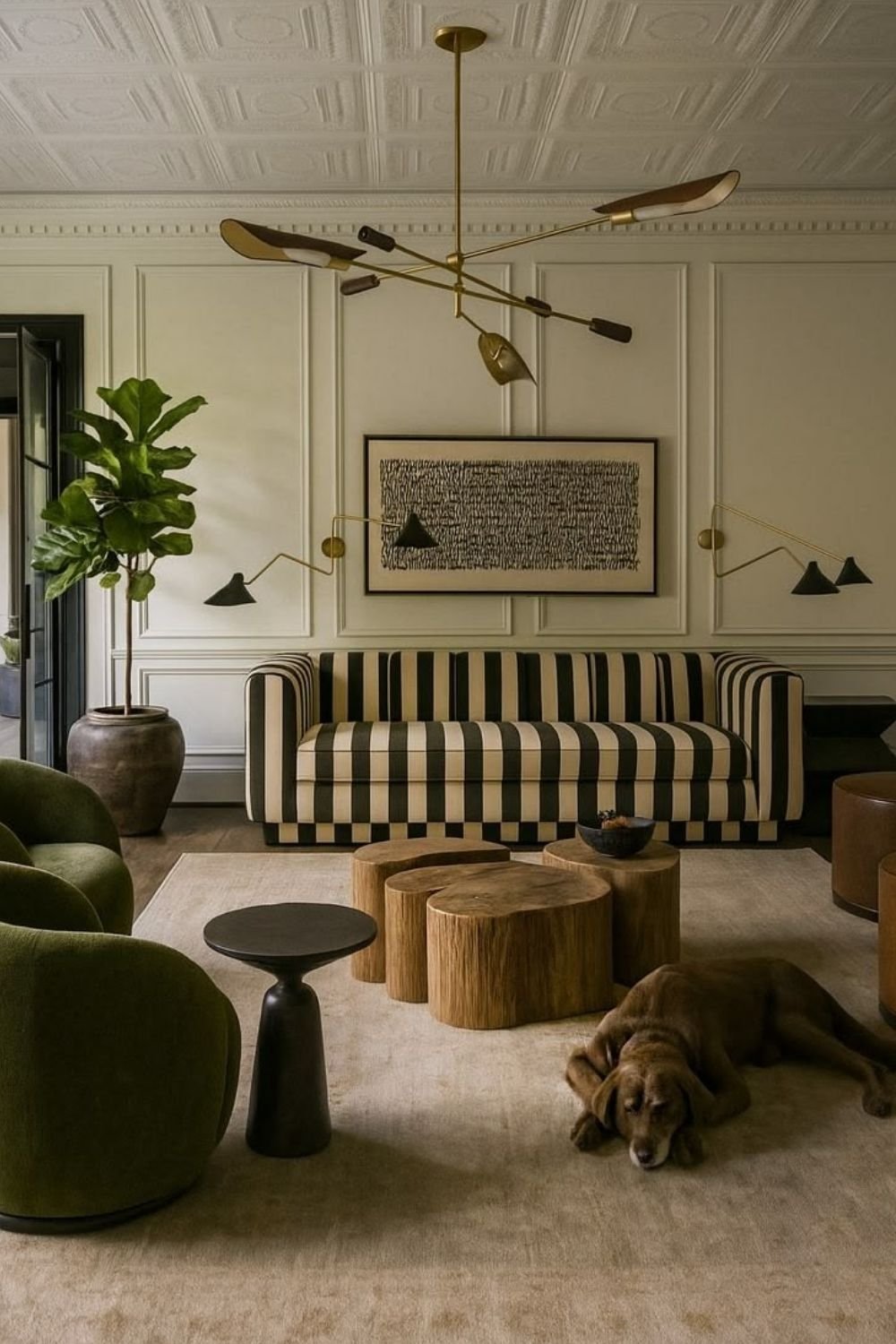
Photo by OurHoneyHome
The solve here is scale. One wide black-and-cream striped sofa, channel-tufted, against pale panelled walls under a pressed plaster ceiling. Brass lighting throughout: an articulated ceiling fixture with black cone shades and two swing-arm wall lights flanking a framed abstract. Green mohair armchairs and a cluster of raw wood stump tables break the graphic quality before it gets severe.
Those stump tables are doing something specific. A handmade natural object in the middle of all that geometry stops the room reading as a set, and it’s the trick I’d steal first from this photograph.
Fluting is the cheapest way in
If you want one detail that signals the style on a budget, it’s vertical ribbing. It appears on almost every piece in this category and it’s available now on mass-market furniture.
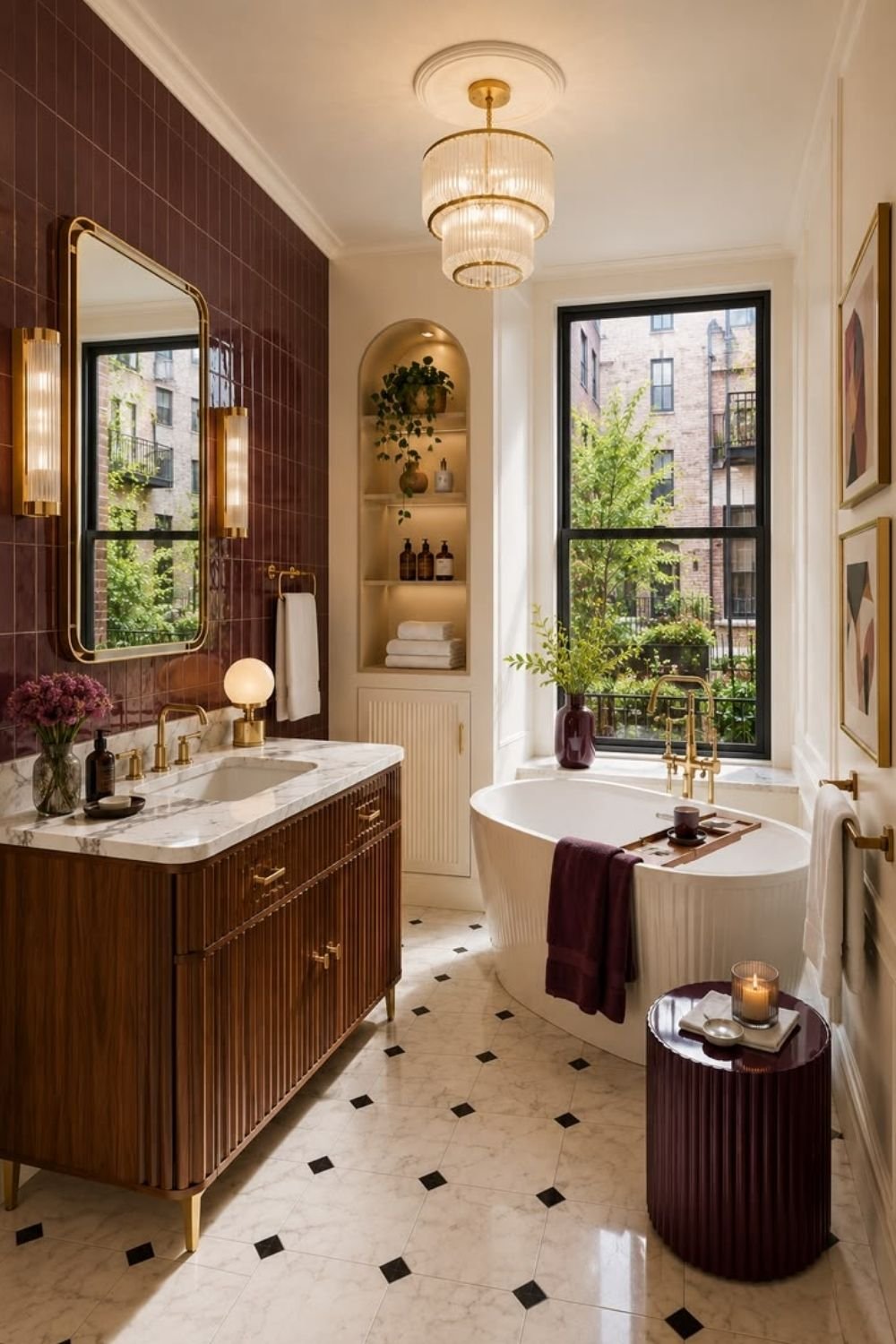
Photo by OurHoneyHome
Count the ribs in this bathroom. A fluted walnut vanity with a marble top and brass legs, a fluted freestanding tub, a fluted burgundy drum side table, fluted glass tube sconces, a tiered glass ceiling light and a ribbed cabinet panel. The wall is glossy burgundy tile laid vertically, which is fluting by another route, and the floor is marble with small black diamond inserts.
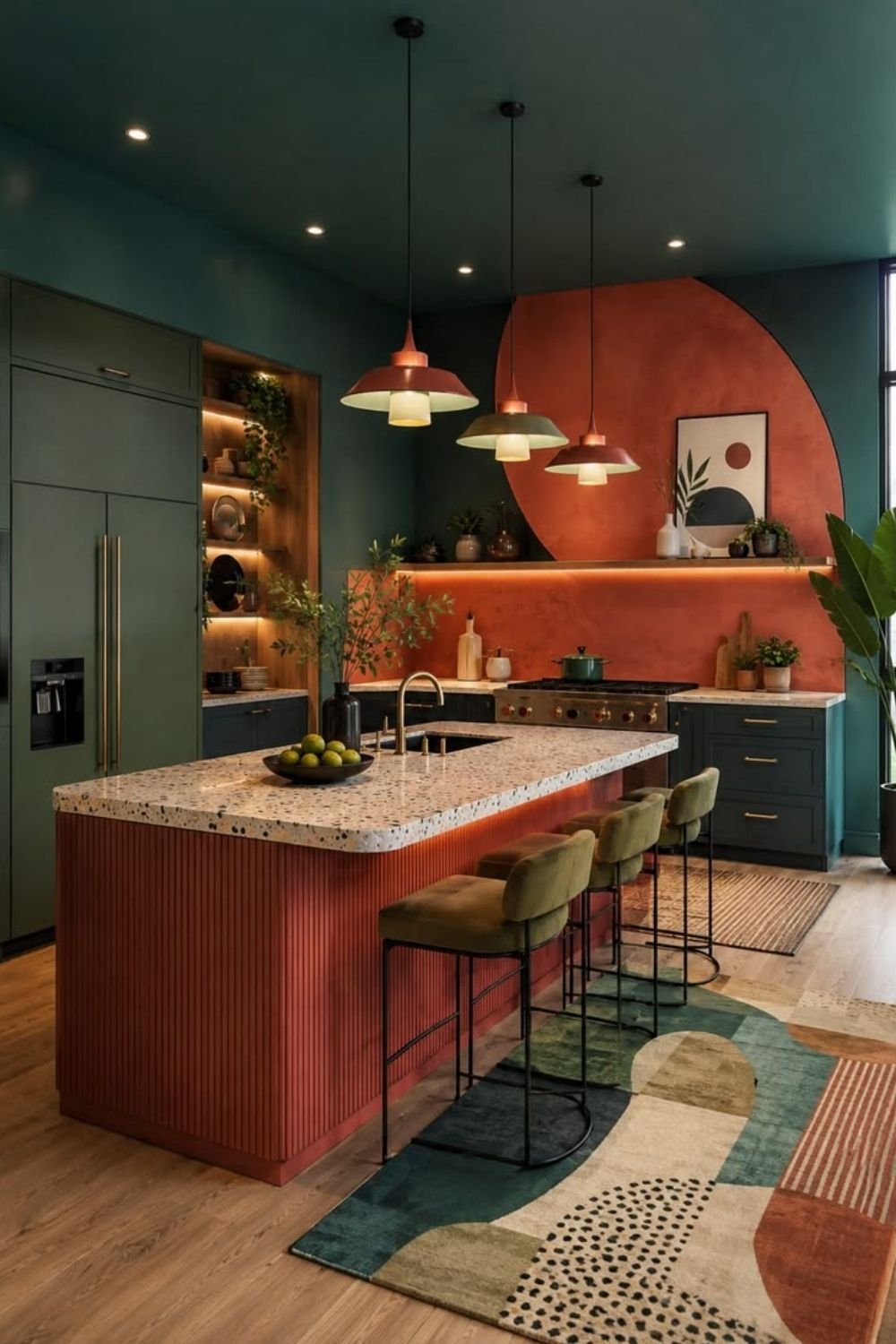
Photo by OurHoneyHome
The kitchen version swaps the palette entirely and keeps the same grammar. A teal ceiling and cabinetry, a terracotta plaster arch painted straight onto the back wall, a fluted terracotta island topped in speckled terrazzo, olive velvet stools and copper pendants. The arch and the ribbing carry the style; the colors are nothing a 1930s designer would recognize.
That kitchen is my favorite of the eight for exactly that reason. It proves the look isn’t about the palette at all.
Fluted panel is also sold by the meter as MDF or oak-veneered board, which makes it one of the few neo deco interior design details you can add to furniture you already own. Cut to size, glued to a flat cabinet door or the side of an island, painted to match, and the piece reads as a different object.
Mixing vintage deco with newer furniture
The scheme people usually want is not a period restoration. It’s a contemporary room with two or three older pieces in it.
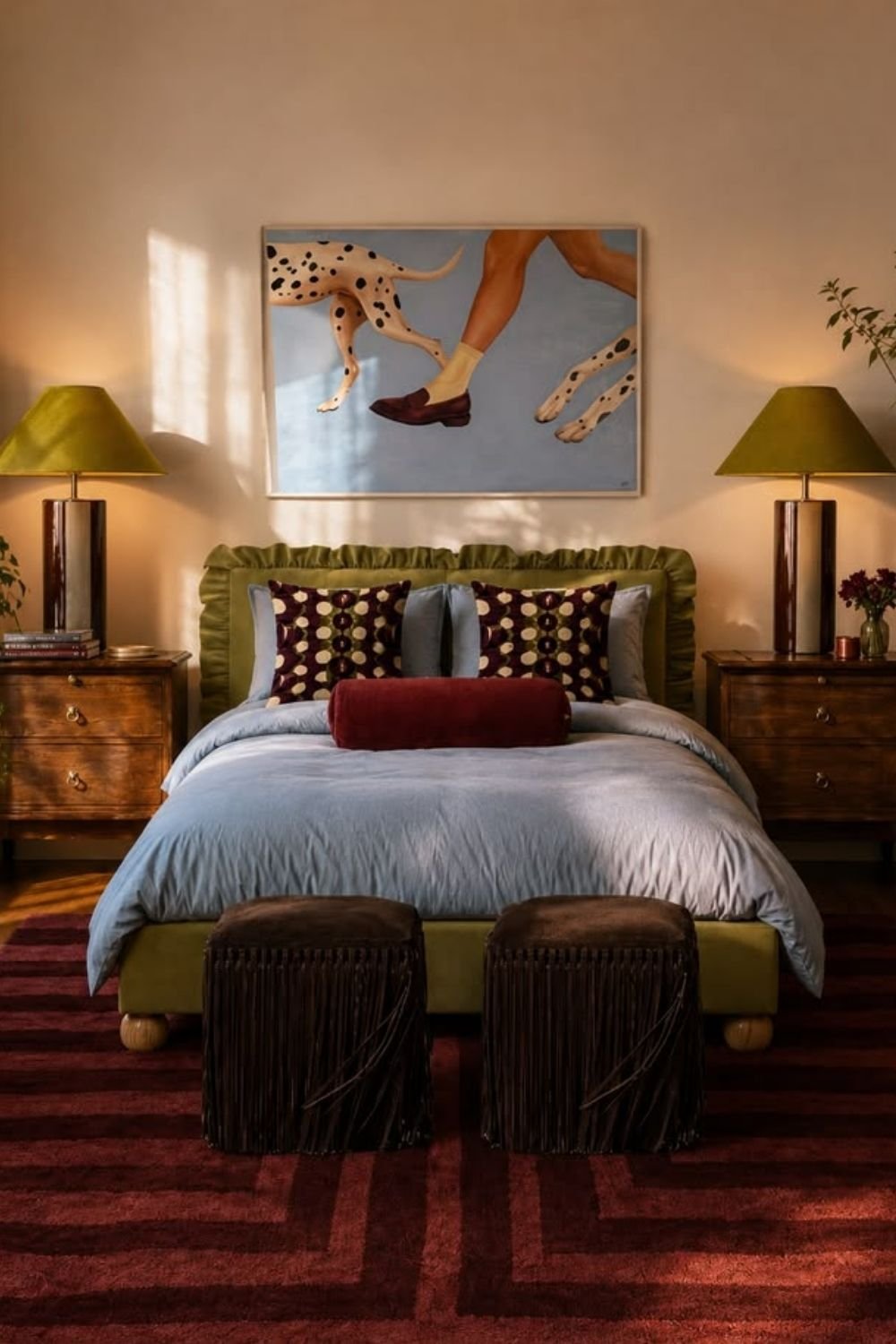
Photo by OurHoneyHome
Here a bed with an olive velvet ruffled headboard and ball feet sits between two genuinely antique bedside chests with ring pulls. The lamps have chrome and burl bases under olive shades, the rug is a burgundy stepped geometric, the cushions are a repeating dot pattern in wine and cream, and two fringed leather ottomans sit at the foot.
The mix works because the old pieces and the new ones share a color, not a period. Nothing in that room is trying to date from the same decade, and the result is warmer than a matched set would be.
Two rules I’d follow for a modern art deco interior built this way: let the vintage pieces be the small items rather than the sofa, and repeat their wood tone somewhere else so they don’t look marooned. If you like the curved end of this, it sits close to the 70s wall shapes that came out of the same instinct.
Bar carts, banquettes and the rooms nobody styles
Deco was built around entertaining, which is why an antique bar cart is almost a required object in this style. Brass frame, two glass shelves, castors, and whatever bottles you own arranged by height rather than by type. Secondhand is the way to buy one, because the 1960s and 70s produced thousands of them and they turn up constantly for less than a new reproduction costs. Look for one with the original castors still on it, since replacements rarely sit at the right height.
The other piece worth planning for is a leather banquette. A run of buttoned or channel-stitched leather along one wall of a kitchen or dining room does more for the neo deco feel than any amount of wall decor, and it seats more people in less floor space than chairs. Tan or oxblood over black, and keep the back low enough that it doesn’t cut across a window.
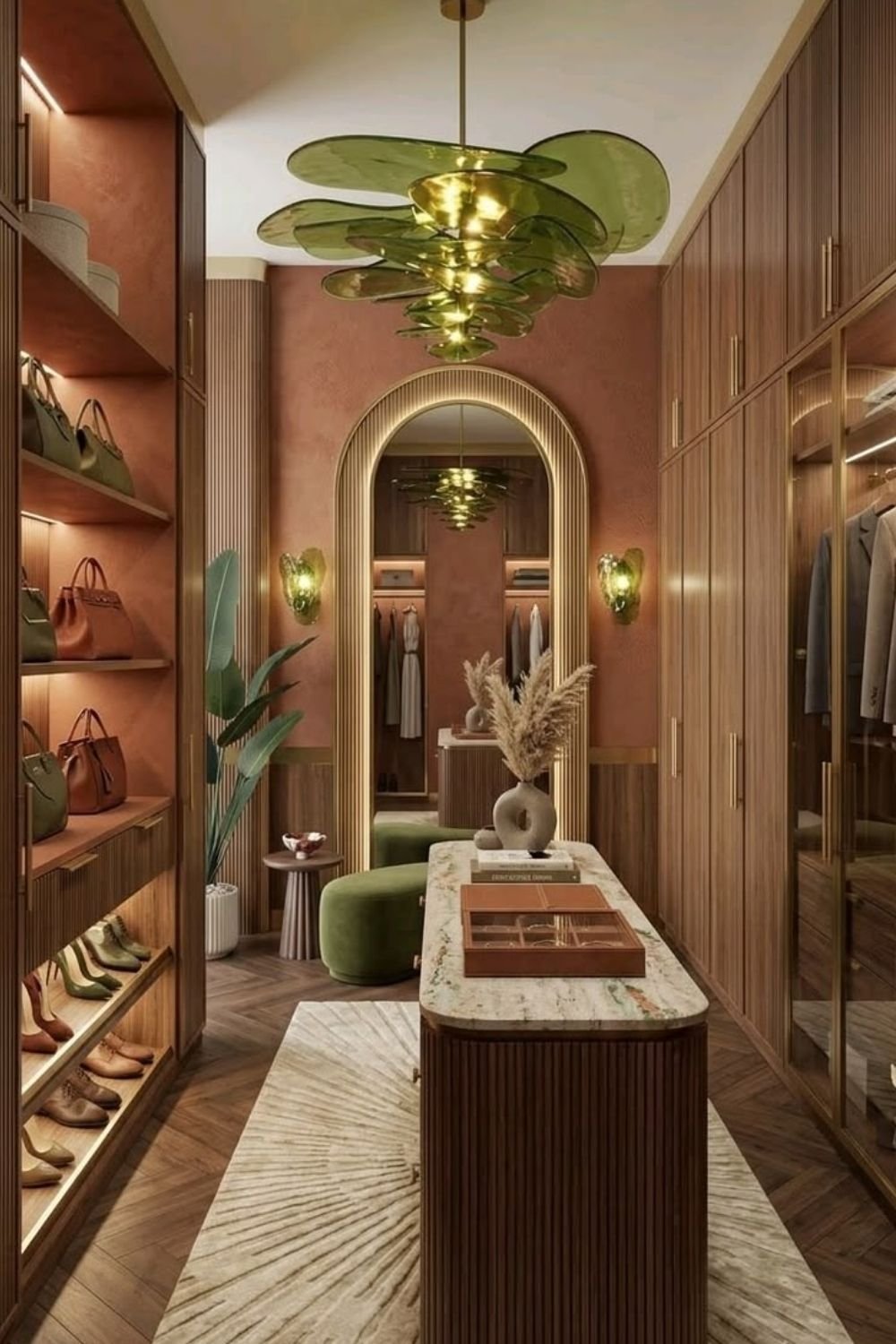
Photo by OurHoneyHome
And then the rooms people skip. This dressing room has terracotta plaster walls, a brass-framed arched mirror at the far end, a petal-shaped green glass chandelier with matching sconces, fluted wood cabinetry with brass trim, a marble-topped island, a green velvet ottoman and a sunburst rug on herringbone floor.
A closet gets away with more than a living room does, because you are the only one who sees it. It’s the sensible place to try a color or a light fitting you’re not sure about, which applies just as well to any of the bedroom directions worth saving.
Where I’d start
One piece of furniture with a curve in it, one arched or fanned mirror, and brass hardware swapped in on whatever is already there. That combination gets a room most of the way into neo deco territory, and it costs far less than committing to a palette.
After that, the honest summary of art deco home decor in its current form is that it’s a shape language rather than a period. Arches, flutes, circles and one warm metal. Everything else, including the color, is yours.
