Every kitchen has one: the dead end of the counter where the toaster goes to be forgotten, the strip of wall above it that never got a shelf, the gap by the fridge that collects paper bags. A small home coffee bar needs about two feet of counter (or a cart that size) and one outlet, which makes those awkward corners a very good fit.
Below is what to check before you pick a spot, then ideas grouped by the kind of corner you have, and a few questions people usually ask.
Before you pick a corner
Five minutes of checking saves a lot of rearranging later:
- An outlet within reach. Espresso machines, grinders and kettles draw a lot of power. Plug each one straight into a wall outlet rather than an extension cord or power strip, and avoid running two heating appliances off the same outlet at once.
- The depth of the counter. Standard counters are about 24 inches deep. Measure your machine front to back and add room for the handle and a cup in front of it.
- The space under the upper cabinets. It’s often around 18 inches. If your machine fills its water tank from the top, or you steam milk, leave enough room to lift the lid and let steam escape without hitting the cabinet.
- Distance to water. Close to the sink is easier for refilling and rinsing, but you can live without it. A small pitcher does the job if the corner is across the room.
- Where the mess goes. Coffee grounds, drips and milk splashes need a surface you can wipe, or a tray that catches them.
The dead end of the counter
This is the most common small home coffee bar, and the easiest to set up: the last two or three feet of counter, often in a corner, where there’s an outlet and nothing much else happens.
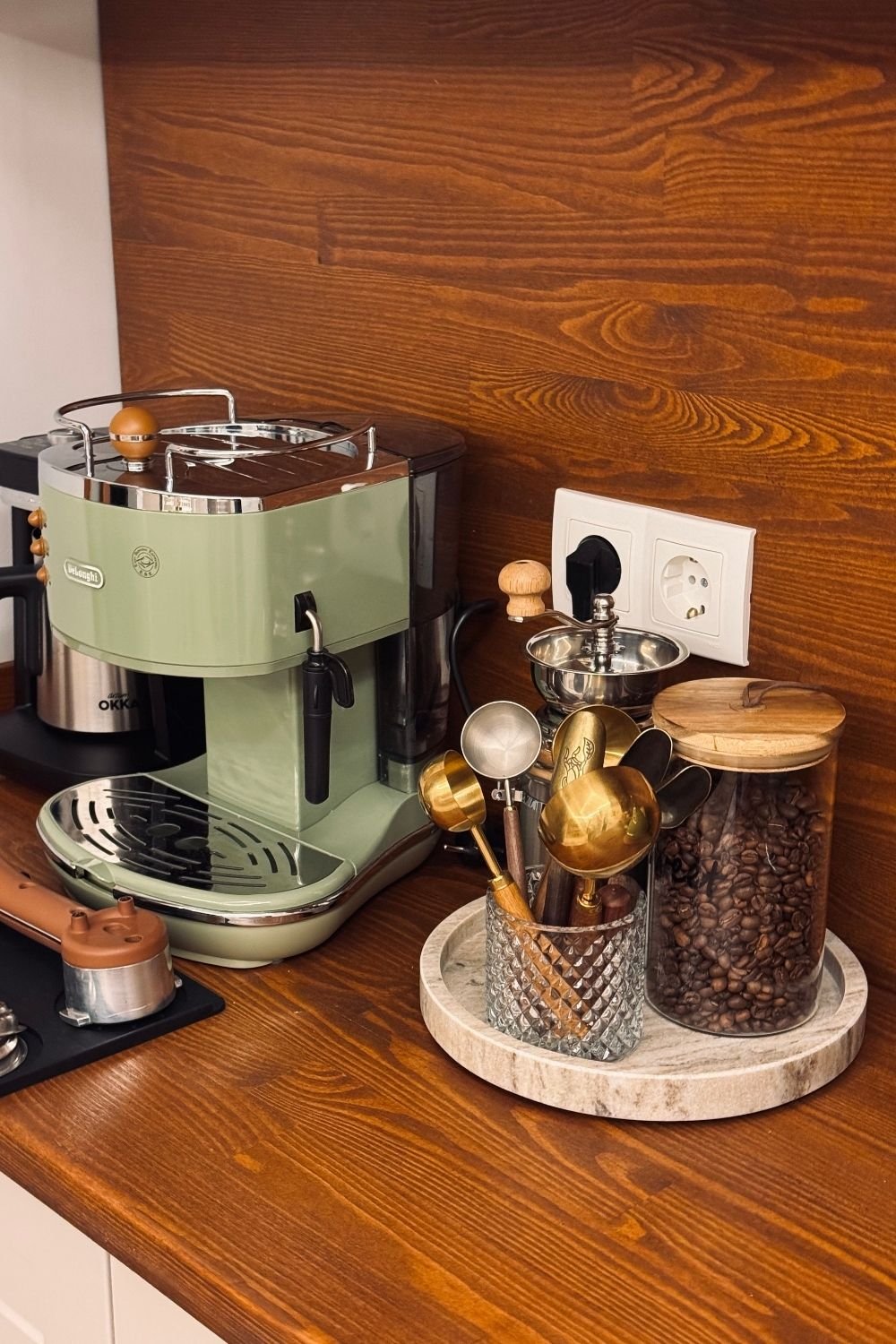
Photo by Saliha Büyükkaya Gülhan on Pexels
This corner shows how little it takes. A pale green retro espresso machine sits against a wood-plank backsplash, and next to it a round marble tray holds everything else: a glass jar of beans with a wooden lid, a small hand grinder and a cut-glass tumbler full of brass and steel measuring scoops. The tray is the trick. It turns five loose things into one station, and when you wipe the counter, you lift one object instead of five.
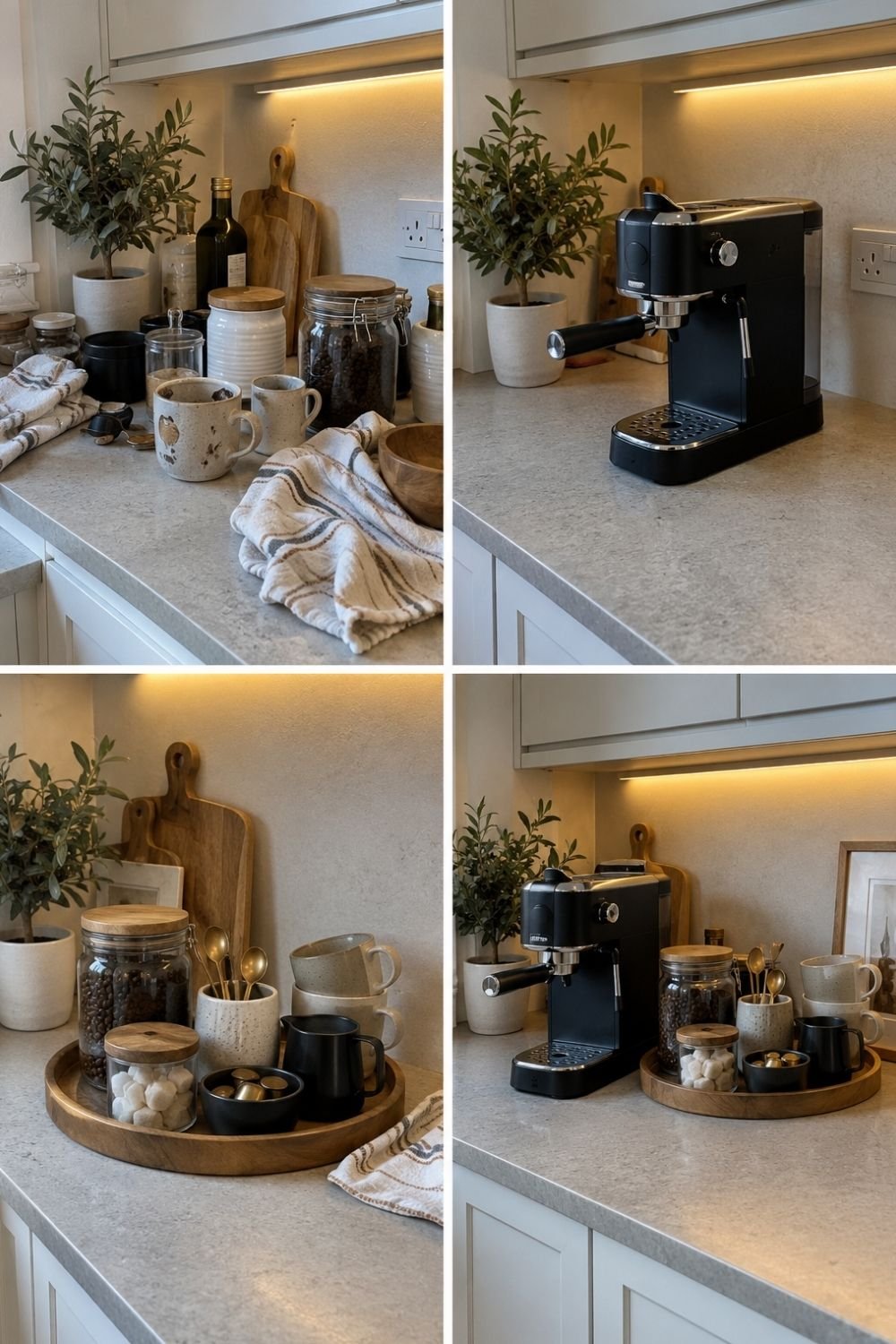
Photo by OurHoneyHome
If your corner currently looks like the first frame above (jars, oil bottles, mugs, cutting boards and tea towels all in one pile), the other three frames show the order to fix it:
- Clear it completely, and put back only the machine. In the second frame it’s a black espresso machine next to a small potted olive tree, and the corner already looks calmer.
- Build the tray separately: a round wooden tray with a jar of beans, a jar of sugar cubes, a cup of gold spoons, a small black milk jug, a bowl of capsules and a stack of mugs.
- Put them together and add one decorative piece. Here it’s a framed print leaning against the wall and two cutting boards behind the tray. An LED strip under the upper cabinet lights the whole corner in the evening.
Everything that isn’t coffee (the oils, the extra boards, the towels) moves somewhere else. That’s the hardest part, and the one that makes the difference.
The blank wall above the counter
If the counter is short but the wall above it is empty, go up. Two floating shelves turn a narrow strip of counter into a full coffee bar, because the mugs, beans and syrups move off the counter.
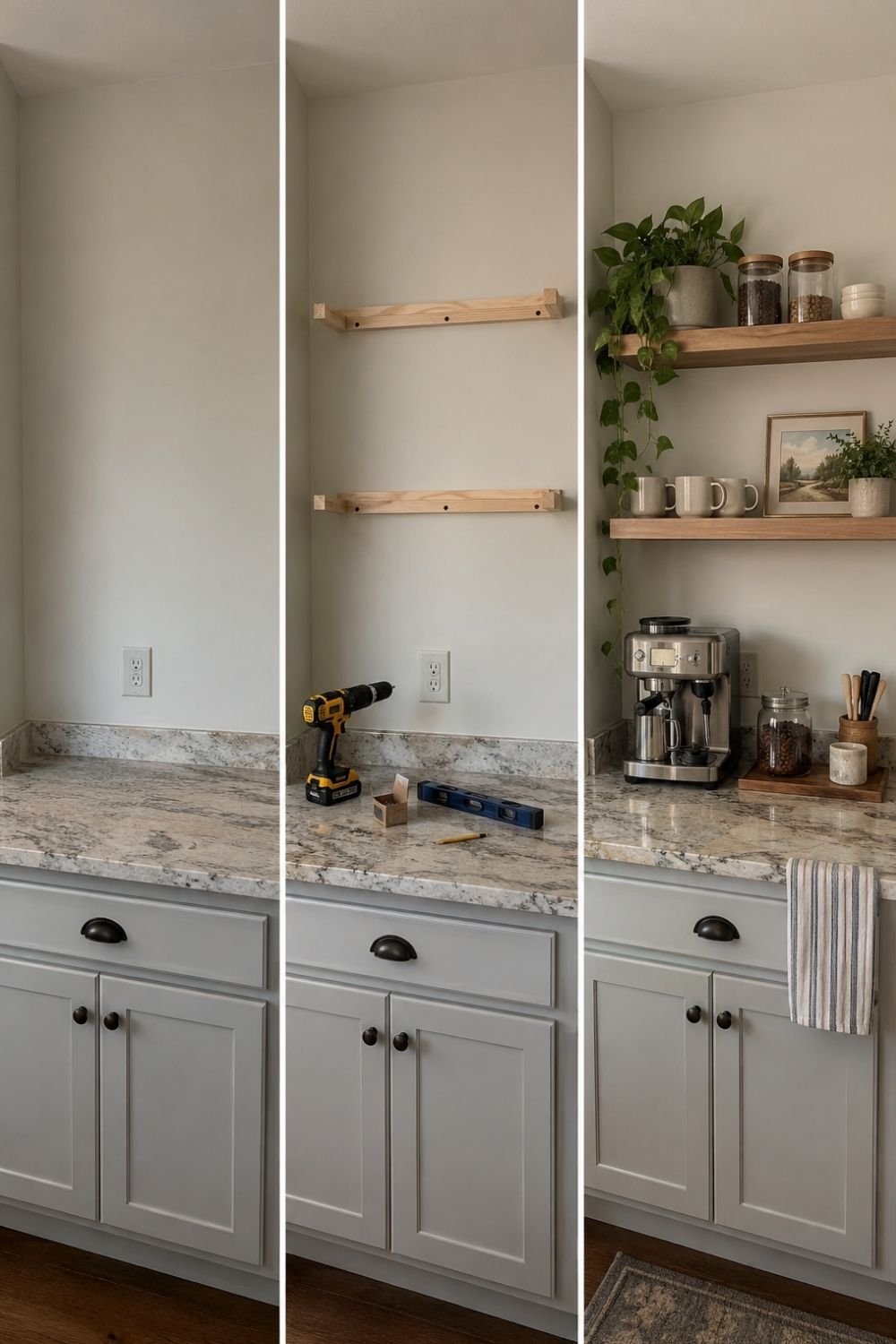
Photo by OurHoneyHome
The three frames show a very ordinary spot: a blank wall above a granite counter and gray cabinets, with a single outlet. Then two floating shelf brackets go up (a drill, a level and a pencil on the counter). Finally, oak shelves hold glass jars of beans, a stack of bowls, a row of matching mugs, a small framed landscape and a trailing pothos. On the counter below, only the espresso machine, a jar, a utensil crock and a small wooden tray.
A few practical points for coffee shelves:
- Mugs on the lower shelf, at a height you can reach half-asleep. Beans and backup supplies go higher.
- Mount into studs or use anchors rated for the weight. A shelf of full ceramic mugs and glass jars is heavier than it looks. If you rent, ask first, or look at a freestanding shelf that sits on the counter.
- Leave a gap above the machine so steam doesn’t rise straight into the bottom shelf.
The spot by the window or the fridge
Some kitchens have no spare counter at all, but they have a gap: between the fridge and the window, at the end of a run of cabinets, or in a corner of the dining area. A small table or a kitchen cart fills it and becomes the coffee bar.
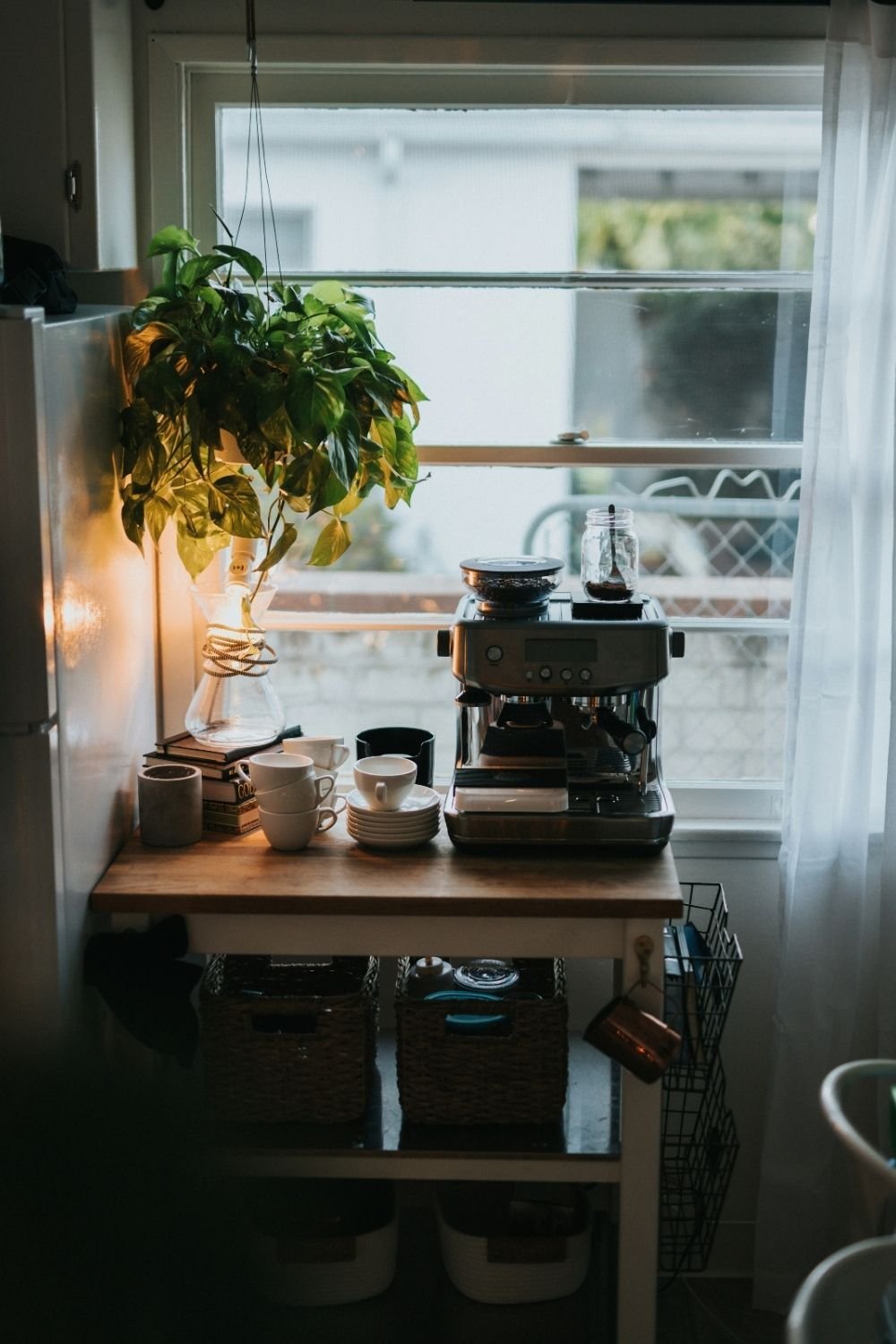
Photo by Nathan Dumlao on Unsplash
This wooden-topped table stands in front of a window, right next to the fridge. On top: an espresso machine with a built-in grinder, stacked white cups and saucers, a glass pour-over carafe and a few books. Underneath, two woven baskets hold the supplies, and a wire basket hooked to the side stores filters and a copper mug. A pothos hangs above it all from the ceiling. The window gives it daylight in the morning, which is exactly when it gets used.
Keep an eye on direct sun, though. Coffee beans lose flavor faster in heat and light, so store them in an opaque container or in a basket below rather than in clear jars on a sunny windowsill.
No counter at all: a rolling cart
A bar cart or kitchen cart is the most flexible small home coffee bar there is. It can live in a hallway, beside the dining table or at the end of the kitchen, and it moves with you to the next apartment.
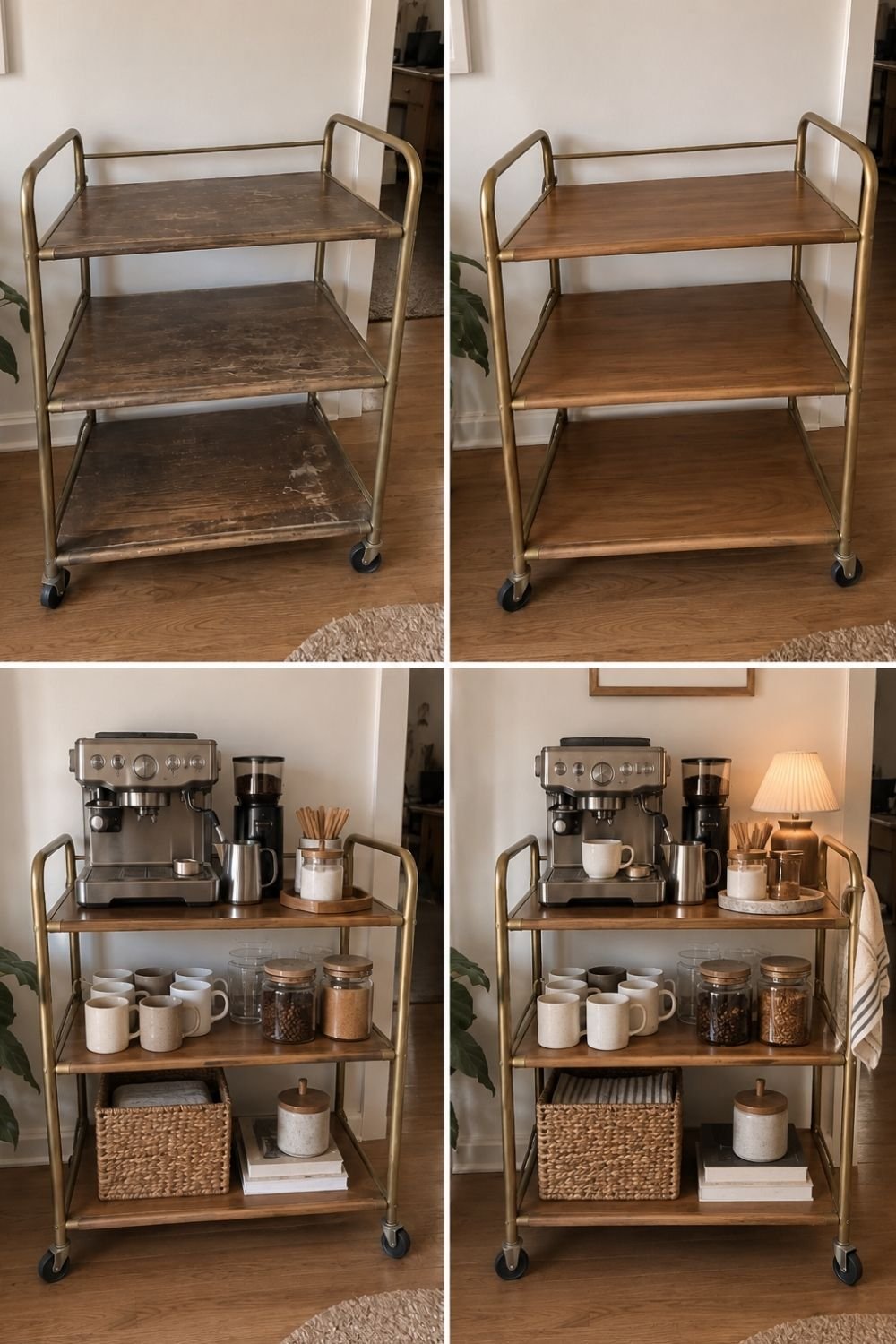
Photo by OurHoneyHome
The four frames above follow one cart from thrift find to coffee station. It starts as a brass-framed cart with badly scratched wood shelves. The shelves get refinished to a warm, even brown. Then it’s styled in three levels: an espresso machine, a grinder, a milk pitcher and a jar of wooden stirrers on top; mugs, glasses and jars of beans in the middle; a woven basket and a stack of books with a lidded canister at the bottom. The last frame adds a small lamp with a pleated shade, a marble tray, a striped towel over the side and a framed picture on the wall above.
What makes a cart work as a coffee bar:
- A solid top shelf strong enough for the machine. Wire or glass shelves wobble under an espresso machine.
- Locking wheels, so the cart doesn’t roll when you tamp or pull a lever.
- An outlet right behind it. The cord should reach without stretching, and it shouldn’t cross a walkway.
Under the stairs or on a sideboard
The odd space under a staircase, or a low cabinet in the dining room, can hold a surprisingly complete coffee bar, especially if more than one person in the house drinks coffee differently.
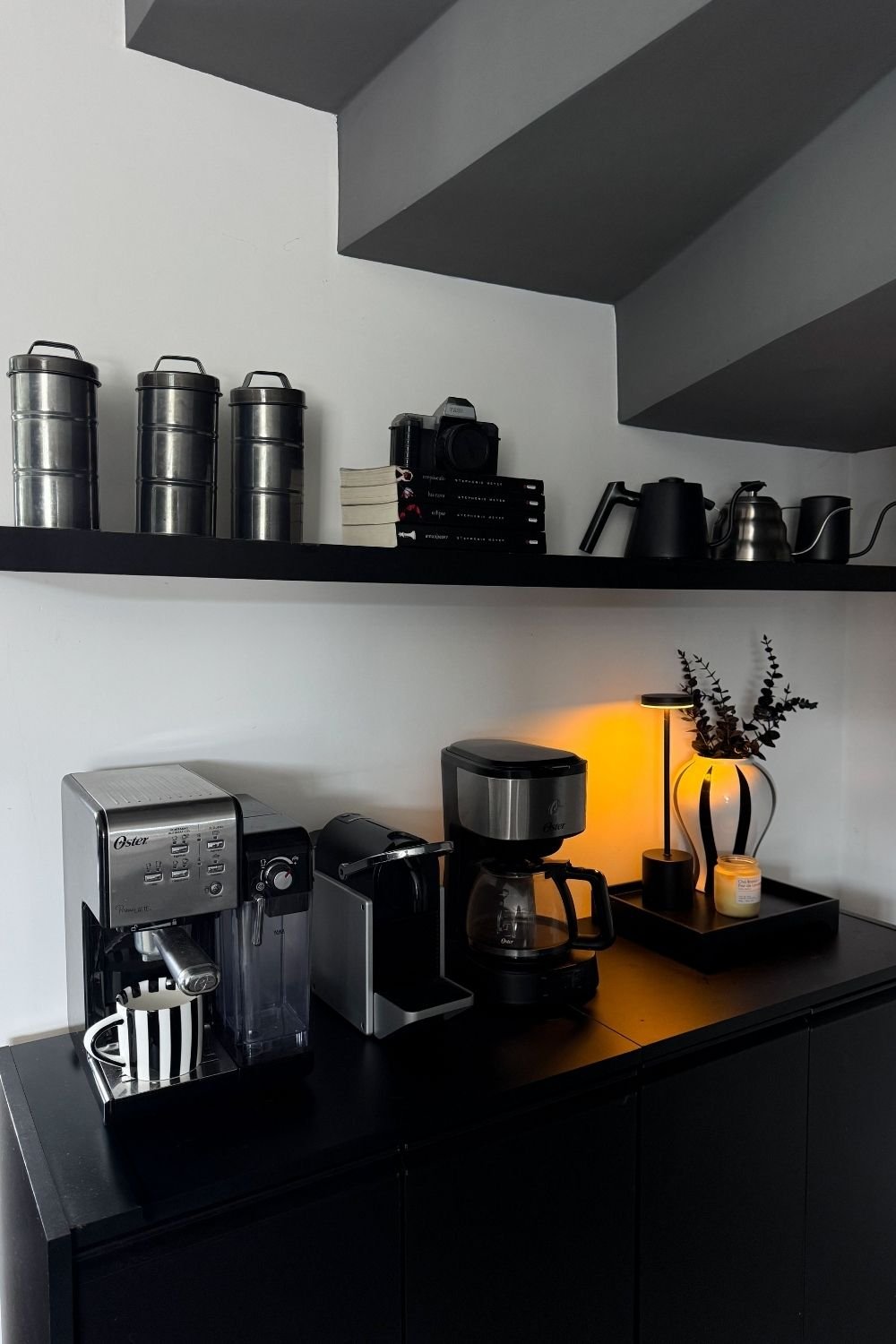
Photo by Fernanda Neitzel on Pexels
This black low cabinet fits under the slope of a staircase and holds three machines side by side: an espresso machine, a capsule machine and a drip coffee maker. One black shelf above carries steel canisters, a stack of books, a camera and three kettles, including a gooseneck pour-over kettle. On the counter, a black tray groups a cordless lamp, a vase of dark eucalyptus and a candle. Everything is black, steel or white, which keeps three machines from looking like an appliance store.
A cordless, rechargeable lamp is a good idea anywhere there aren’t enough outlets. It saves the outlets for the machines.
Clear the clutter first
Most coffee corners don’t need more things. They need fewer.
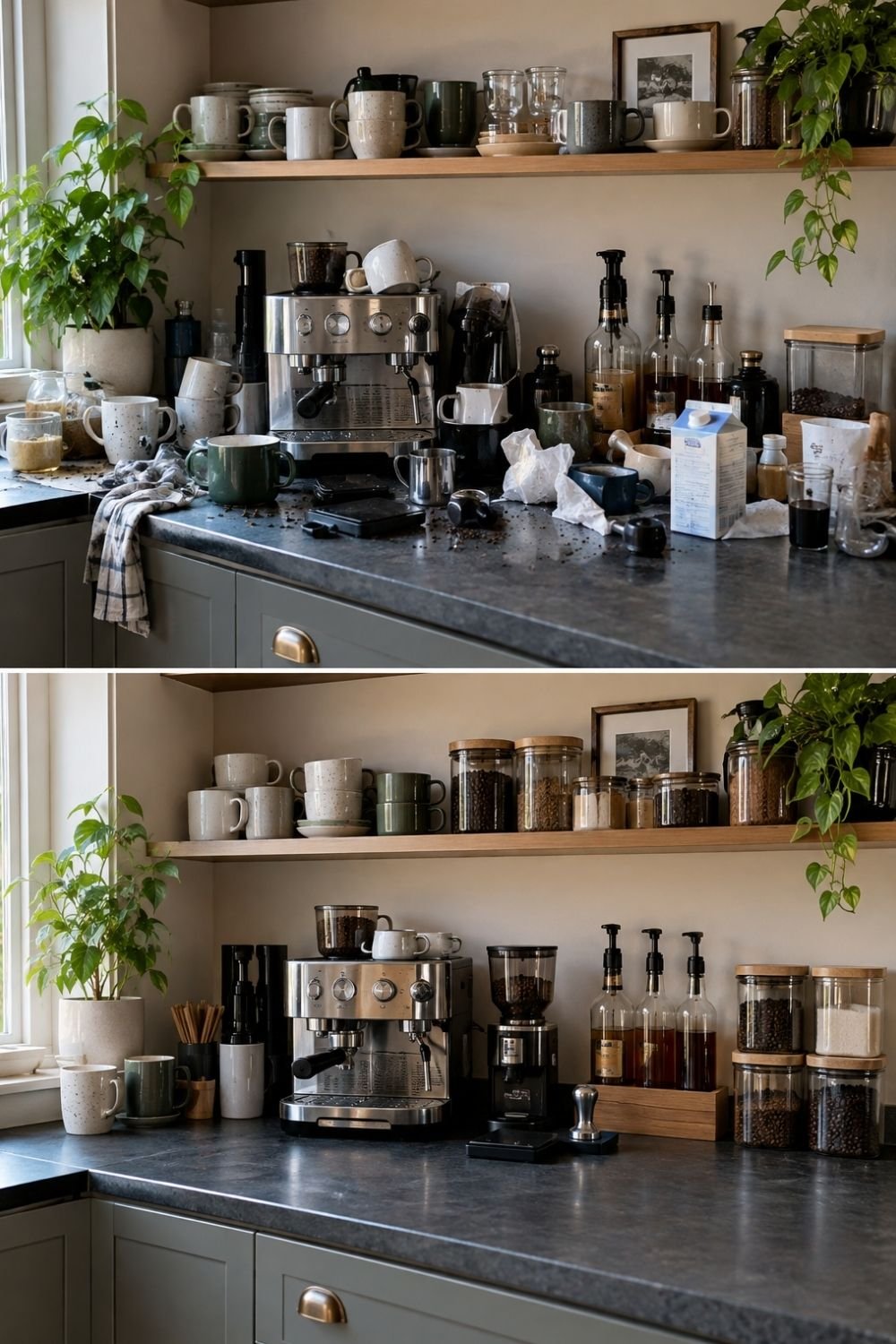
Photo by OurHoneyHome
The “before” is a familiar sight: spilled beans, mugs in every direction, a milk carton, tissues, a tangle of bottles. The “after” uses the same machine and the same supplies, just organized: syrup bottles with pumps lined up in a wooden caddy, beans and sugar in stacked canisters, the tamper on its own mat, and the mugs moved up to the open shelf next to jars of beans and a trailing plant.
Four habits keep it that way:
- One home for every item, even if it’s just a spot on the tray.
- Decant what you use daily (beans, sugar, cocoa) into matching containers, and store the bags out of sight.
- Keep only the mugs you use. The rest can go to a cabinet.
- A small towel or knock box within reach, so spills get wiped before they spread.
The countertop styling post has more on keeping counters useful and still good-looking.
Give your small home coffee bar one look
Once it works, pick one style so the coffee bar looks like part of the kitchen rather than a pile of appliances.
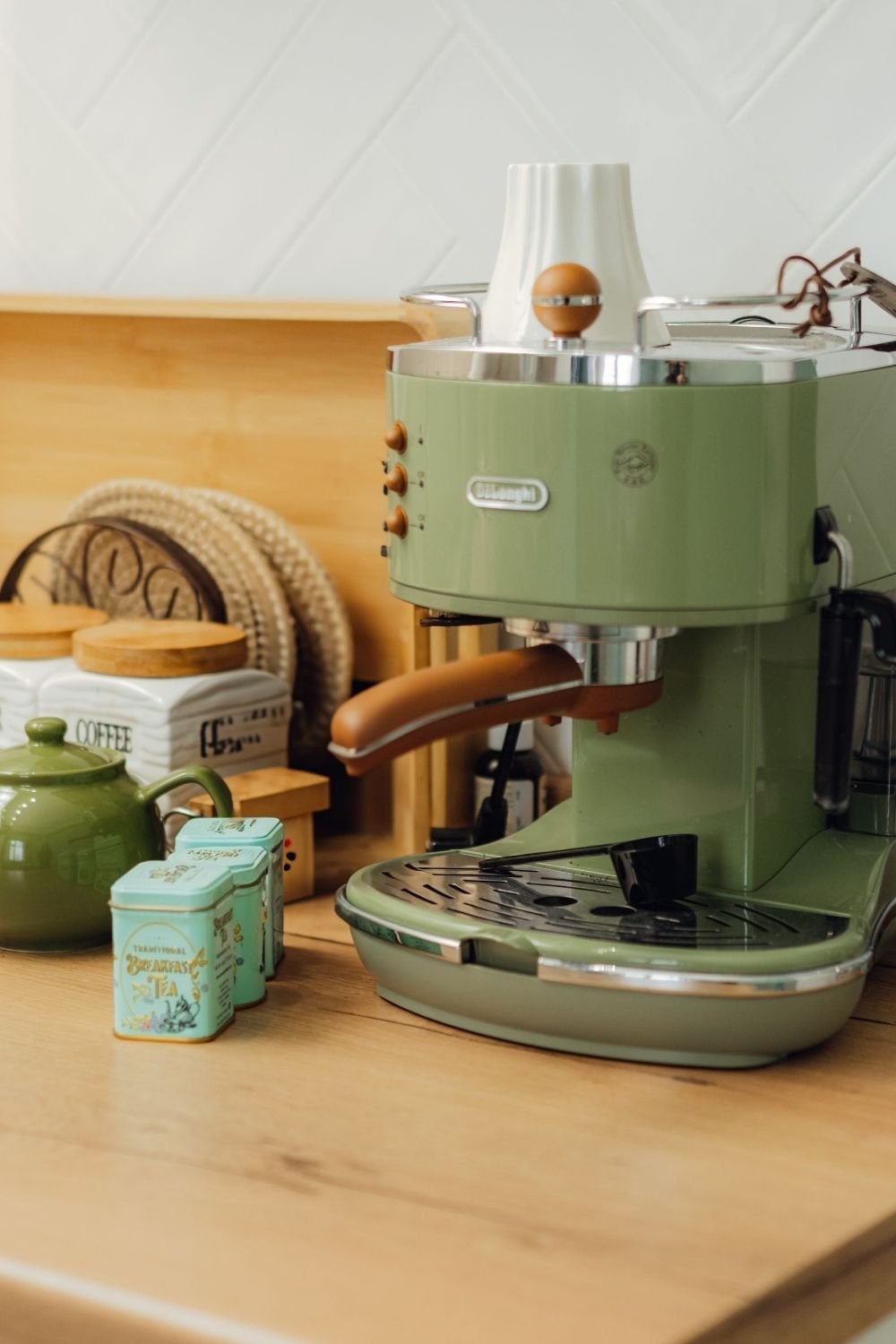
Photo by Seljan Salimova on Pexels
- Vintage: a retro machine in a soft color, like this sage green one with wood-look knobs, plus a green ceramic teapot, mint tea tins, a white canister marked “coffee” and woven trivets. It pairs well with a grandmacore kitchen.
- Café-style: stainless steel machine, white cups and saucers, glass jars, a small chalkboard for the day’s order.
- Minimalist: one machine, one tray, one row of matching mugs, and nothing else on the counter.
- Luxury: marble tray, brass scoops and spoons, a lamp, glass canisters with wood lids.
- Colorful: a bright machine or kettle and mugs in two or three colors. The colorful kitchen post has ideas for building a palette around it.
Seasonal touches (a small pumpkin in fall, a sprig of greenery in December) can come and go on the tray without changing the setup.
Questions people ask about a small home coffee bar
How much space does a home coffee bar need? About 2 feet of counter or a cart top that size fits one machine and a tray. With a shelf above, that’s enough for a full espresso setup.
Can the machine go under upper cabinets? Usually, yes, if there’s room to open the lid and refill the tank without pulling the machine out. Steam and heat can damage cabinet finishes over time, so pull the machine forward when you steam milk.
Can a coffee bar double as a tea or cocoa station? Easily. Swap the grinder for a kettle, and add a jar of tea bags and a tin of cocoa. The tray-and-shelf setup is the same.
What if I only have a drip coffee maker? The same ideas apply. A tray, a jar of ground coffee, a stack of mugs and a small shelf above turn a basic machine into a proper coffee corner.
And that’s pretty much it: one outlet, one tray, a shelf if you can add one, and a corner that finally has a job.
