Most homes have the box. It lives on top of a closet, it comes down at the end of November, and every year a little less of it makes it out: the foil garland that’s lost half its fringe, the plastic dreidels nobody plays with, the sign with glitter that migrates into the carpet until March.
My take on Hanukkah decor ideas is simple. Buy or make a handful of things you’d be happy to unpack for the next ten years, add something living and something soft, and let the candles do the rest. The light is already the most beautiful thing in the room. Everything else is just a frame around it, and a frame made of greenery, linen, brass and wood looks warmer and more cozy than anything that comes shrink-wrapped.
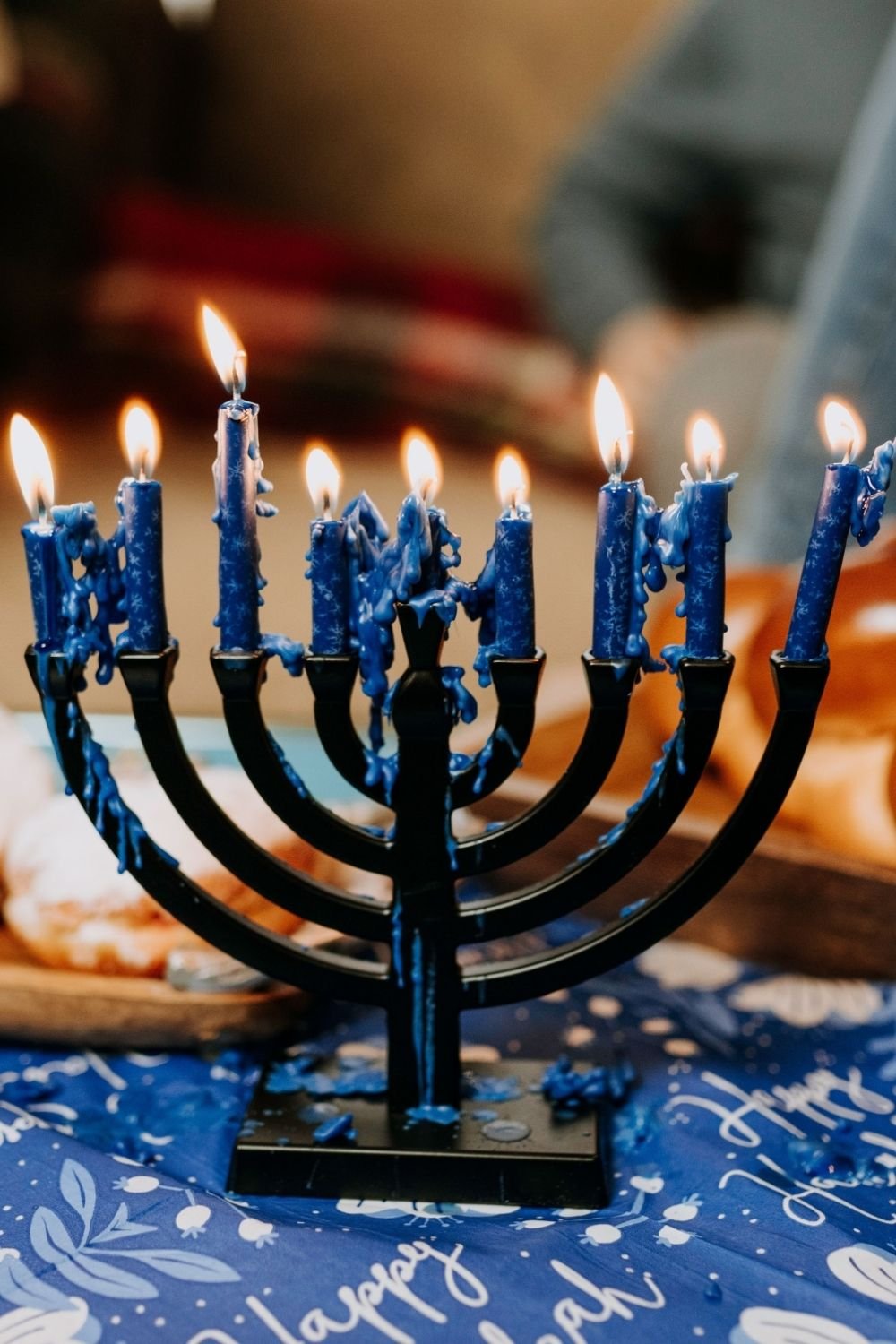
Photo by RDNE Stock project on Pexels
Look at the photo above and notice how little is going on. A simple black menorah, blue candles burning down with wax running over the arms, a printed blue and white cloth underneath, and a plate of something fried just out of focus behind it. No garland, no signs. It still reads as Hanukkah from across the room.
Below, I’ve organized this by material rather than by room, because that’s how these pieces actually get reused: the brass candlesticks come back out in December, the linen napkins get used all year, the greenery goes wherever it’s needed.
Start with the menorah, and give it room
All Hanukkah home decor starts in the same place. Whatever else you do, the menorah is the main event, so it deserves space rather than competition.
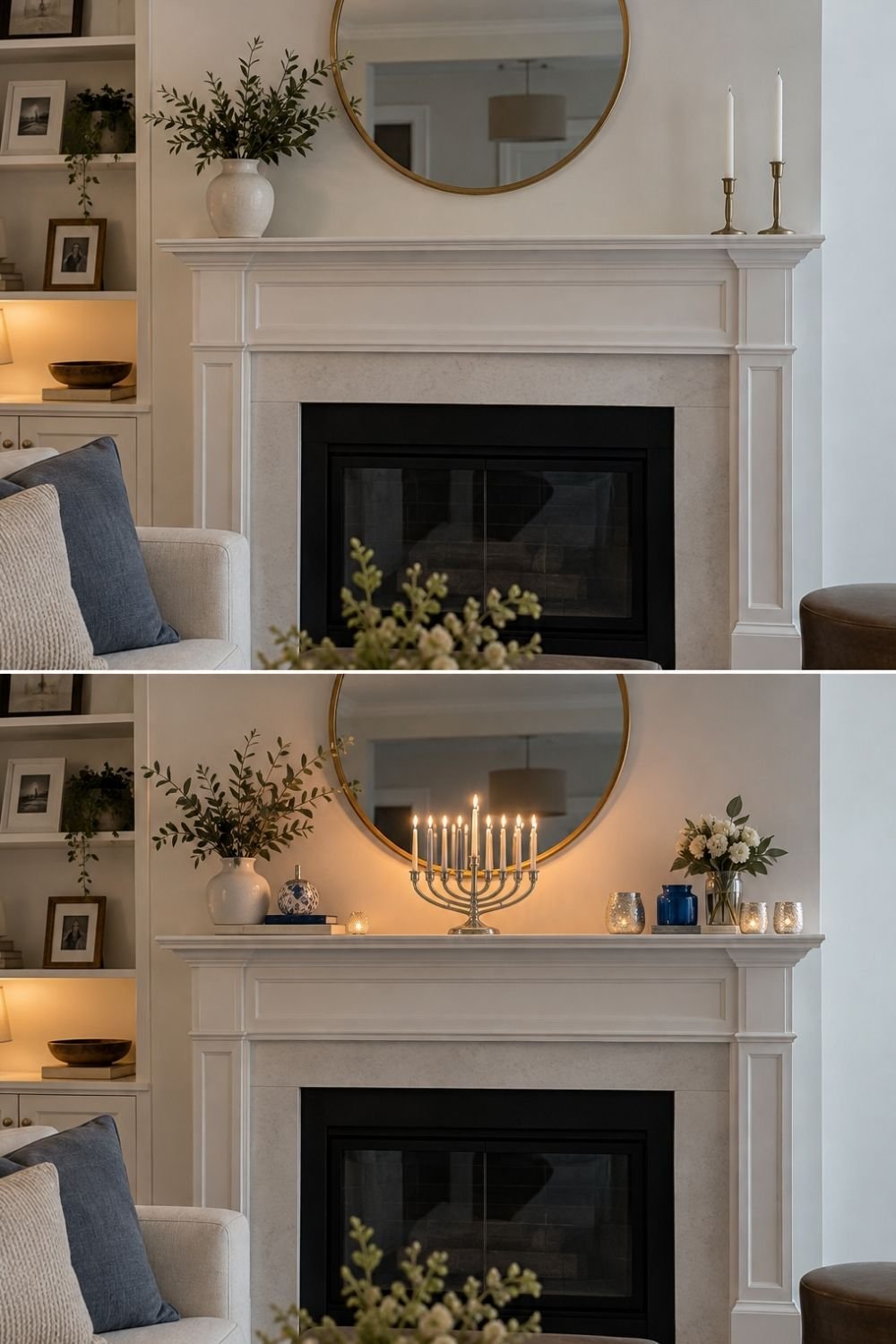
Photo by OurHoneyHome
The before-and-after above shows a mantel handled exactly this way. On top, it’s the everyday version: a white fireplace, a round gold mirror, a cream vase of greenery on one side and two brass candlesticks on the other. On the bottom, a silver menorah with nine lit candles sits in the center in front of the mirror, which doubles the light. Around it there’s a small blue and white ceramic ball on a stack of books, a cobalt glass jar, a few mercury glass votives and a little vase of white flowers. That’s all that changed, and the mantel now clearly belongs to the holiday.
A few practical notes for displaying it:
- Put it where it can be seen from outside, traditionally in or near a window, if that works safely in your home.
- Choose a heatproof surface: stone, metal, a tile or a tray. Not directly on a wood shelf or a tablecloth.
- Leave empty space on both sides. Decor crowding the arms is a fire risk and makes the menorah look smaller.
- Keep it away from curtains, greenery and paper. This matters more than any styling rule here.
- Candles go in from the right, and get lit from the left, newest first, with the shamash doing the lighting. It’s worth leaving a clear path to reach each candle.
Light and metal
After the menorah itself, candles and metal are what carry the whole look, and they’re the part of your Hanukkah decorations that never goes out of date.
- Brass or silver candlesticks in mixed heights, grouped in threes on a mantel, sideboard or table.
- Tea lights in mercury or clear glass scattered along a table runner. Ten small flames do more than one big centerpiece.
- A tray under everything, which catches wax and lets you move the whole arrangement in one go.
- Warm string lights along a mantel or a bookshelf, in warm white rather than cool blue.
- Dimmed lamps in the rest of the room, so the candles are the brightest thing.
None of this is holiday-specific, which is the point. Candlesticks, votives and a tray work in February just as well.
Greenery instead of tinsel
This is the swap that changes the most. Fresh (or good faux) greenery gives a table depth and scent, and it costs less than a set of themed decorations.
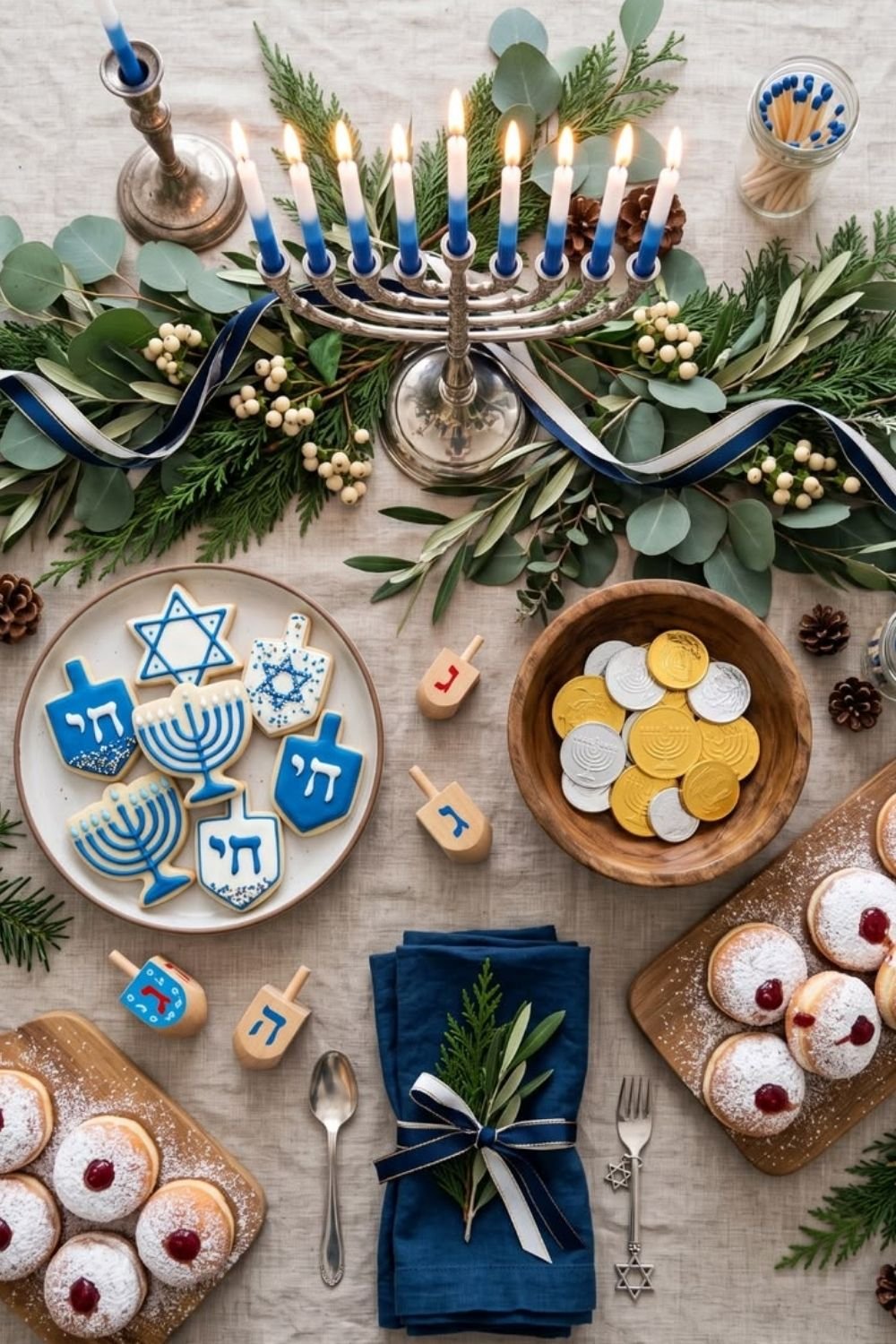
Photo by OurHoneyHome
The overhead shot above shows how much a loose greenery runner does. Eucalyptus, olive branches, cedar and white berries run down the middle of a linen cloth, with a silver menorah and blue ombré candles rising out of them, plus navy and white ribbon woven through and a few pinecones. Around it: a plate of iced cookies, a wooden bowl of chocolate coins, wooden dreidels, jam-filled doughnuts on wood boards, navy napkins tied with ribbon and a sprig of greenery, and a jar of blue-tipped matches.
Ideas that work anywhere:
- A loose runner of eucalyptus and olive down the center of the table, with candles set into it (well away from the leaves).
- A bundle of branches in a ceramic jug on the entry table.
- A small wreath with a navy ribbon on the front door or a mirror.
- Cedar or fir clippings in a bowl, which smell like December without any scent spray.
- A few white blooms: ranunculus, anemones or white roses, for a more elegant table.
Swap list, if you want it as one line each: instead of foil garland, try a greenery runner. Instead of a glitter sign, try a framed print or nothing. Instead of plastic confetti, try chocolate coins in a wooden bowl.
Textiles you’ll use again
Textiles are where a lot of holiday budgets go wrong. A blue tablecloth covered in printed dreidels gets used eight days a year. Plain, good textiles in the right colors get used constantly.
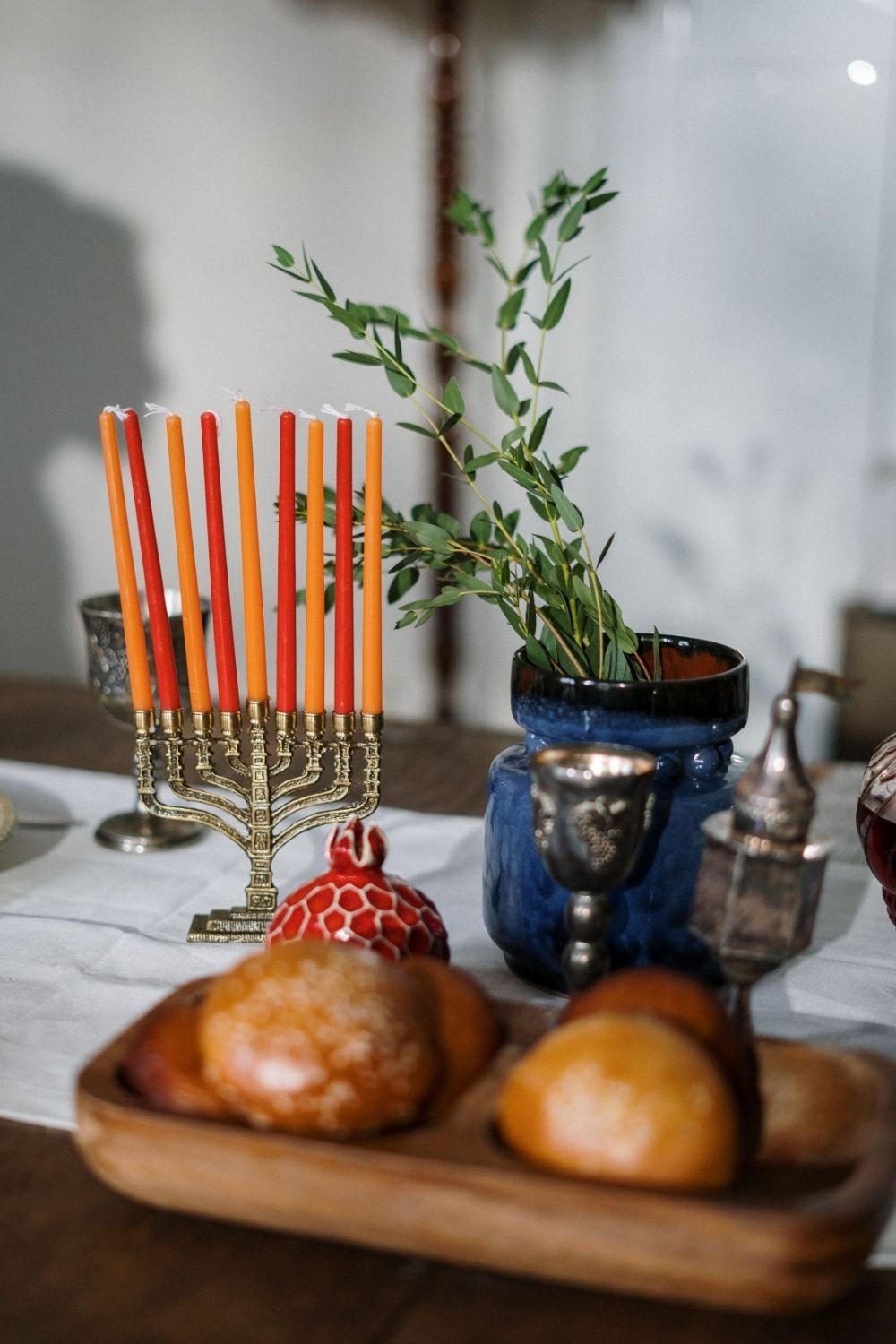
Photo by cottonbro studio on Pexels
The table above is mostly ordinary things. A brass menorah with orange and red candles, a deep blue glazed pot holding olive branches, a silver goblet, a small ceramic pomegranate, a plain white cloth and a wooden tray of doughnuts. The blue comes from the pottery rather than from a themed tablecloth, and the whole thing looks collected rather than bought for the week.
What I’d invest in:
- Navy or indigo linen napkins. They work at every meal, all year.
- One patterned runner in blue and white: a block print, an ikat, a woven stripe.
- A cream or natural linen tablecloth as the base for everything.
- Velvet ribbon in navy, silver or cream, for napkins, wreaths and gift wrap.
- A blue throw or two cushion covers for the sofa, which quietly pull the living room into the same palette.
The table
Hanukkah table decor is where people spend the evening, so it’s worth the most effort, and it needs to stay usable.
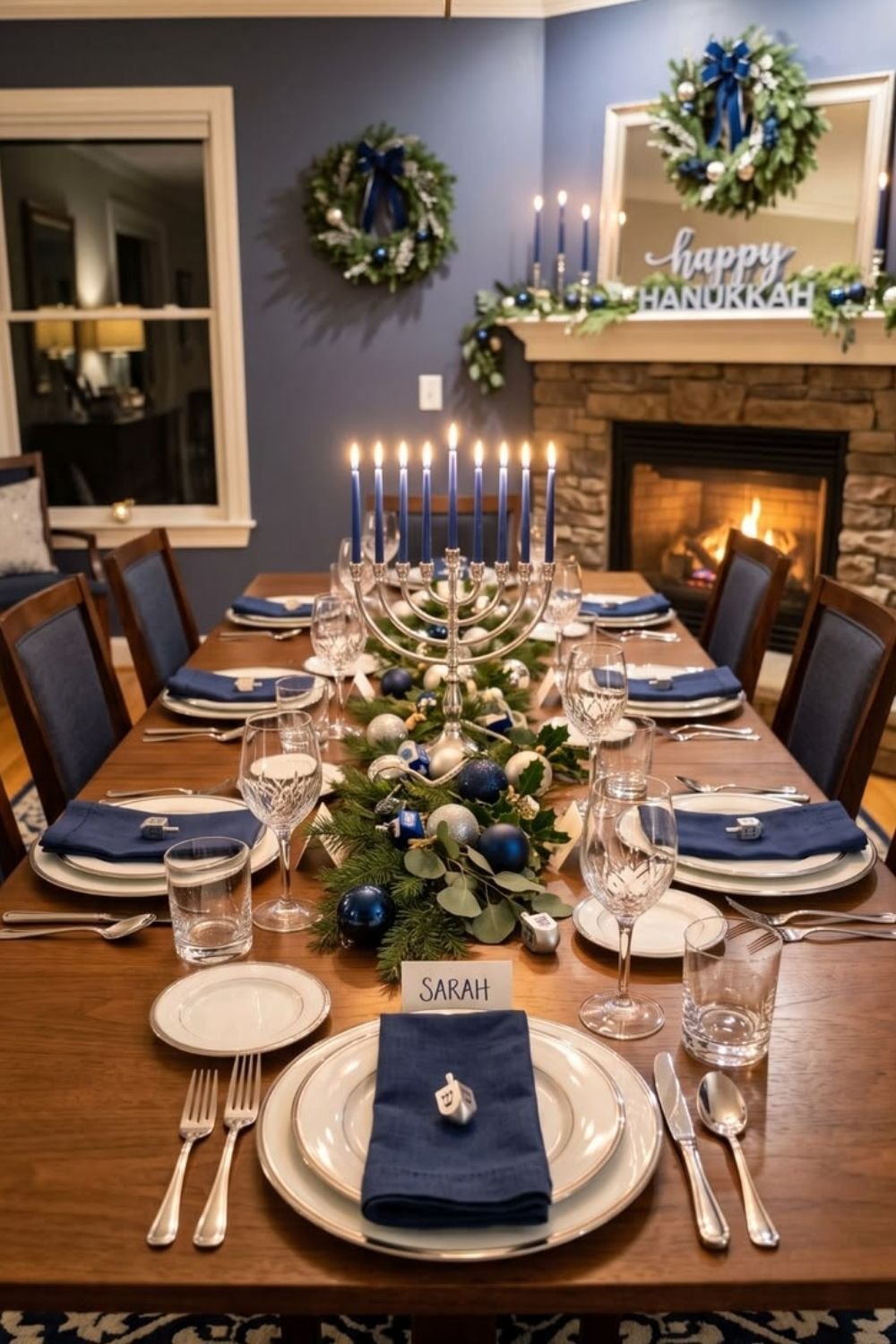
Photo by OurHoneyHome
This table pulls the whole room together. A silver menorah with lit blue tapers sits at the center on a bed of cedar and eucalyptus with navy and silver ornaments, small dreidels and cream candles tucked in. Each place setting has a white plate, a navy napkin with a little dreidel on top, silver flatware, cut glass and a handwritten place card. The blue-gray wall behind carries a wreath with a navy bow, and the stone fireplace mantel has greenery, blue candles and a “Happy Hanukkah” sign.
A few table rules I’d follow:
- Keep the centerpiece low so people can see each other. The menorah can be the tall thing, since everyone wants to see it.
- Leave landing space for serving plates, especially for fried food that arrives hot.
- Use place cards. A name in handwriting on plain card is one of the cheapest ways to make a table feel considered.
- Don’t decorate the middle so heavily that nothing can be passed across it.
The entryway
Hanukkah entryway decor is the first thing guests see and one of the easiest spots to style, since it usually needs nothing but a console and a few pieces.
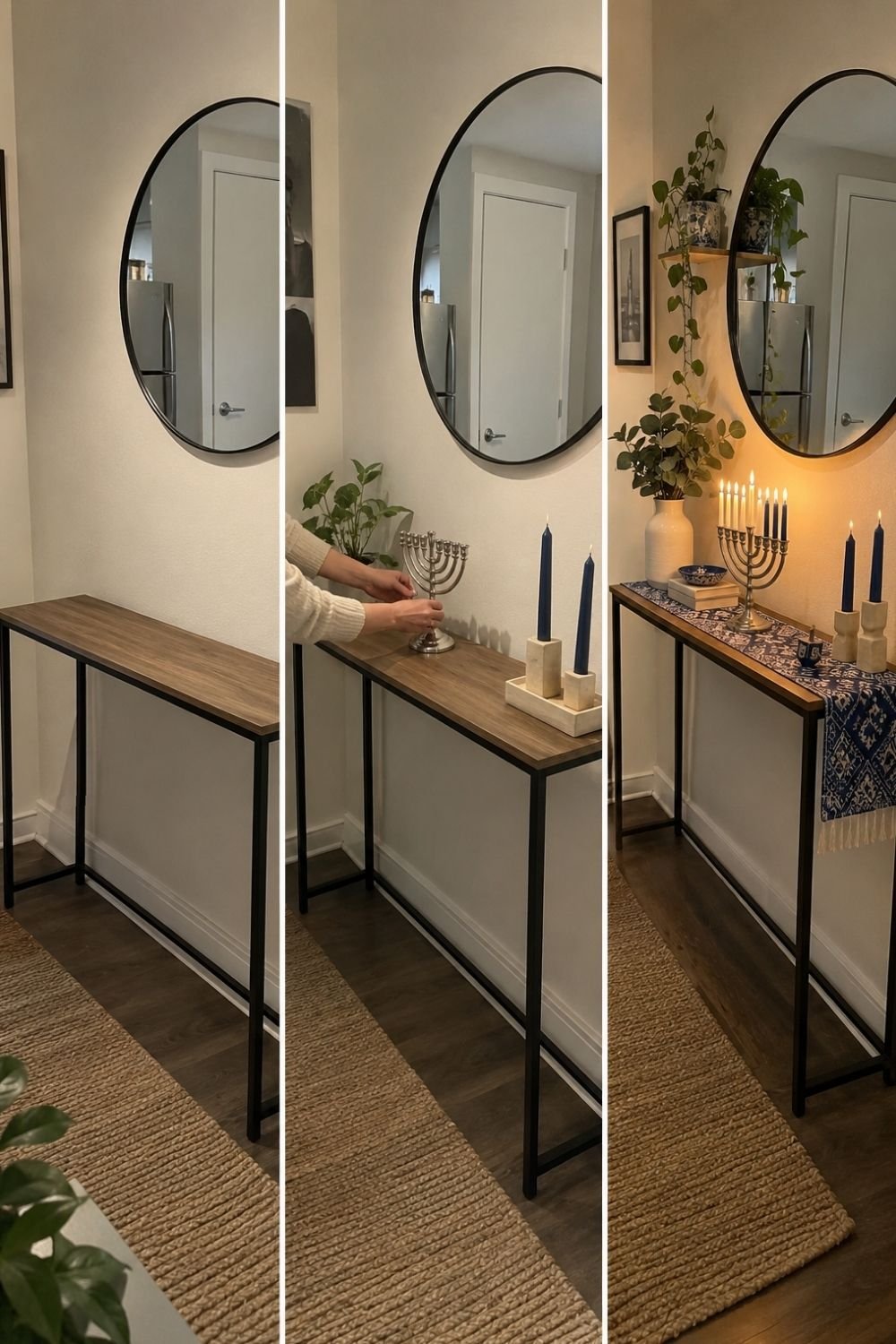
Photo by OurHoneyHome
The three frames above build one up. First, a narrow wood and black console under a round mirror, with a jute runner on the floor and nothing on top. In the second, a silver menorah goes on, with two navy tapers in stone holders beside it. In the last, the finished version: a blue and white patterned runner with tassels along the console, a white vase of eucalyptus, a stack of books with a blue bowl on top, the lit menorah reflected in the mirror, chunky stone candle holders with navy candles, and a small dreidel by the books.
Notice the mirror again. Anything reflective behind candles doubles the light, which is why a mirror, a metal tray or a glass vase earns its place here.
Paper, wood and things made at home
Some of the best Hanukkah decorations are the ones made at the kitchen table, especially with kids. Paper is cheap, and a good garland lasts several years if it’s stored flat.
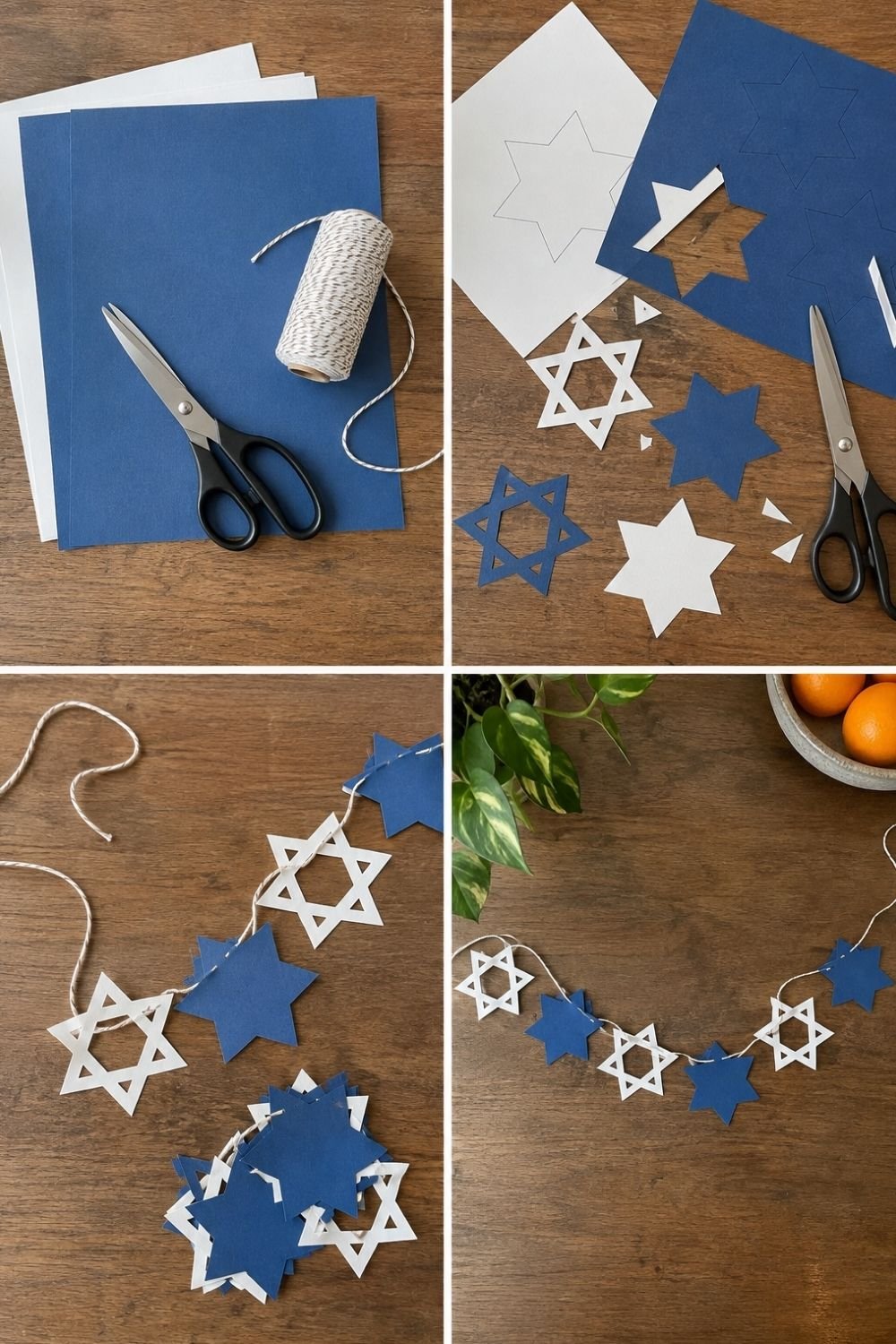
Photo by OurHoneyHome
The four frames above show a star garland from start to finish: navy and white card, scissors and baker’s twine; stars traced and cut from both colors; the shapes threaded onto the twine, alternating navy and white; and the finished garland laid out on a wood table next to a pothos and a bowl of oranges.
To make one: cut two six-pointed stars per template (one solid, one with the middle cut out), alternate colors along a length of twine, and glue or thread them in place. Hang it across a mantel, a bookshelf or a window frame.
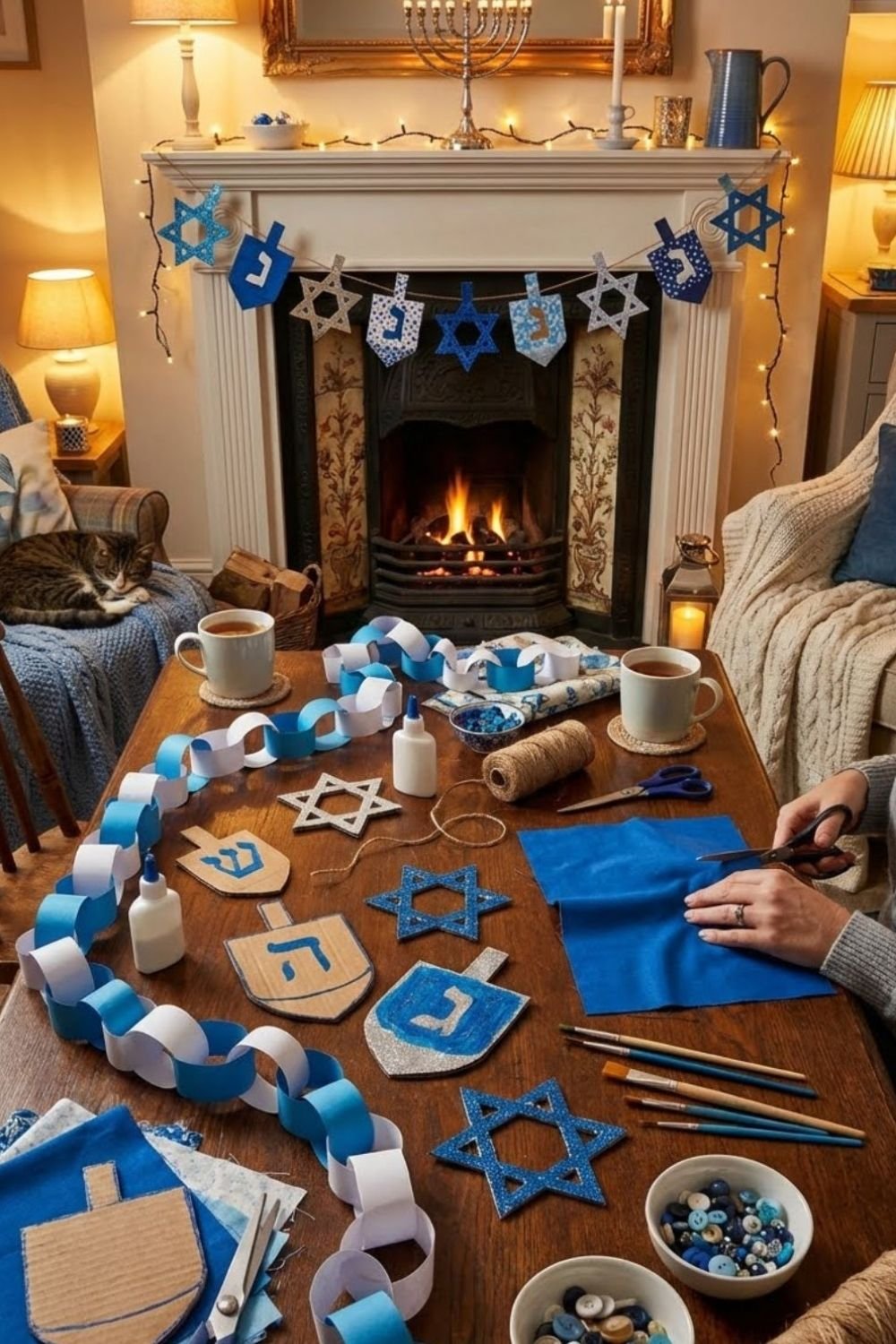
Photo by OurHoneyHome
This one shows the whole afternoon: a coffee table covered in blue and white paper chains, cardboard dreidels, glittered stars, felt shapes, buttons, twine, glue and paintbrushes, with two mugs of tea, a cat asleep on the armchair and a fire going. On the mantel behind, the finished garland of stars and dreidels is already hanging, with fairy lights and a menorah above it.
Other easy makes worth keeping:
- Felt dreidels or stars to hang on a branch in a vase.
- Painted wooden dreidels, which double as table decor and as something to play with.
- A paper chain in navy, white and silver, which kids can make in twenty minutes.
- Framed handwriting or a child’s drawing, brought out every year like an ornament.
Pick a palette
- Blue, white and silver: the classic. Keep the blues in one family (navy plus pale blue reads better than five different blues).
- Warm neutral: cream, brass, wood and greenery, with blue only in small doses. My favorite, and the easiest to live with if your home is neutral all year.
- Minimalist: minimalist Hanukkah decor means white candles, one menorah, a single greenery stem, nothing else on the surface.
- Elegant: brass, mercury glass, white flowers, velvet ribbon and cut glassware.
Whichever you pick, the Christmas styling post and the New Year’s post use the same trick of building around candles and metal, so pieces move easily between all three.
Small apartments
You don’t need a mantel or a long table for any of these Hanukkah decorating ideas.
- One shelf or windowsill is enough: menorah, two candlesticks, a small vase of greenery.
- A tray on the coffee table keeps the whole display portable, which matters when the coffee table is also the dining table.
- Hang the garland on a curtain rod or across a bookshelf with removable hooks, so there’s no drilling.
- Use the kitchen counter if that’s the room everyone gathers in. The countertop styling post has a grouping trick that works for this.
- Watch the clearances. In a small space, the candles need more care: away from curtains, blinds, paper and shelves above.
Packing it away so next year is easier
The whole point of buying fewer, better pieces is that next year should take an hour rather than an afternoon. A few things that help:
- One labeled box, not three. If it doesn’t fit, you probably have decorations you don’t use.
- Wrap the menorah in a cloth, and clean the wax off first with hot water or a hairdryer on low.
- Store garlands flat, between sheets of paper, so the points don’t crease.
- Keep the candles cool and dark. Colored candles bend and fade near a radiator or a window.
- Drop a note in the box with what you’d change: more tea lights, fewer ornaments, new napkins. Next you will be grateful.
And the pieces that don’t belong in the box, like the linen napkins, the brass candlesticks and the blue ceramics, just go back into everyday use. That’s how you can tell they were the right things to buy.
