Afrohemian is what happens when African design traditions meet the layering habits of bohemian interiors. Natural fiber, carved wood, pattern with meaning behind it, earthy color, plants, and objects that were collected rather than bought as a set.
It’s a style that rewards knowing what you’re looking at. A mudcloth cushion from a maker in Mali and a factory print sold as “tribal” look superficially similar and are not remotely the same object, and the difference shows up in the room. So throughout this post I’ve named the craft traditions the pieces come from wherever the style is clearly identifiable, because that naming is a large part of what separates afrohemian decor from generic global boho.
This one is organized by material rather than by room. Each section is one element I’d build around, and most of them work as easily in a bedroom or an entryway as in a living room.
Carved wood is the anchor, not the accent
Almost every afrobohemian home decor scheme I like has one substantial piece of carved or hewn wood in it, and the rest of the room arranges itself around that piece.
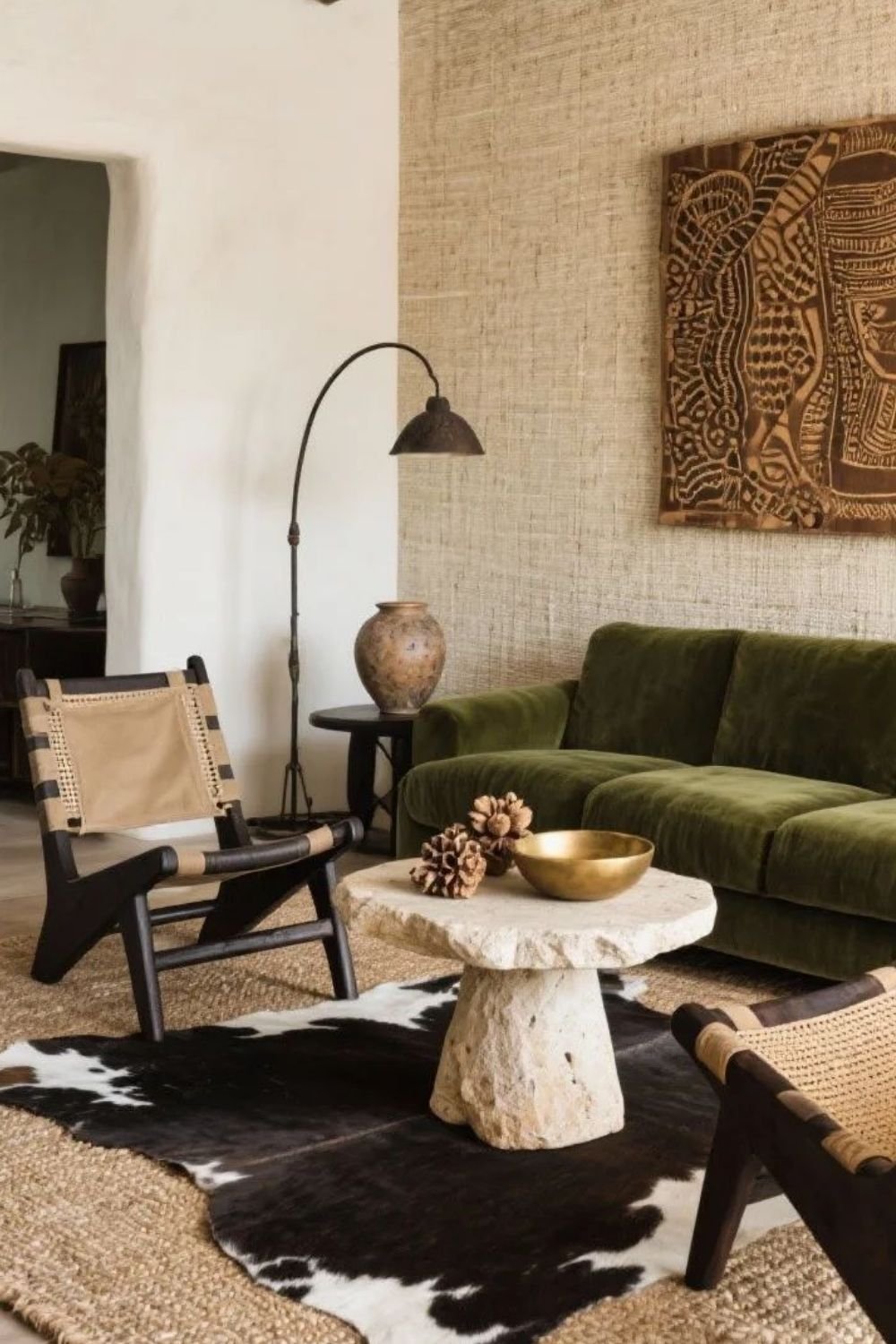
Photo by OurHoneyHome
The room above is a good demonstration. A deep olive velvet sofa sits against a wall clad in woven raffia, with a large carved relief panel hung above it. Two low sling chairs in black wood with leather and woven seats face in, the floor is jute with a cowhide layered over it, and a rough stone pedestal table holds a brass bowl and a couple of dried seed pods. A terracotta urn stands on a small dark side table.
The carved panel is doing all the heavy lifting. Take it off that wall and the room becomes a pleasant neutral living room with a green sofa. Leave it up and everything else reads as supporting cast.
The low chairs are worth noting too. Sling and strap seating of this kind, with a wooden frame and a woven or hide seat, shows up across West African furniture traditions and in mid-century designs that borrowed from them. A rattan accent chair does a similar job at a lower price and is far easier to find.
One very large wooden thing beats five small ones
Following from that: if the budget only stretches to one significant piece, make it big. Scale is what stops this style from looking like a shelf of souvenirs.
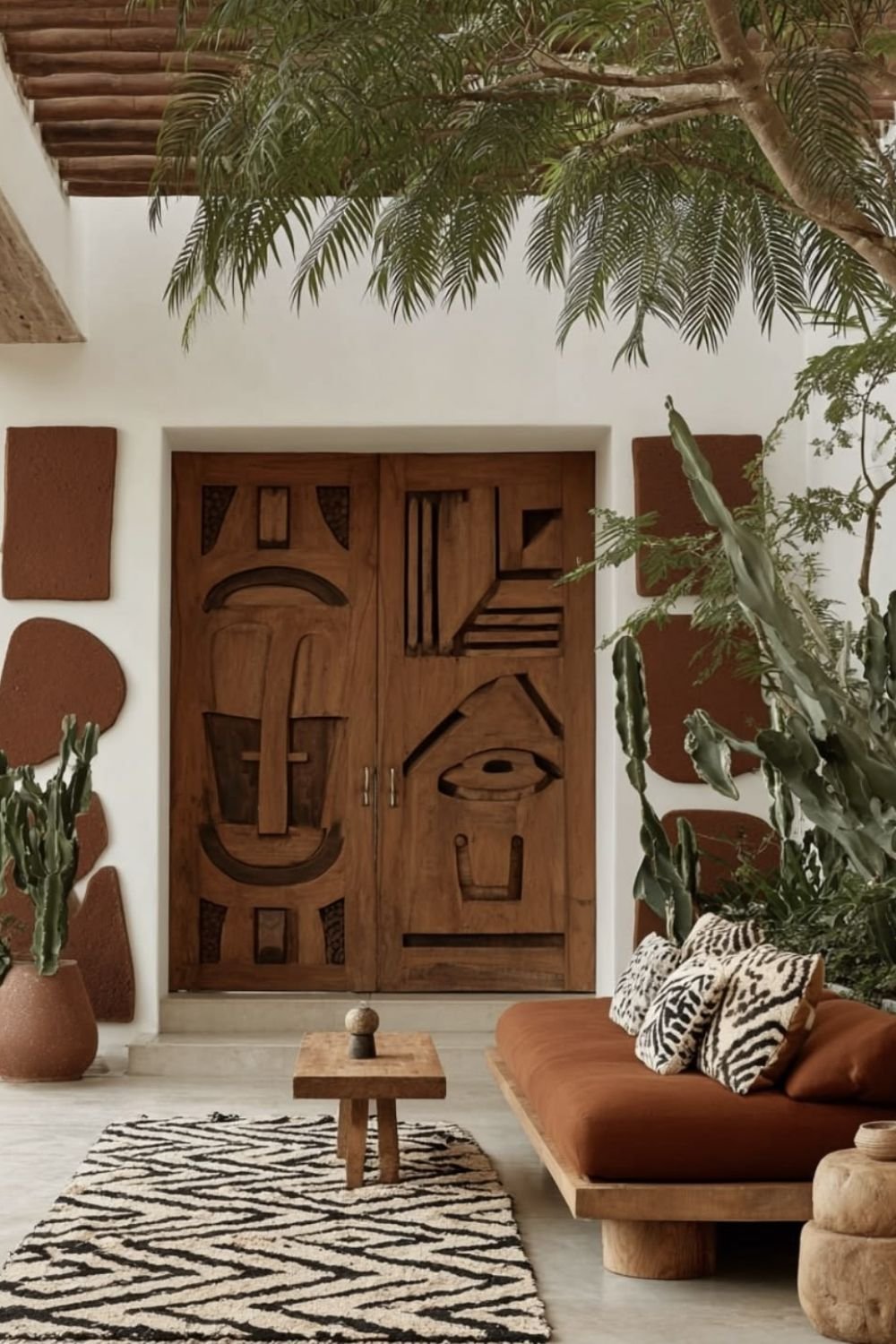
Photo by OurHoneyHome
Here a pair of tall carved doors with a deep abstract relief sits in a white plaster wall, flanked by irregular terracotta panels hung like paintings. Below, a low wooden platform daybed carries a rust cushion and a set of black-and-cream patterned pillows, with a small carved four-legged table in front of it on a zigzag rug, and cacti and a feathery tree filling the corners.
The doors are the room. Everything else is quiet by comparison, which is exactly why it works.
If you can’t hang carved doors, the same effect comes from one oversized wooden piece: a plank bench, a chunky low table, a single tall carved panel. The failure mode of this style is lots of small carved objects on lots of small surfaces, which reads as clutter rather than intent.
Baskets do more work than any other single object
If I could only use one category of thing, it would be baskets. They bring texture, they’re usually the least expensive part of the room, and unlike most decorative objects they hold things.
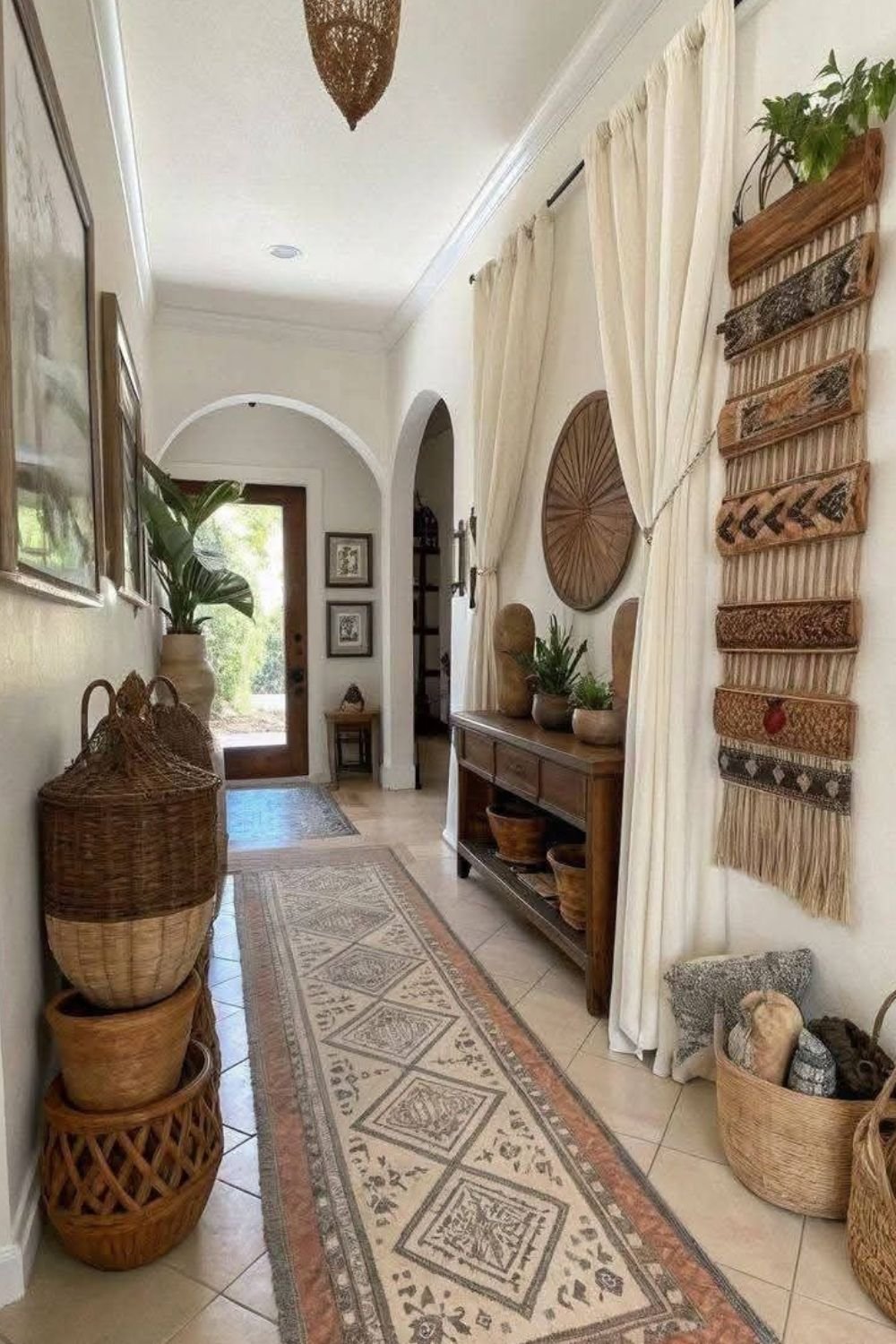
Photo by OurHoneyHome
This entryway is almost entirely woven basket decor. A lidded basket sits on two stacked terracotta and wicker planters by the door, a woven pendant hangs overhead, a carved round disc is mounted on the far wall, and a wooden rail holds a long panel of stitched textile strips with a fringe at the bottom. A dark wood console carries potted plants, with more baskets underneath and a basket of stones on the floor.
Worth knowing what you’re buying. The tightly coiled bowls with geometric banding come from the Zulu ilala palm tradition in South Africa. The wide flat-bottomed ones with looped handles and bright dyed bands are usually Bolga baskets, woven from elephant grass in and around Bolgatanga in northern Ghana. Both are made by hand and both are sold, unattributed, as “African basket” by a great many shops.

Photo by OurHoneyHome
And the useful version. Nine shallow wall baskets hung in a loose grid on a kitchen wall, holding lemons, limes, apples, cucumbers, carrots, ginger and oranges, with a pothos trailing down through them.
I like this more than any fruit bowl. It gets produce off the counter, it keeps air around everything, and the wall becomes texture and color that changes with the shopping. Two hooks per basket so they don’t tip, and nothing heavy above head height.
Pattern belongs on the textiles, and it has names
Pattern in an african boho living room lives on cloth, not on walls or furniture. Cloth can be moved, layered, washed and replaced, which is how the style stays collected rather than decorated.
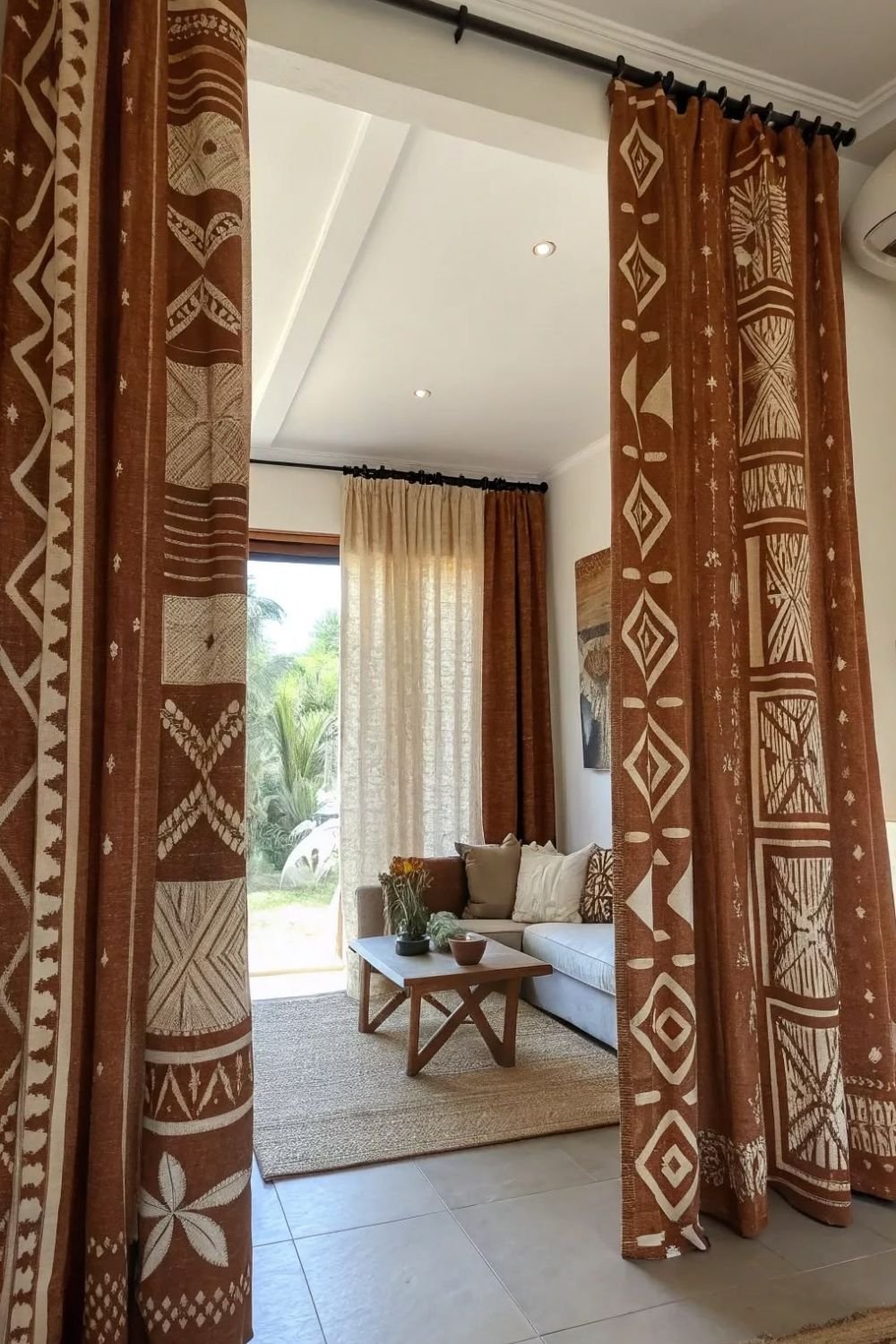
Photo by OurHoneyHome
The room above is seen through a pair of rust and cream curtains carrying bold geometric panels: diamonds, arrows, cross-hatching and stylized figures in bands down the length of the fabric. Beyond them the room itself is plain. Gray sofa, wooden coffee table, jute rug, sheer inner curtains, a single framed piece on the wall.
That restraint is deliberate and it’s what I’d copy. One patterned textile at full height, everything else calm.
The vocabulary on those curtains comes from bògòlanfini, the mud-dyed cotton made by Bamana artisans in Mali, usually called mudcloth in English. It isn’t the only tradition worth knowing. Adire is the indigo resist-dyed cloth of the Yoruba in southwestern Nigeria, with its own patterns and its own meanings. Kuba cloth, woven from raffia palm fiber by Kuba peoples in the Democratic Republic of Congo, carries dense interlocking geometry and is often cut-pile rather than printed.
Buying the genuine article costs more than a printed copy and supports the people who make it, which seems like the obvious choice if you’re going to build a room around the pattern.
Earthy and saturated at the same time
The color story here confuses people, because the palette is described as earthy and yet the rooms are rarely beige. Earthy means the pigments look like they came out of the ground. It doesn’t mean muted.
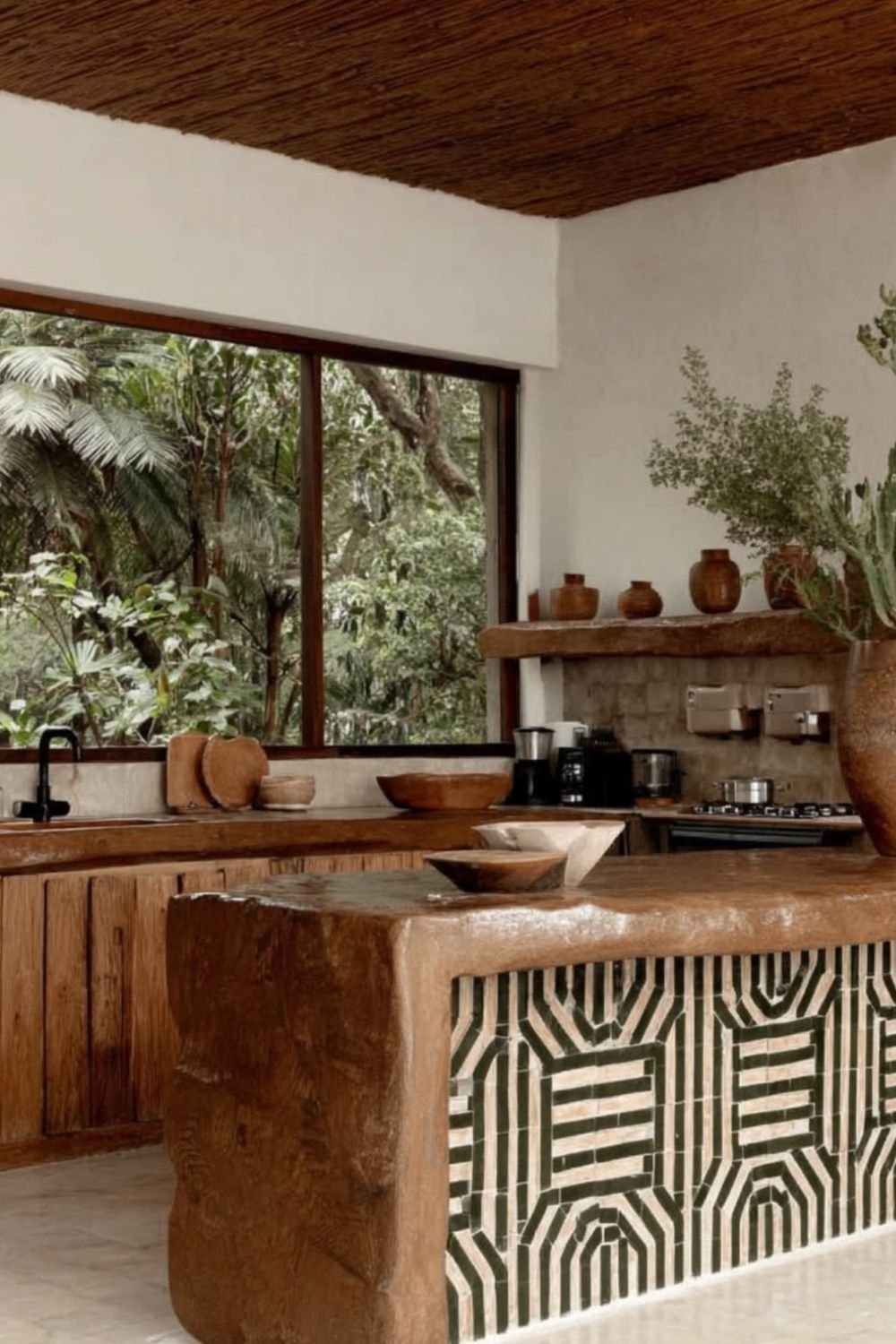
Photo by OurHoneyHome
This kitchen is built from a single hewn timber island and matching counters, with a reed ceiling above, a thick wooden shelf holding round terracotta pots, and a window looking straight into jungle. The front of the island is faced in a panel of green and cream tile laid in a maze-like geometric pattern.
Three colors, near enough: wood brown, terracotta, and that deep green. The green tile is as saturated as anything you’d find in a maximalist scheme, and it still reads as natural because it sits against raw wood rather than white gloss.
The geometric layout of the tile matters as much as the color. Straight bands turning back on themselves belong to a long tradition of painted and woven geometry across the continent, from Ndebele wall painting in South Africa to the interlocking patterns of Kuba weaving, and a plain green tile in the same spot would have carried none of it.
If you want a quieter version of afro chic home decor, keep the same three-color logic but let the wood do more of the work. If you want a louder one, put the saturated color on a large surface like this rather than scattering it across cushions.
Animal print, used the way it actually works
This is the part of the style most likely to go wrong, and the reason is usually quantity rather than taste.
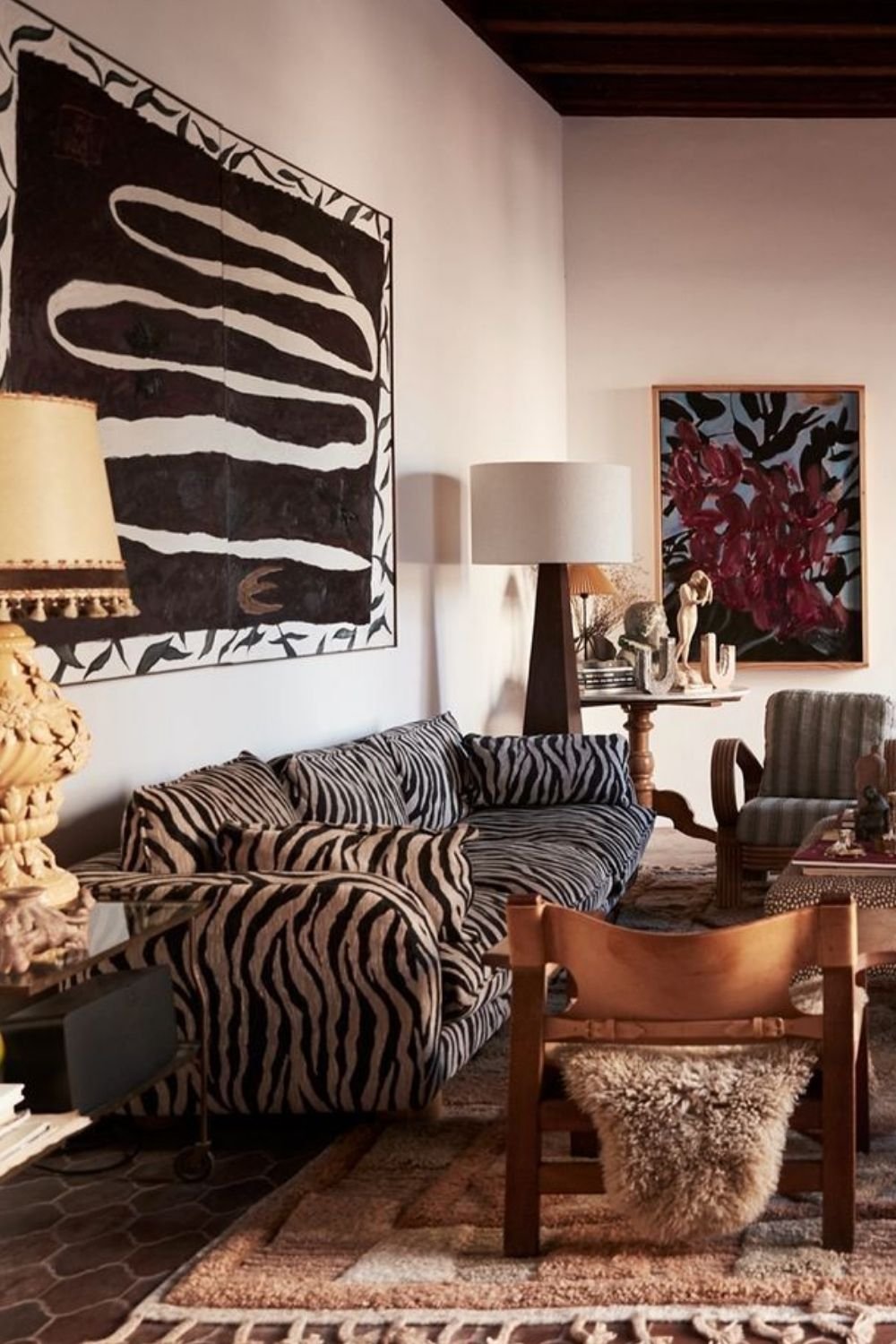
Photo by OurHoneyHome
Here a zebra-print sofa anchors a room with a large black-and-white abstract canvas above it, a framed painting of red blooms on the far wall, sculptural table lamps, a dark wood chair with a sheepskin thrown over it, and layered rugs in the style of Amazigh weaving from the Middle Atlas over dark hexagonal tile.
The sofa is the only animal print in the room. Everything around it is either solid or abstract, and the black-and-white canvas above echoes the sofa’s palette without repeating its pattern.
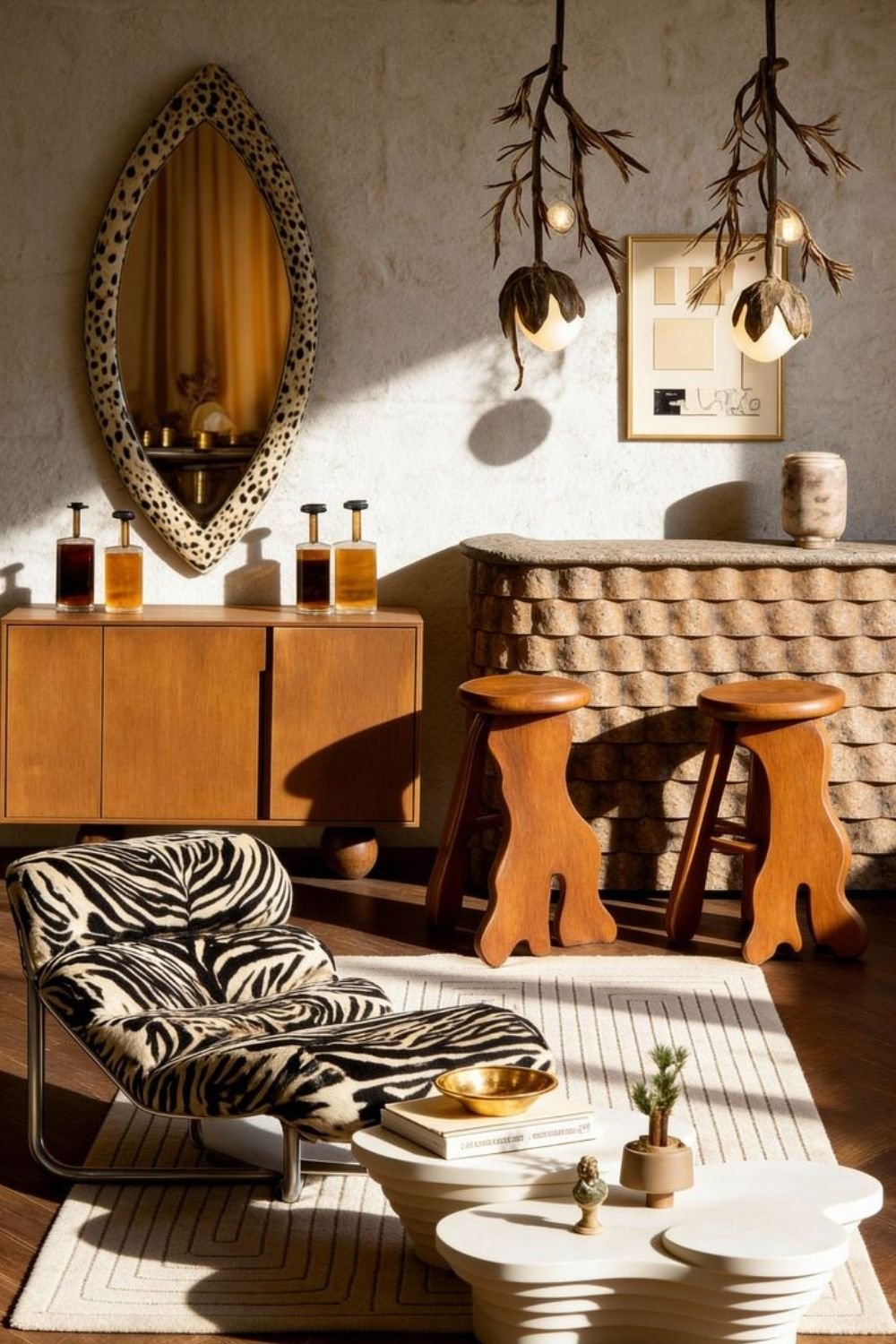
Photo by OurHoneyHome
The second room pushes it further and still holds together. A leopard-spotted framed mirror hangs above a warm teak sideboard with four decanters on top, a zebra lounge chair on a chrome frame sits on a fine striped rug, two wavy-legged wooden stools stand at a textured plaster bar, and branch-shaped pendants hang overhead.
Two prints, both black and white, and absolutely everything else is a solid warm neutral. That’s the rule: print carries the pattern, and nothing else in the room competes.
The renter-friendly version
Almost none of the above needs permission. Baskets hang from adhesive hooks, textiles go over an existing curtain rail, rugs layer over whatever carpet is already down, and a carved panel can lean against a wall rather than hang on one.
In a bedroom, the whole look can sit on the bed and the floor. A mudcloth or adire throw folded across the end, two patterned cushions among plain linen, a jute rug under the bed, a woven pendant shade swapped onto the existing fitting, and one carved stool as a nightstand. If you want to see how that fits alongside other directions, it layers well over most of the bedroom styles worth saving.
The one piece of furniture I’d buy rather than improvise is seating, because a woven or rattan chair is the fastest way into this style and it moves with you. A freestanding rail fills a similar role in a bedroom, and both go in the van when the lease ends.
Where I’d start
If I were building one of these rooms from nothing, I’d buy in this order: one large wooden piece, one patterned textile, three baskets in different sizes, then plants. Everything after that is adjustment.
What holds it together is restraint, which sounds like odd advice for a layered style. The rooms above each have one loud element and a lot of quiet material around it. The version that goes wrong is the one where every surface has a pattern on it, which is worth remembering if you’re coming at this from a more general boho living room and used to layering everything at once.
And buy from the makers where you can. The style is built on specific traditions with specific names, and a room that contains the actual cloth rather than a printed approximation of it looks different in a way that’s hard to articulate and easy to see.
