Yes, it can, and square footage has very little to do with it. The cozy bathroom ideas that make the biggest difference in a small space are about light color, texture and a handful of soft materials: a warmer bulb, a wall color with some depth, a towel you’d want to touch, a plant that can live with steam. None of these need more room. Most of them don’t even need a contractor.
Quick answer: Swap cool white bulbs for 2700K, add one warm wall color or finish, bring in two or three natural textures (wood, woven fiber, cotton), and fix the ventilation before you add anything that can hold moisture.
The ideas below go layer by layer, in the order we’d tackle them, and most have a renter-friendly version.
Cozy bathroom ideas that start with the light
The fastest change costs about as much as a lightbulb. Most small bathrooms come with one ceiling fixture and a cool white bulb, which makes white tile look blue and skin look tired. Lower color temperatures give off a yellower, softer light, and Energy Trust of Oregon notes that most people prefer around 2700K in rooms where the point is to relax. For a bathroom where you also shave or do makeup, 2700–3000K is a sensible range: warm, but not so orange that you can’t tell navy from black.
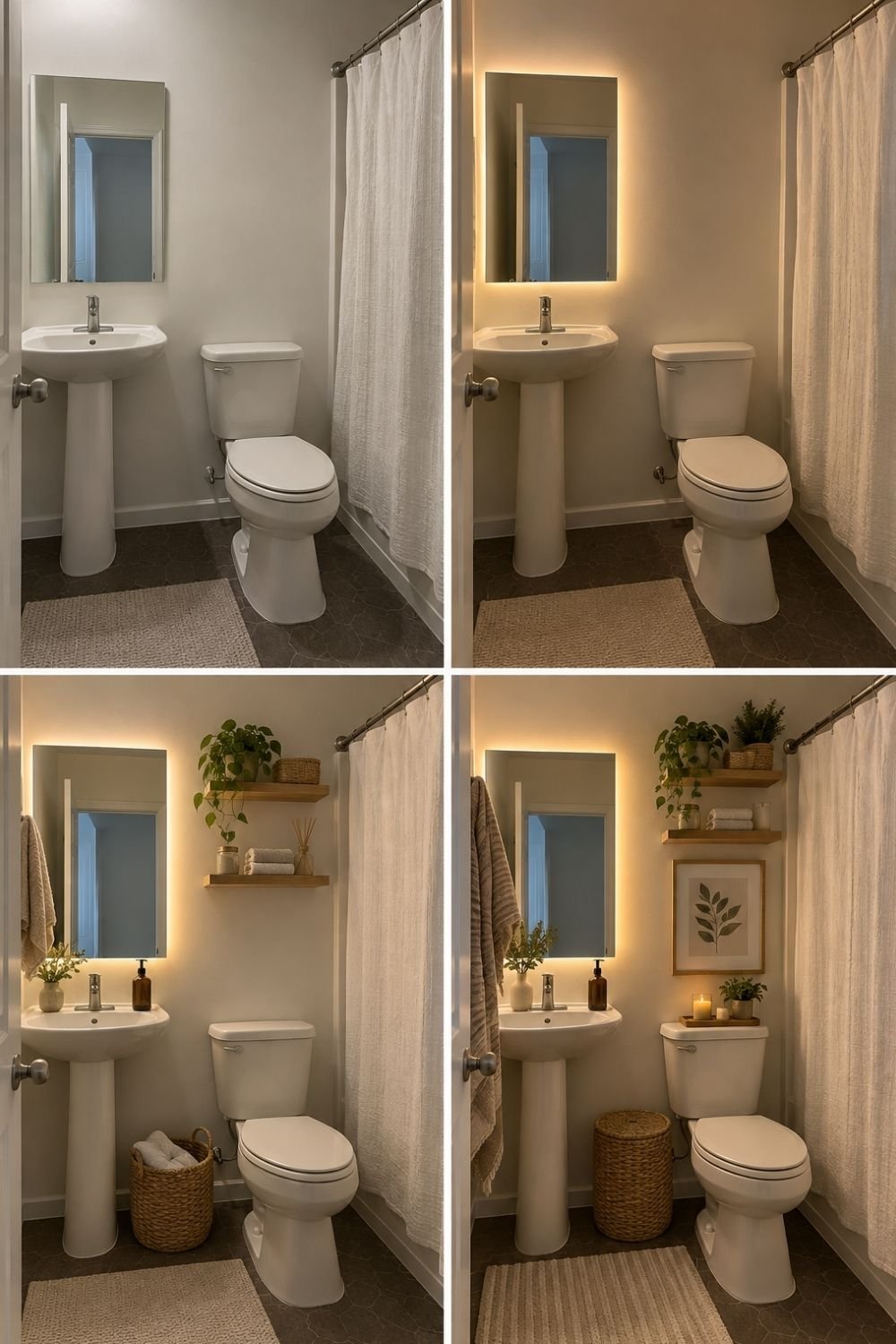
Photo by OurHoneyHome
The four-step photo above shows how much of the change comes from light alone. The second frame changes nothing but the mirror, which gets a warm backlight, and the white walls already read as cream. The shelves, plants and baskets come after that, and they’d look flat under the original light.
Other options, from easiest to most involved:
- Warmer bulbs in the fixtures you already have. Check that the bulb is rated for enclosed or damp locations if the fixture is closed.
- A second light source at eye level. One overhead light throws shadows down your face; a light beside or behind the mirror fills them in.
- Plug-in wall sconces with the cord run through a cord cover, if you rent or don’t want to open the wall.
- A pendant with a woven or paper shade, which scatters the light into soft patterns on the wall.
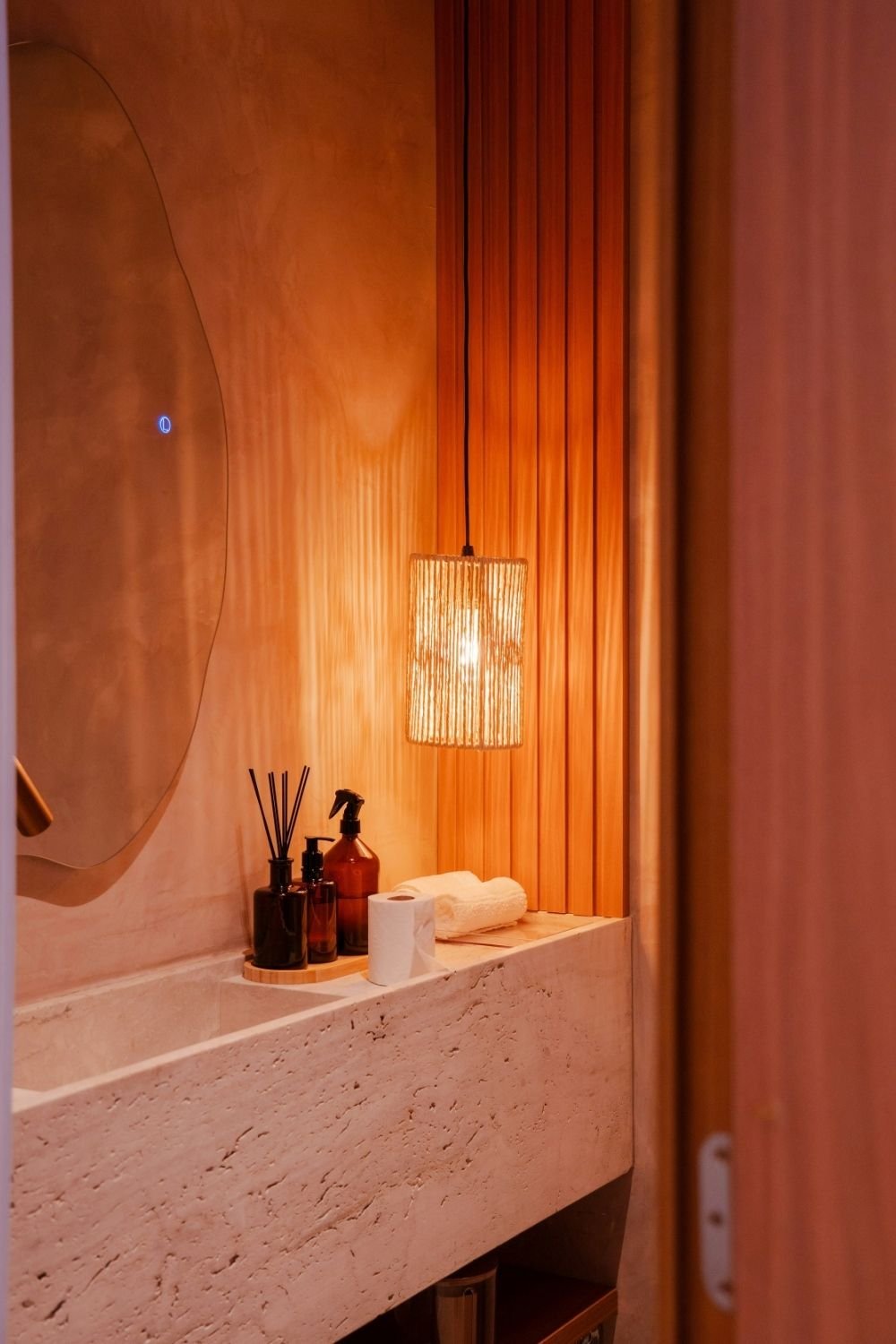
Photo by Rodrigo Rodrigues | WOLF Λ R T on Unsplash
To be fair, anything hardwired (a backlit mirror, new sconces, a pendant over the vanity) is a job for a licensed electrician. Bathrooms combine water and electricity in a small space, and wet-location rules exist for good reason.
A mirror that works harder than you’d think
In a small bathroom the mirror is often the biggest single object on the wall, so its shape and frame do a lot of the decorating. A rectangular builder-grade mirror with no frame looks like part of the plumbing. A round, arched or oval mirror with a thin wood or dark metal frame looks like something someone chose.
- Size it to the vanity, not the wall. A mirror slightly narrower than the vanity below it looks settled; a wider one looks like it’s sliding off.
- Backlit mirrors add a light source and a mirror in one purchase. The catch: most need hardwiring, and the built-in LEDs can’t be swapped later, so check the color temperature before you order.
- Wood frames need a finish. Sealed wood handles steam; raw wood can swell and discolor.
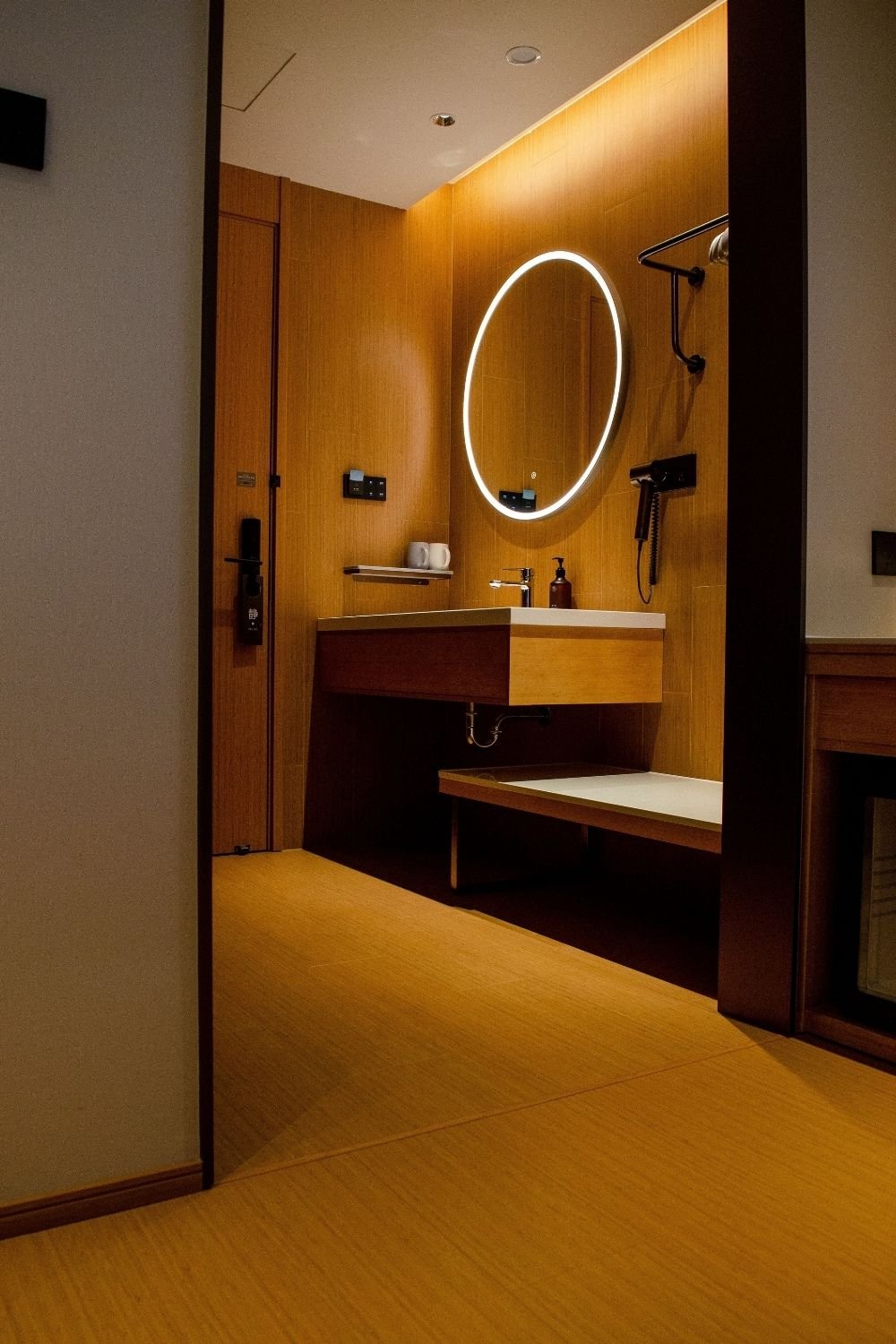
Photo by silas tarus on Pexels
The hotel bathroom above is a good reference for what a round backlit mirror does against wood-look walls: the ring of light lands on the grain and makes the whole wall glow, with no other lamp in sight.
Warm up the walls with paint and color
White is the default in small bathrooms because it’s supposed to make the room look bigger. In a windowless half bath with one fixture, it mostly makes the room look like a clinic.
Warm neutrals are the easy start: greige, taupe, mushroom, warm off-white. They look calm in daylight and go soft and golden under a 2700K bulb.
Richer colors work better in small bathrooms than most people expect: olive, deep green, terracotta, plum, charcoal. Mind you, dark paint doesn’t shrink a room so much as blur its corners, and in a space you spend three minutes in at a time, that’s a fair trade. If you’re nervous about going that dark, these tips for styling black accent walls apply to a single bathroom wall too.
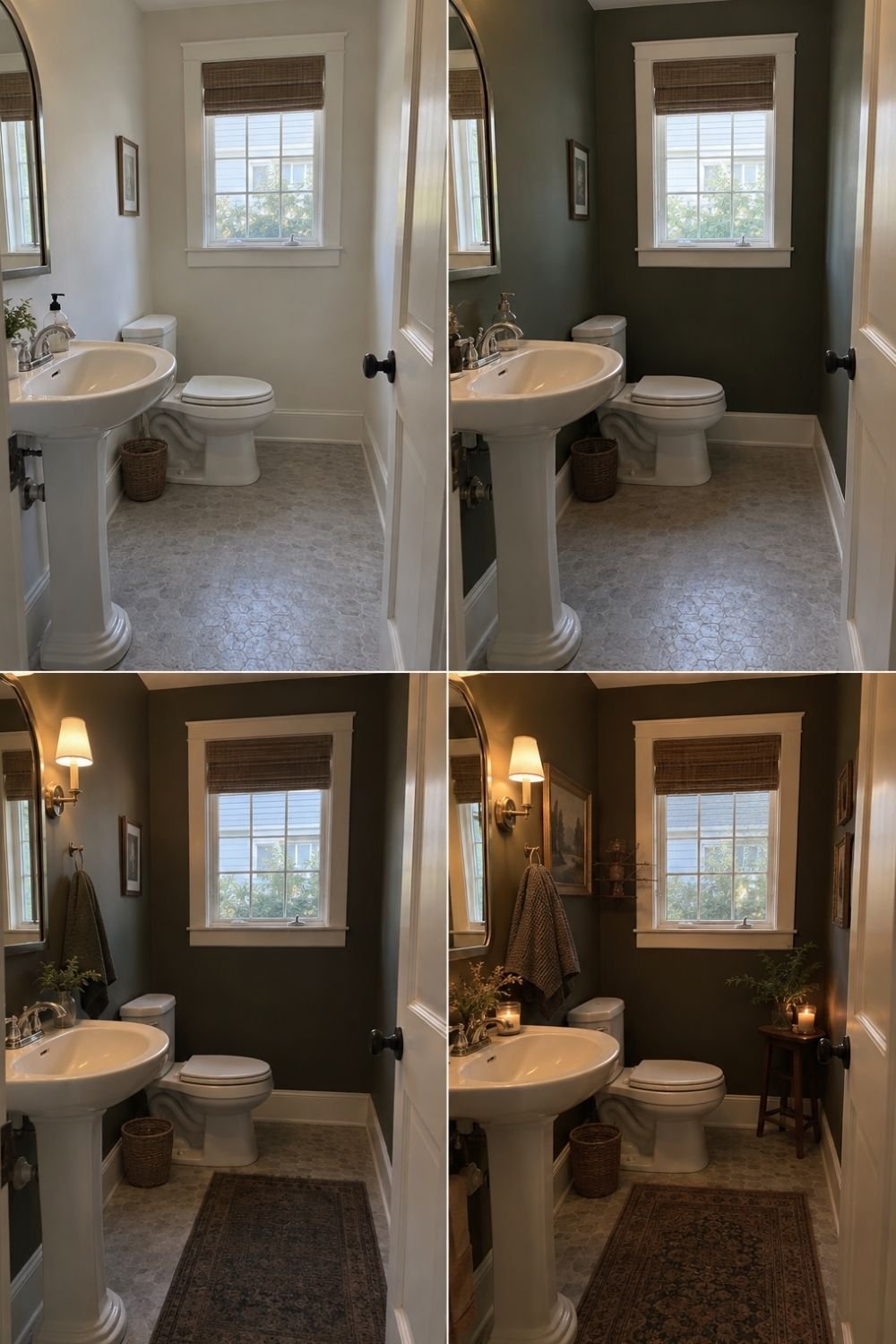
Photo by OurHoneyHome
The powder room above goes from white to a dark olive-charcoal in the second frame, and the white trim, window and pedestal sink suddenly look crisp instead of blending into the walls. The last two frames add a brass sconce with a fabric shade, a vintage-style rug and a couple of framed landscapes. The paint does most of the work, though.
Painting every wall, the ceiling and sometimes the trim in one color is called color drenching, and tiny bathrooms suit it because there are few surfaces and no furniture to plan around. If a full drench feels like too much, there’s a softer way to try color drenching. It’s worth experimenting with a sample pot first: a deep color looks completely different at night than in the store.
Choose a satin or semi-gloss finish made for bathrooms. It wipes clean and handles moisture better than flat paint.
Tiles and wall finishes that add warmth
If the tile is staying, as it usually does in a rental, work with its color: cream and beige tile pairs well with wood, brass and linen, and cold white tile warms up once wood and woven fiber are nearby. If you can change the finishes, these add the most warmth per square foot:
- Warm-toned tile: terracotta, handmade-look zellige, travertine, sand or clay-colored porcelain. Rectangular tile laid vertically makes a low ceiling look a little taller.
- Grout color: a warm beige or greige grout ties the tiles into one surface; bright white grout outlines every tile and makes a small wall look busy.
- Plaster and stone looks: limewash, microcement or a travertine vanity, like the one in the lighting section, give the soft matte texture of spa bathrooms with almost no decor needed.
- Wood-look wallpaper or panels: wood grain warms up a powder room fast, as long as it’s rated for bathrooms and kept away from direct water.
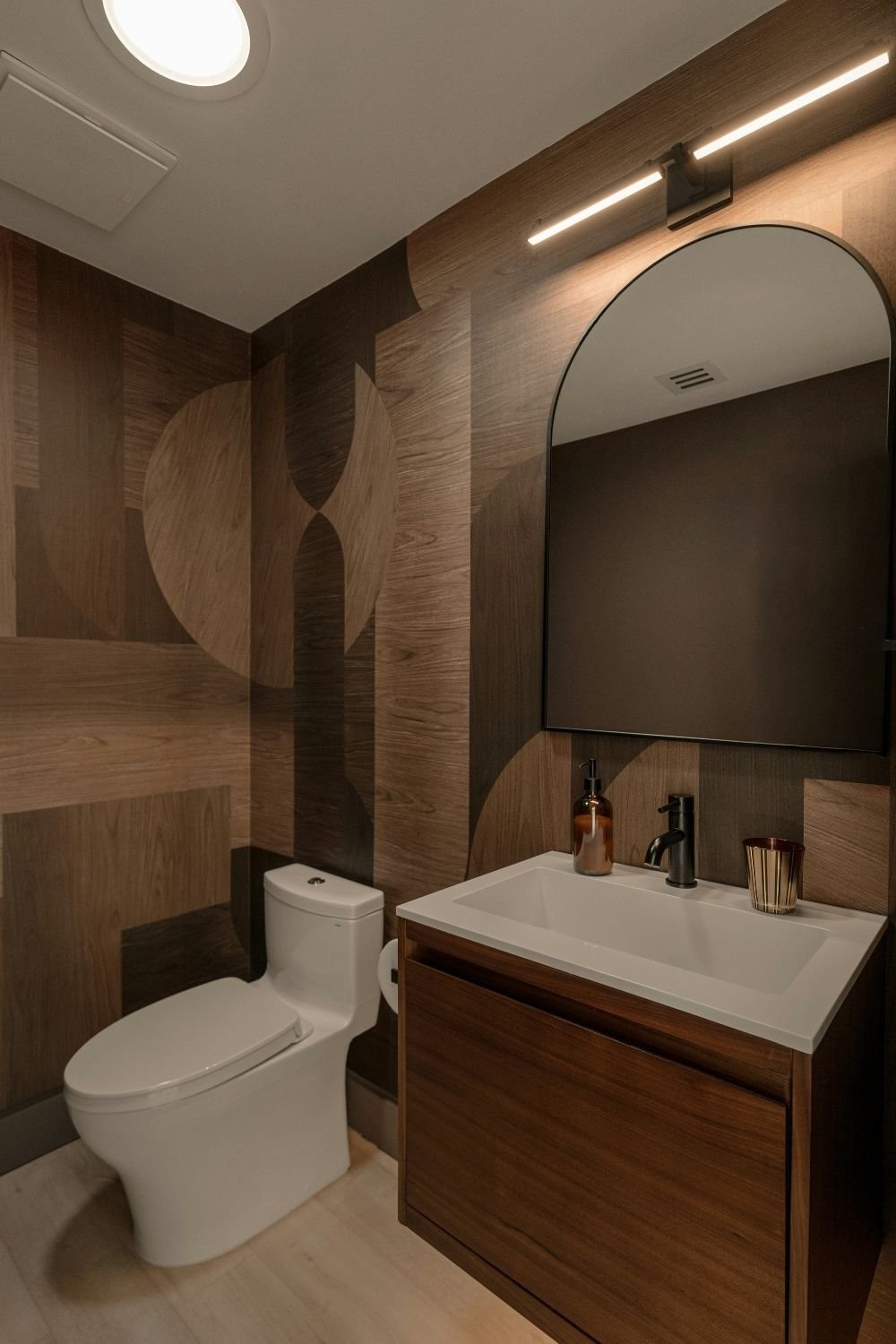
Photo by Peter Muniz on Unsplash
Peel-and-stick wallpaper is the renter’s answer, and it can work well on one wall, like the botanical print behind the toilet below. I’d pay close attention to where it goes: keep it on the wall farthest from the shower, pick a vinyl product that says it’s suitable for bathrooms, and expect the seams to lift if the room stays steamy for long stretches. Good ventilation (more on that below) decides how long it lasts.
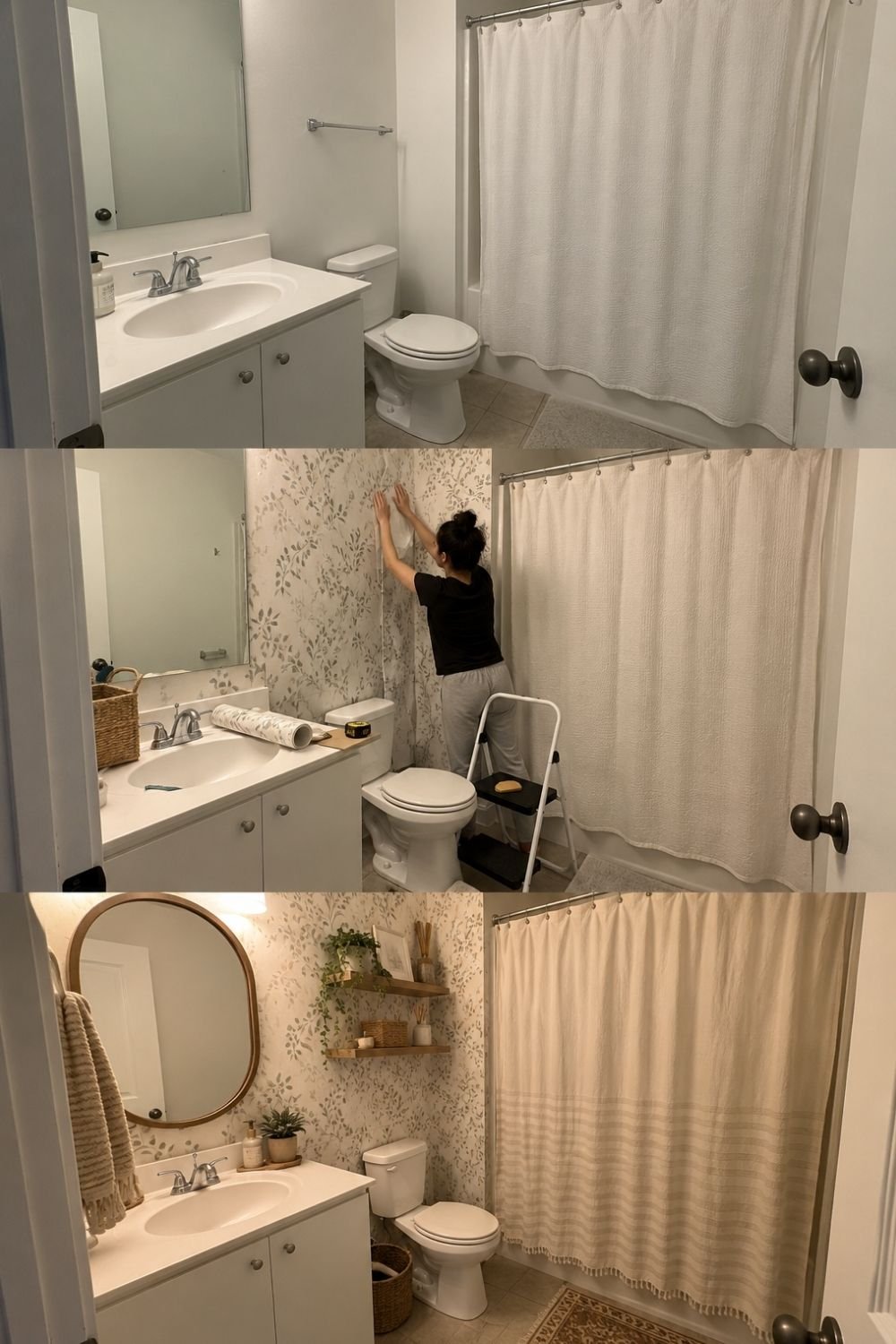
Photo by OurHoneyHome
The same makeover swaps in an oval wood-framed mirror, two floating shelves and a striped, fringed shower curtain. The vanity, toilet and floor never change.
Small toilet room ideas
A separate toilet room (a WC or water closet) is usually long, narrow and tiled halfway up, which is exactly why it tends to feel like a hallway with plumbing. The good news: there are only two or three walls to work with, so small changes show.
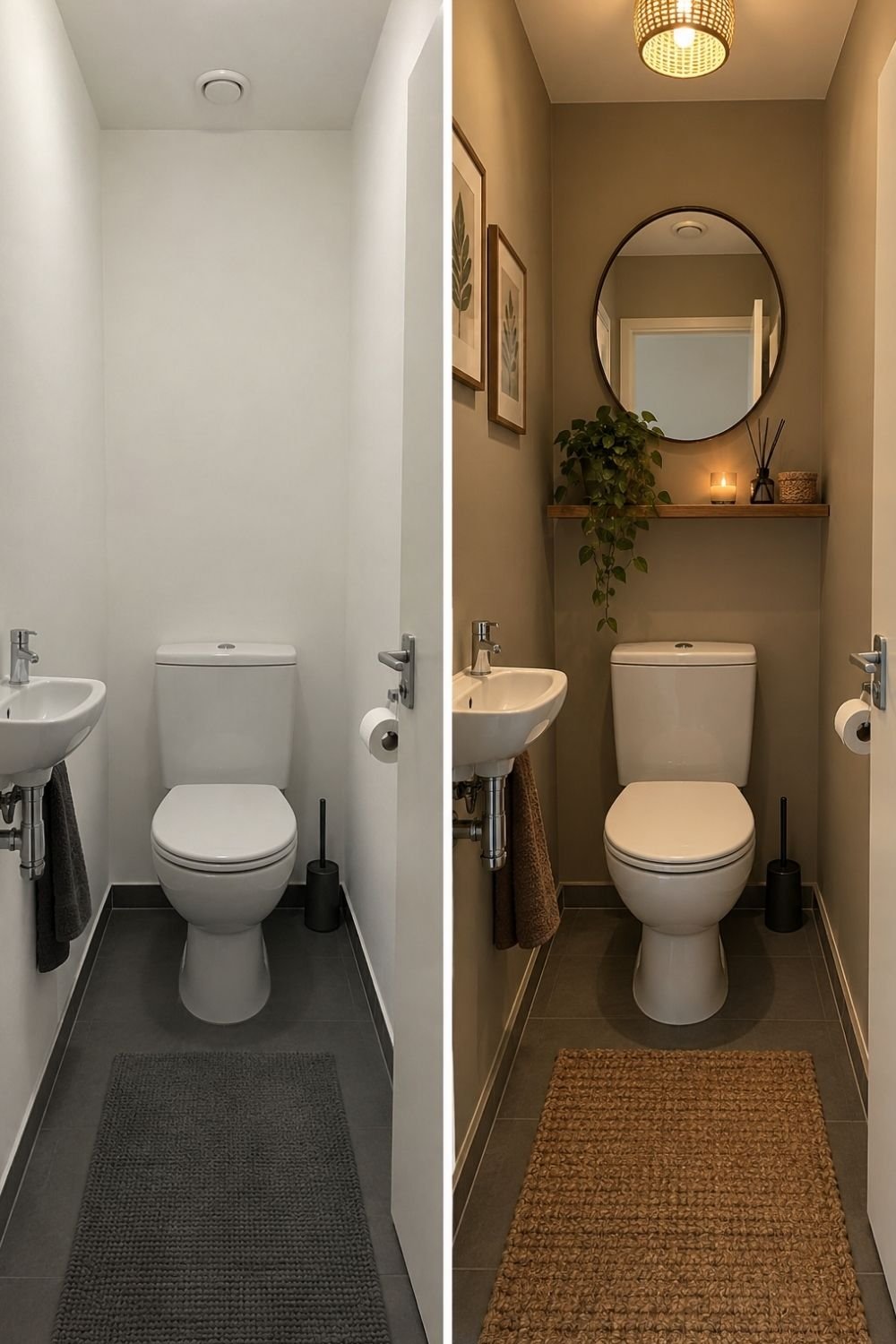
Photo by OurHoneyHome
Everything in the “after” half of this photo is something you could copy in a weekend:
- Warm taupe paint above the tile line, which makes the dark gray floor tiles look intentional instead of gloomy.
- One narrow wood shelf above the tank, set high enough that the tank lid still lifts off. It holds a candle, a reed diffuser and a trailing plant, and nothing else.
- A round mirror on the back wall, so the room has a focal point at eye level.
- A woven pendant shade in place of the bare ceiling fixture.
- A jute runner in place of the gray bath mat. The warm brown fiber picks up the wood shelf.
- Two framed leaf prints on the side wall, hung low enough to see from where you sit. That’s the viewpoint that matters in this room.
For toilet tiles, the same logic as above applies: a long, narrow room looks wider with tile laid across the short dimension, and a floor tile in a warm mid-tone hides more than bright white does. If the floor tile is staying, a washable runner covers most of it.
Soft layers that can handle steam
Textiles are where a small bathroom starts to look lived in. The downside is that fabric holds water, and in a room with poor airflow it starts to smell musty. What tends to hold up:
- Waffle, ribbed or striped cotton towels in cream, oatmeal or rust. They dry faster than thick plush ones.
- A textured cotton shower curtain with a separate liner behind it. The liner takes the water; the curtain does the decorating.
- A flat-woven or low-pile rug that goes in the washing machine. Printed vintage-style rugs hide water spots better than solid colors.
- A woven hamper with a lid, which doubles as a small side table.
An easy mistake to make is buying more textiles than the room can dry. Two towels on hooks dry faster than four towels folded on a rack.
Which plants survive a bathroom?
Humidity is rarely the problem for bathroom plants. Light is. A bathroom with a window, even a frosted one, can support a surprising number of plants; a windowless one can’t support any for long, however much steam there is. There, a plant that rotates to a sunny room every week or two, or a grow light, is the realistic option. Cuttings in glass jars are another low-commitment way in, and a small propagation station fits on a bathroom windowsill.
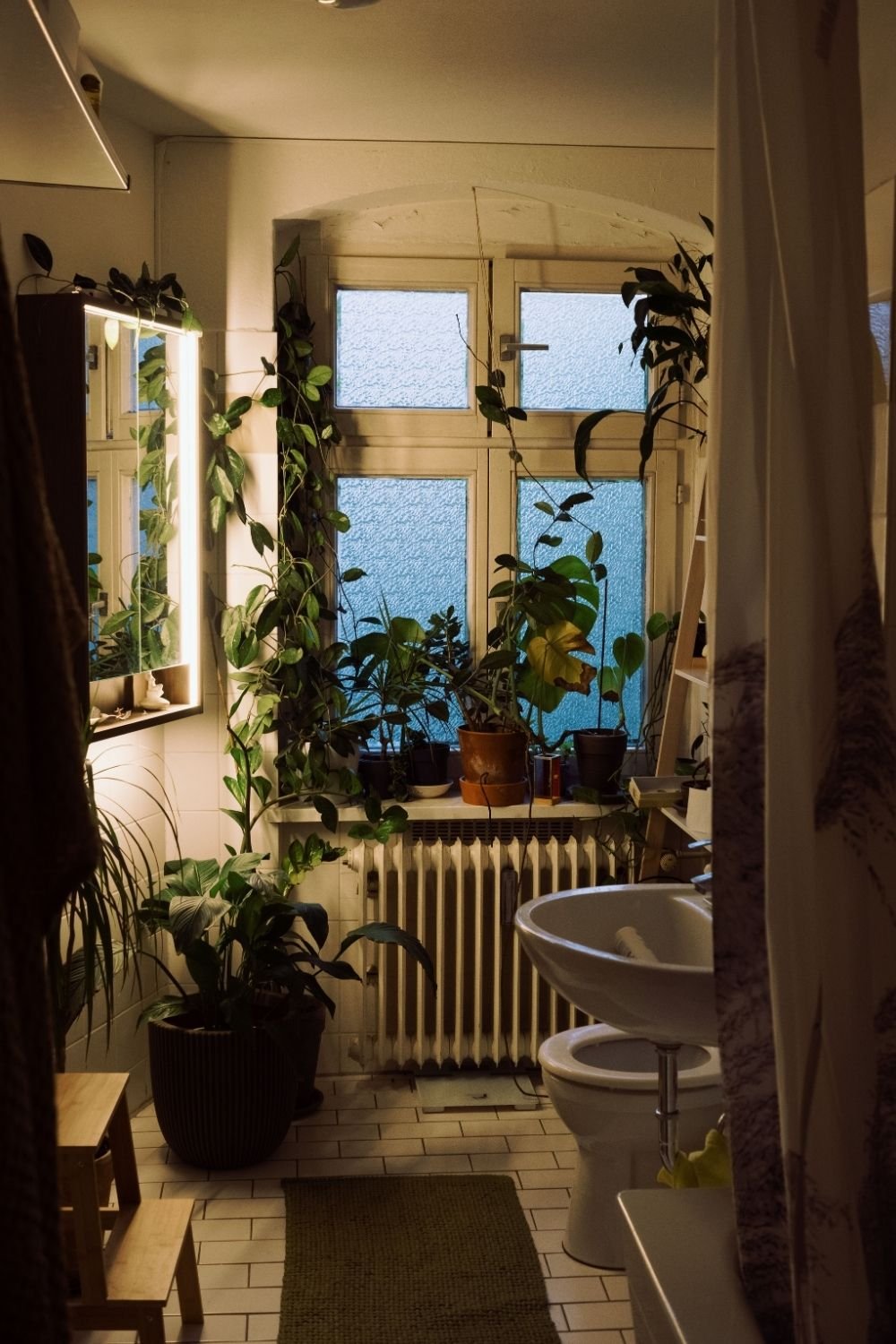
Photo by Felipe Souza Melo on Pexels
The bathroom above has a large frosted window, which is why the sill, the floor and even the top of the mirror cabinet can hold plants. Trailing plants such as pothos are the usual pick for shelves because they tolerate lower light.
If you have pets, check before you buy. Golden pothos is toxic to both cats and dogs according to the ASPCA: chewing it causes mouth irritation, drooling and vomiting. Keep it on a shelf pets can’t reach, or look up pet-safe options such as Boston fern in the ASPCA plant database before you choose.
Storage that doesn’t look like storage
Small bathrooms get cluttered because every bottle ends up on the sink. Hide most of it and display a few things.
- Floating wood shelves above the toilet or beside the mirror, with three or four objects each: a plant, a jar of cotton pads, a rolled towel.
- Lidded baskets for everything with a loud label: spare toilet paper, cleaning products, hair tools.
- Matching pump bottles in amber or clear glass, so the sink shows two calm shapes instead of five brands.
- A small tray to group what lives on the counter. Wiping the counter becomes a one-lift job.
Of course, this isn’t magic. If the storage isn’t enough for what you own, the fix is fewer bottles, not prettier baskets.
Pick a direction: spa, Japandi, vintage or moody
Choosing one direction keeps the room from looking like a sampler. The same small bathroom reads very differently in four styles:
- Spa: stone or stone-look surfaces, plaster walls, a woven pendant, amber bottles, white or oatmeal towels. The travertine vanity near the top of this post is a good reference.
- Japandi: light or mid-tone wood, low contrast, very little on display, round mirror, soft indirect light. The hotel bathroom with the backlit round mirror leans this way.
- Vintage: a pedestal sink, a printed rug, framed landscapes or botanical prints, brass fixtures, a small wooden stool as a side table.
- Moody: dark olive, charcoal or plum on every wall, warm sconces, wood and brass accents. The dark powder room and the wood-grain powder room both fit here.
It depends on the rest of your home, too. A moody powder room off a bright Scandinavian living room can be a fun surprise; the same color in a bathroom you use every morning might wear on you.
Keep it dry, or none of this lasts
Every soft, natural material in this post (wood, cotton, jute, wallpaper, plants in soil) reacts to trapped moisture. Before adding them, make sure the room can dry out.
- Run the fan, and check that it’s big enough. The Home Ventilating Institute recommends 1 CFM of fan capacity per square foot for bathrooms up to 100 square feet, and running the fan for 20 minutes after a shower. A 5 × 8 ft bathroom (40 square feet) needs at least a 40 CFM fan. A cheap timer switch makes the 20 minutes automatic.
- Watch the humidity. The EPA recommends keeping indoor humidity below 60%, ideally between 30 and 50%. A small hygrometer tells you whether the fan is keeping up.
- Don’t decorate over mold. Mold has to be cleaned off, not painted or wallpapered over. The EPA suggests a professional if the moldy area is larger than about 10 square feet.
- Candles: the U.S. Fire Administration advises keeping candles at least 12 inches from anything that can burn, which rules out a lot of spots near towels and shower curtains in a small bathroom. Battery-operated flameless candles give the same glow on a crowded shelf.
Where to start with these cozy bathroom ideas
If you’d rather do this in stages, this is how the ideas compare. Cost is relative: $ is a small purchase, $$$ usually means a contractor.
| Idea | Effort | Cost | Renter-friendly? |
|---|---|---|---|
| Warmer bulbs (2700–3000K) | 10 minutes | $ | Yes |
| New towels, shower curtain, rug | An afternoon of shopping | $–$$ | Yes |
| Baskets, tray, matching bottles | An afternoon | $ | Yes |
| Plants (or flameless candles) | Minimal | $ | Yes |
| Framed mirror swap | An hour | $$ | Usually, if you keep the original |
| Peel-and-stick wallpaper on one wall | A day | $$ | Yes, with good ventilation |
| Painting walls (and ceiling) | A weekend | $–$$ | Ask your landlord first |
| Floating shelves | An hour or two | $$ | Needs drilling |
| Hardwired sconces or lighted mirror | Electrician | $$$ | No |
| New tile or wall finishes | Contractor | $$$ | No |
A short checklist for the first weekend:
- Check the fan and humidity first.
- Swap the bulbs.
- Clear the counter into baskets.
- Add one natural texture: wood, woven fiber or a plant.
- Live with it for a week before buying paint.
In short: warm light first, one wall color or finish with some depth, a few natural textures, and a fan that keeps up. That covers almost everything a small bathroom or toilet room needs.
